Neatorama |
- The Lie Of ‘Expired Food’
- This Cat Just Wanted Some Milk
- Why Do We Buy What We Buy?
- An Ancient Christian Sect of Nudists
- New Trapdoor Spiders Named After Celebrities
- The Bug the World Fought Over
- World War II Spawned America’s Shark Obsession
| Posted: 12 Jul 2021 02:39 AM PDT
Do you throw your food away when it gets past its labeled 'expiration date'? Frankly, while this action is understandable, as eating 'expired' food may squick you out, on some level, throwing away food is wasteful. Vox's Alicia Wilkinson reports that throwing out uneaten food is bad for the environment. Landfills in the US are piled with wasted food, with most of which was still perfectly fine to eat. So how do we stop ourselves from wasting food? We need to look past the 'expiration dates,' Wilkinson believes: Apparently, very wrong. Researchers have found that "expiration" dates — which rarely correspond to food actually expiring or spoiling — are mostly well-intentioned, but haphazard and confusing. Put another way, they're not expiration dates at all. And the broader public's misunderstanding about them is a major contributor in every single one of the factors I named above: wasted food, wasted revenue, wasted household income, and food insecurity. If you've been throwing out food based on the freshness label, though, you're not alone. It's a widespread practice. Chef, journalist, and cookbook writer Tamar Adler, author of An Everlasting Meal: Cooking with Economy and Grace, explains: "In the absence of culinary information, people assume that any information they've been given must be the most important information." A big part of the problem is that most of us don't really believe we're capable of determining if a food is good for us. "It's really hard to imagine you're supposed to trust your own nose and mouth," Adler said. "Add that to convenience culture and rapacious late-stage capitalism and, well, we're fucked." Image credit: Jimmy Dean  |
| This Cat Just Wanted Some Milk Posted: 11 Jul 2021 09:03 PM PDT
-via Metafilter |
| Posted: 11 Jul 2021 09:03 PM PDT Consumerism is what drives the economy in a capitalist society, so buying more stuff is a good thing, right? Not always. Buying more stuff than we can afford can ruin one's personal finances. Many of us end up with way more stuff than we need. All that unnecessary stuff takes a lot of energy and resources to produce, and getting rid of it overflows our landfills. So why do we buy so much stuff?
That drive to keep up with the Joneses and display our status with consumer goods hasn't followed an even trajectory, as our references (meaning the people we want to keep up with) have gone through changes. Sociologist Juliet Schor explains how our buying habits have changed with the times and why at Vox. -via Digg |
| An Ancient Christian Sect of Nudists Posted: 11 Jul 2021 08:28 PM PDT
In the early Christian church, different sects interpreted the scriptures in many different ways. The second century Adamites based their culture on Adam and Eve, and lived their lives as if they existed before sin. That meant no clothing, no marriage, and no laws. They might even be seen as ancient hippies. Another thing they had in common with hippies is that they annoyed the surrounding establishment, Christian or otherwise.
Despite occasional revivals, the Adamites were pretty much squashed out of existence all at once. Read how that happened at Messy Nessy Chic. -via Strange Company (Image credit: Rolf Kranz) |
| New Trapdoor Spiders Named After Celebrities Posted: 11 Jul 2021 10:44 AM PDT
You might recognize some of the names. U. neilgaimani is for author Neil Gaiman, who had another spider named for him in January. U. gabrieli is named for musician Peter Gabriel, U. brandicarlileae is for singer Brandi Carlile, and quite a few others are named for scientists. -via Boing Boing |
| Posted: 11 Jul 2021 10:44 AM PDT
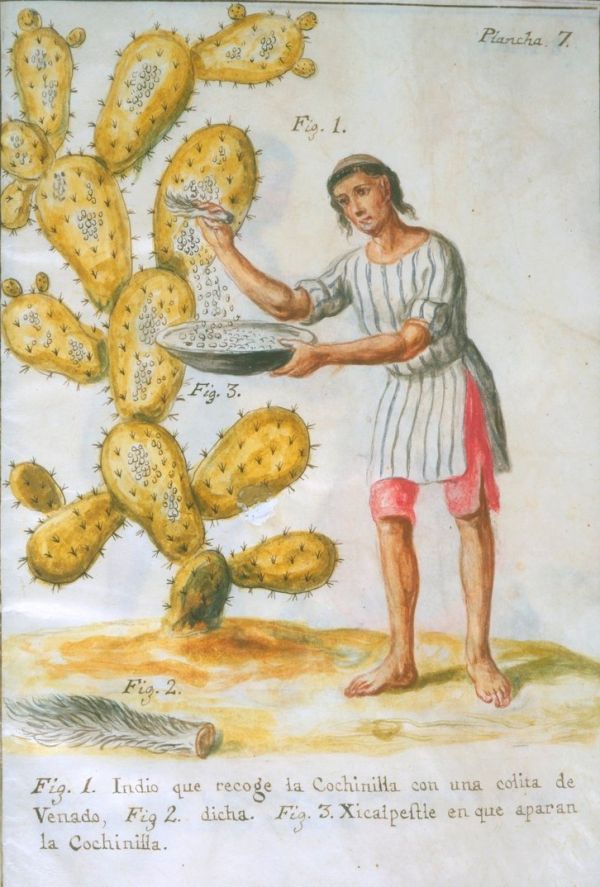
Paints, dyes, and other colorants have been very important in history- particularly those colors that are hard to manufacture. Red was among those up until Spanish conquistadors came to the Americas and found native industries cranking out red dye from the cochineal insect.
Read the history of cochineal red and how it took Europe by storm at Mental Floss. -via Strange Company (Image credit: José Antonio de Alzate y Ramírez) |
| World War II Spawned America’s Shark Obsession Posted: 11 Jul 2021 10:44 AM PDT Are Americans obsessed with sharks? Well, in 1975, Jaws defined what we now call the summer blockbuster. And Shark Week still draws audiences more than 30 years after it began. But the real obsession with sharks began earlier, when Americans were put in real danger from sharks. That wasn't their greatest danger, because we're talking about World War II. But it was the time that millions of Americans were introduced to ship travel in the armed forces, where surviving an enemy attack could lead to yet more danger.
There were some fairly terrifying incidents of ship attack survivors being eaten by sharks, drawn by the blood of the wounded and the dead. Read about the rise of shark fear and how it lingers all these years later at The Conversation. -via Damn Interesting |





| You are subscribed to email updates from Neatorama. To stop receiving these emails, you may unsubscribe now. | Email delivery powered by Google |
| Google, 1600 Amphitheatre Parkway, Mountain View, CA 94043, United States | |
No comments:
Post a Comment
Keep a civil tongue.