| Here are the FeedBlitz blog updates for ignoble.experiment@arconati.us
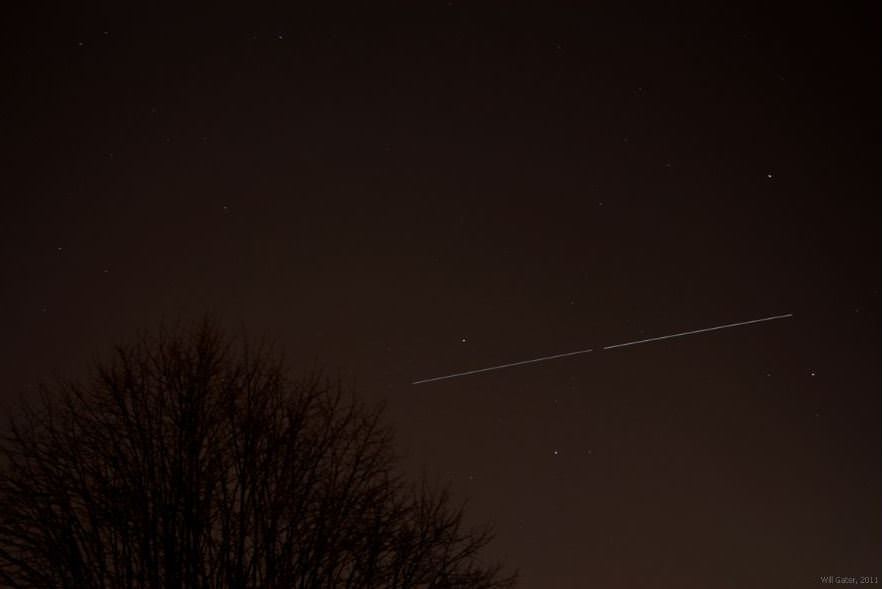
 Discovery and ISS pass over the UK on March 7, 2011, captured by Will Gater. UPDATE: We’ve already got a sighting! The image above was taken this evening in the UK by science writer Will Gater. Space shuttle Discovery undocked from the ISS on early Monday, March 7, and depending where you live, you might have an opportunity to see the two spaceships flying in tandem. This is an incredible sight, and will be the last opportunity to see Discovery in orbit, as she will be retired after she lands and completes the STS-133 mission. Spaceweather.com reports that the station and shuttle will be flying over parts of the United States and Europe Monday and Tuesday, appearing in the night sky as a closely-spaced pair of bright lights. The ISS is bigger, so will appear as the brighter object trailing the smaller Discovery as they move across the sky. To find out if you’ll be able to see the two spaceships in your area, there are a few different sites to check out:
(...)
Read the rest of Double Spaceship Sighting Alert – and last chance to see Discovery in orbit (111 words)
© nancy for Universe Today, 2011. | Permalink | 2 comments | Add to del.icio.us
Post tags: ISS, Observing, Space Shuttle, Space Shuttle Discovery, Space Station, STS-133
Feed enhanced by Better Feed from Ozh 

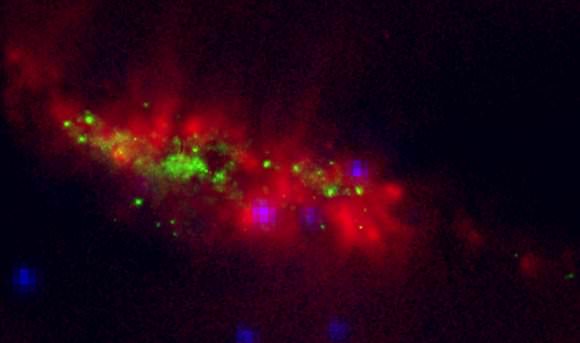
 False color mosaic showing the Subaru COMICS image (red), a Hubble near-infrared image of stars (green) and a Chandra X-ray image (blue) dominated by extremely hot gas and black holes. Credit: JAXA Messier 82′s galactic windstorms emanate from many young star clusters, rather than any single source, say astronomers who released this new image today. The international team of scientists, led by Poshak Gandhi of the Japan Aerospace Exporation Agency (JAXA), has used the Subaru Telescope to produce a new view of M 82 at infrared wavelengths that are 20 times longer than those visible to the human eye. (...)
Read the rest of New Look at Messier 82 Reveals Superwind Source, Young Star Clusters (488 words)
© anne for Universe Today, 2011. | Permalink | No comment | Add to del.icio.us
Post tags:
Feed enhanced by Better Feed from Ozh 

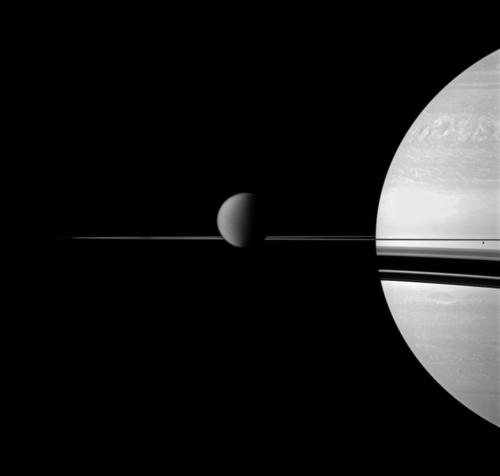
 Saturn, its rings and moons small to large in this Cassini image. Credit: NASA/JPL/Space Science Institute This latest offering from the Cassini spacecraft shows a wide-angle view of Saturn, its rings, and a sampling of the planet's moons in varying sizes. Saturn’s largest moon, Titan, is in the center of the image, with the smaller moon Enceladus on the far right, while appearing just below the rings on the far left beyond the thin F ring is teeny-tiny Pandora. Oh, to have this view out your spacecraft window as you approach the ringed-world for a flyby!
(...)
Read the rest of Saturn’s Rings, Moons Line Up in Latest Stunning Cassini Image (102 words)
© nancy for Universe Today, 2011. | Permalink | One comment | Add to del.icio.us
Post tags: Cassini, Enceladus, Pandora, Titan Saturn
Feed enhanced by Better Feed from Ozh 

 Hubble's latest view of the very unusual Westbrook Nebula. Credit: NASA/ESA Looking oddly reminiscent of the "V" depicted in the logo for the sci-fi television series "V," this has to be one of the strangest objects in space. It's the Westbrook Nebula — also known as PK166-06, CRL 618 and AFGL 618 — and is a protoplanetary nebula. But this highly irregular bundle of disconnected jets and clouds is the result of a burst of a dying star expelling toxic gases such as carbon monoxide and hydrogen cyanide. Well, toxic to us, anyway, but maybe not to The Visitors! (...)
Read the rest of Hubble Captures the “V” (203 words)
© nancy for Universe Today, 2011. | Permalink | 3 comments | Add to del.icio.us
Post tags: Hubble, Protoplanetary Nebulae, Westbrook Nebula
Feed enhanced by Better Feed from Ozh 


William Shatner, who played Captain James T. Kirk on the original Star Trek television series, provided a very special message to the crew of space shuttle Discovery during the STS-133 Flight Day 12 wakeup call. With strains of Alexander Courage’s famous theme song from Star Trek playing, Shatner replaced the original television introduction with, “Space, the final frontier. These have been the voyages of the Space Shuttle Discovery. Her 30 year mission: To seek out new science. To build new outposts. To bring nations together on the final frontier. To boldly go, and do, what no spacecraft has done before.” (...)
Read the rest of Special Star Trek Song Beamed Up To Space Shuttle (157 words)
© nancy for Universe Today, 2011. | Permalink | 3 comments | Add to del.icio.us
Post tags: Space Shuttle, Space Shuttle Discovery, Star Trek, STS-133
Feed enhanced by Better Feed from Ozh 


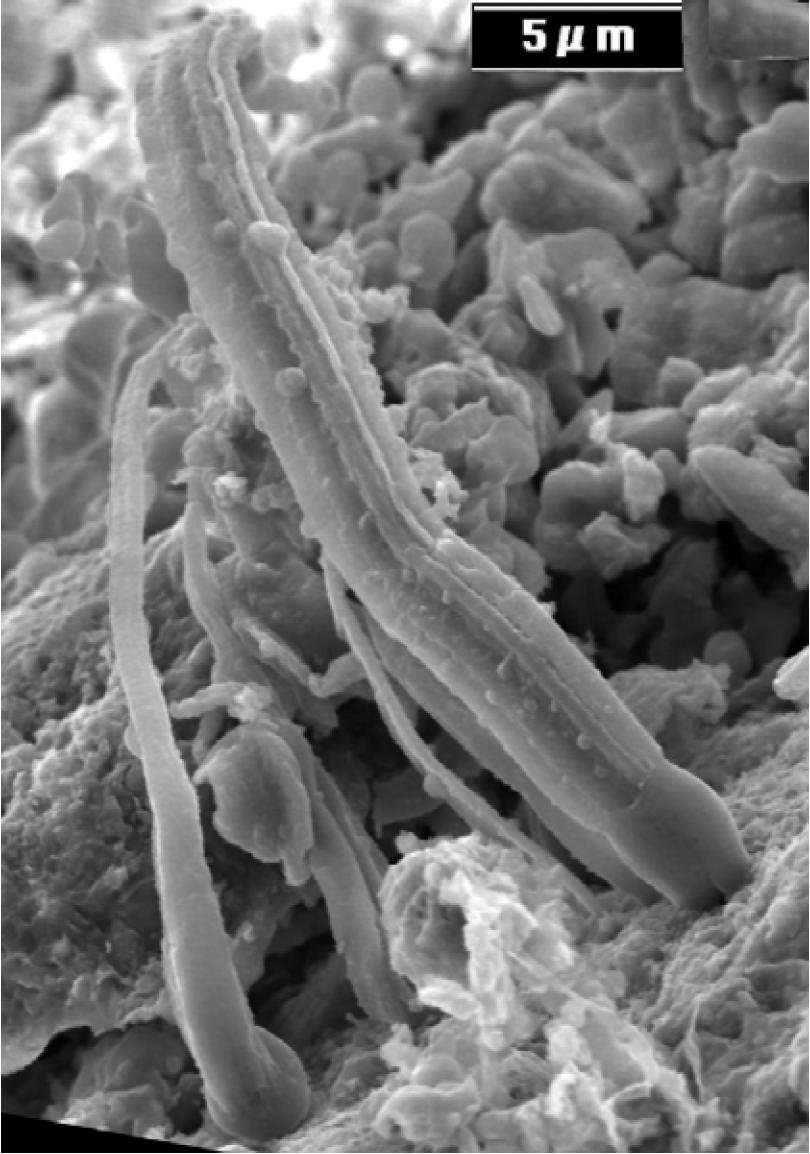
 Image of permineralized remains in the one of the meteorites studied by Richard Hoover. Credit: Journal of Cosmology A recent paper published by a NASA scientist claims the discovery evidence of fossil bacteria in a rare subclass of carbonaceous meteorite. The claims are extraordinary, and were the paper published somewhere other than the Journal of Cosmology, (and given an "exclusive preview" on Fox News) more people might be taking this seriously. But, even so, the topic went viral over the weekend. Titled “Fossils of Cyanobacteria in CI1 Carbonaceous Meteorites” and written by NASA scientist Dr. Richard Hoover of the Marshall Space Flight Center, the paper makes the bold claim that meteorites found in France and Tanzania in the 1800s (the Alais, Ivuna, and Orgueil CI1 meteorites) have clear evidence pointing to space-dwelling microbes, with inferences of panspermia — the theory that microbes brought to Earth in comets and meteorites could have started life on our planet. “The implications,” says an online synopsis of the paper, “are that life is everywhere, and that life on Earth may have come from other planets.”
(...)
Read the rest of Claim of Alien Life in Meteorites Needs Further Review (869 words)
© nancy for Universe Today, 2011. | Permalink | 13 comments | Add to del.icio.us
Post tags: Astrobiology, Meteorites, panspermia, Richard Hoover
Feed enhanced by Better Feed from Ozh 

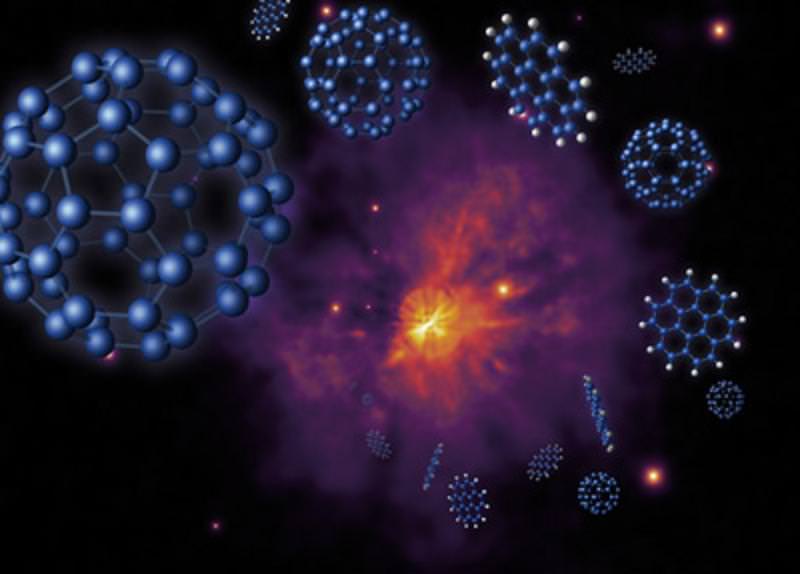
 Artist's concept of buckyballs and polycyclic aromatic hydrocarbons around an R Coronae Borealis star rich in hydrogen. Credit: MultiMedia Service (IAC) When I first heard about buckyballs a couple of decades ago, I had nothing but the deepest respect for anyone who understood abstract ideas like string theory and branes. After all, how often were you likely to discuss Buckminster fullerenes with a contemporary while standing in the laundry detergent aisle of your local grocery store? The very concept of “magnetic” carbon was new and exciting! It was known to exist in small quantities in nature – produced by lightning and fire – but the real kicker was born solely in a laboratory. Buckyballs have been found on Earth and in meteorites, and now in space, and can act as “cages” to capture other atoms and molecules. Some theories suggest that the buckyballs may have carried to the Earth substances that make life possible. (...) Read the rest of Buckyballs… Throwing Astronomers A Curve (560 words)
© tammy for Universe Today, 2011. | Permalink | 3 comments | Add to del.icio.us
Post tags:
Feed enhanced by Better Feed from Ozh 

 NGC2403 by Warren Keller No. You’re not looking at a Hubble image. This incredibly detailed photo was taken with a 14.5″ telescope from right here on the surface of planet Earth. When Allan Sandage turned the Hale telescope its way, he discovered the first Cepheid variables beyond our local galaxy group. At the time he concluded its distance as about 8,000 light years away, but today it is believed to be as distant as 8,000,000. What’s its name? NGC 2403… (...)
Read the rest of A New Spin On NGC 2403 (861 words)
© tammy for Universe Today, 2011. | Permalink | 13 comments | Add to del.icio.us
Post tags:
Feed enhanced by Better Feed from Ozh 

| 














No comments:
Post a Comment
Keep a civil tongue.