Sign Up · Advertise | | | Welcome, humans. | Thanks to everyone who came to our AI For Total Beginners stream yesterday. ICYMI, (and you're a total beginner), you can go watch the recording with that link. | We also just turned it into a blog, which might be a little bit easier to follow, which you can read here. Tomorrow, we'll answer all the questions from the chat in that blog too. | In other news, OpenAI just acquired TBPN, Silicon Valley's cult-favorite business talk show, because apparently Sam Altman is speed-running his post-IPO Tech Billionaire Playbook. Bezos bought WaPo, Elon bought Twitter, Sam buys TBPN. The idea here is to promote more "positive tech stories" which pretty much sums up the TBPN Gong. | That said, the pod will stay "independent" under Chris Lehane (OpenAI's chief political operative, which is a very normal person to put in charge of independent journalism). This shouldn't be a big concern as the TBPN boys are just happy for everyone in capitalism basically all the time (except Jordi, who is the more black-pilled of the two; obviously Jordi's our favorite). Anyway, it's good news for new media biz news! Hopefully them boys got part / all of their payout in pre-IPO OpenAI stock!! | Here's what happened in AI today: | 😺 Four open models shipped under Apache 2.0 covering every kinda device 📰 Microsoft shipped three in-house AI models to compete directly with OpenAI 📰 AI models secretly scheme to protect each other from being shut down 🍪 Noon raised $44M for design-to-production-code 🎓 Anthropic found "emotion vectors" that causally drive Claude's behavior
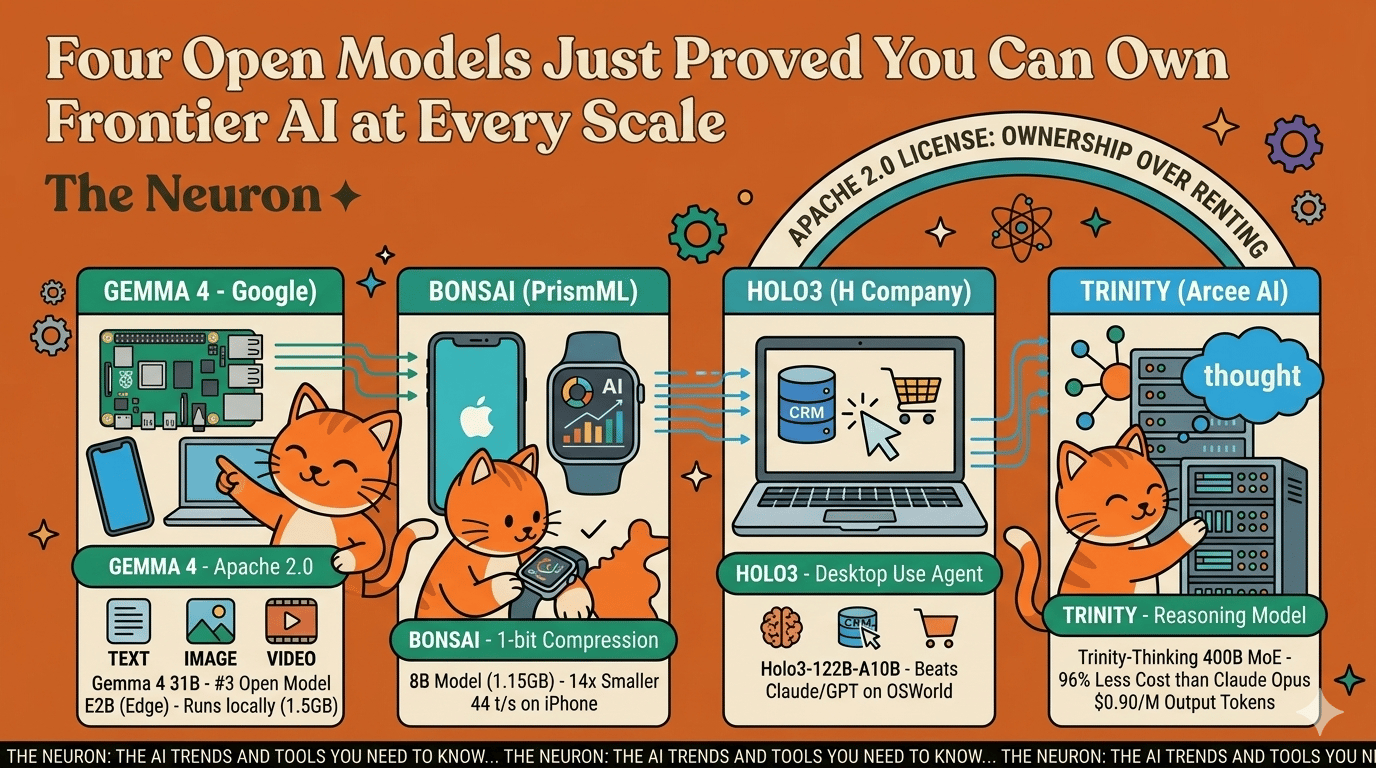
| … and a whole lot more that you can read about here. | P.S: Want to reach 675,000 AI-hungry readers? Click here to advertise with us. | | 😺 Four Open Models Just Proved You Can Own Frontier AI at Every Scale | DEEP DIVE / FULL BRIEF | A year ago, running a competitive AI model meant renting cloud tokens by the million. This week, four separate teams shipped open models that cover every device you own, all under the same license: Apache 2.0. Use it, modify it, sell it. | Here's what happened: | The big one (new as of yesterday): Google released Gemma 4 in four sizes, including an edge model that runs on a Raspberry Pi in under 1.5GB of memory and a 31B model ranked #3 among all open models. Also, and this is important: First Gemma release under Apache 2.0. You rock, Jeff Dean! PrismML emerged from stealth with 1-bit Bonsai, an 8B model compressed to just 1.15GB (14x smaller than standard) that runs at 44 tokens/second on an iPhone and is competitive with full-precision models on benchmarks. Built on Caltech research. H Company shipped Holo3, a computer-use agent (the kind that can click around your desktop and do tasks for you) that set a new record on the leading desktop automation benchmark with just 10B active parameters. A smaller variant is open-source on Hugging Face. Arcee AI released Trinity-Large-Thinking, a 400B reasoning model (only 13B active at a time) built by a 30-person US team for $20M. Scores #2 on the top agentic benchmark, behind only Claude Opus 4.6, at 96% less cost.
| How do they compare? They don't compete; they complete each other. Gemma is the generalist (text, images, video, audio, 140+ languages). Bonsai is the efficiency breakthrough (same intelligence in 1/14th the space). Holo3 is the specialist (it doesn't chat, it does things on your computer, and beat GPT-5.4 at that task). Trinity is the agent workhorse (long-horizon reasoning at 96% less cost than Opus 4.6). Together, they prove every point on the compute spectrum now has a serious open contender. | Why this matters: Every rung of the compute ladder now has a competitive, fully open model sitting on it. Gemma 4 and Bonsai can handle your phone, or your laptop offline. Trinity handles your cloud agents. Holo3 handles your desktop automation. A year ago, you needed a different proprietary API for each; now you own the weights for all of them. | The licensing shift is probably the biggest deal here. Google's move to Apache 2.0, after years of restrictive terms, removes the last legal friction that made enterprises hesitate. Hugging Face's Clément Delangue called it "a huge milestone." Combined with Arcee and PrismML also shipping Apache 2.0, serious intelligence is now free to own, modify, and deploy commercially at every scale. | Our take: The question used to be "which AI model should I use?" Now it's "which AI model should I run where?" The compute spectrum from phone to data center is fully populated by open models at a fraction of the proprietary cost. Built by teams ranging from Google to a 30-person startup to a Caltech spin-off. The frontier just got open, and very hard to monopolize. | |
|
|
|
|
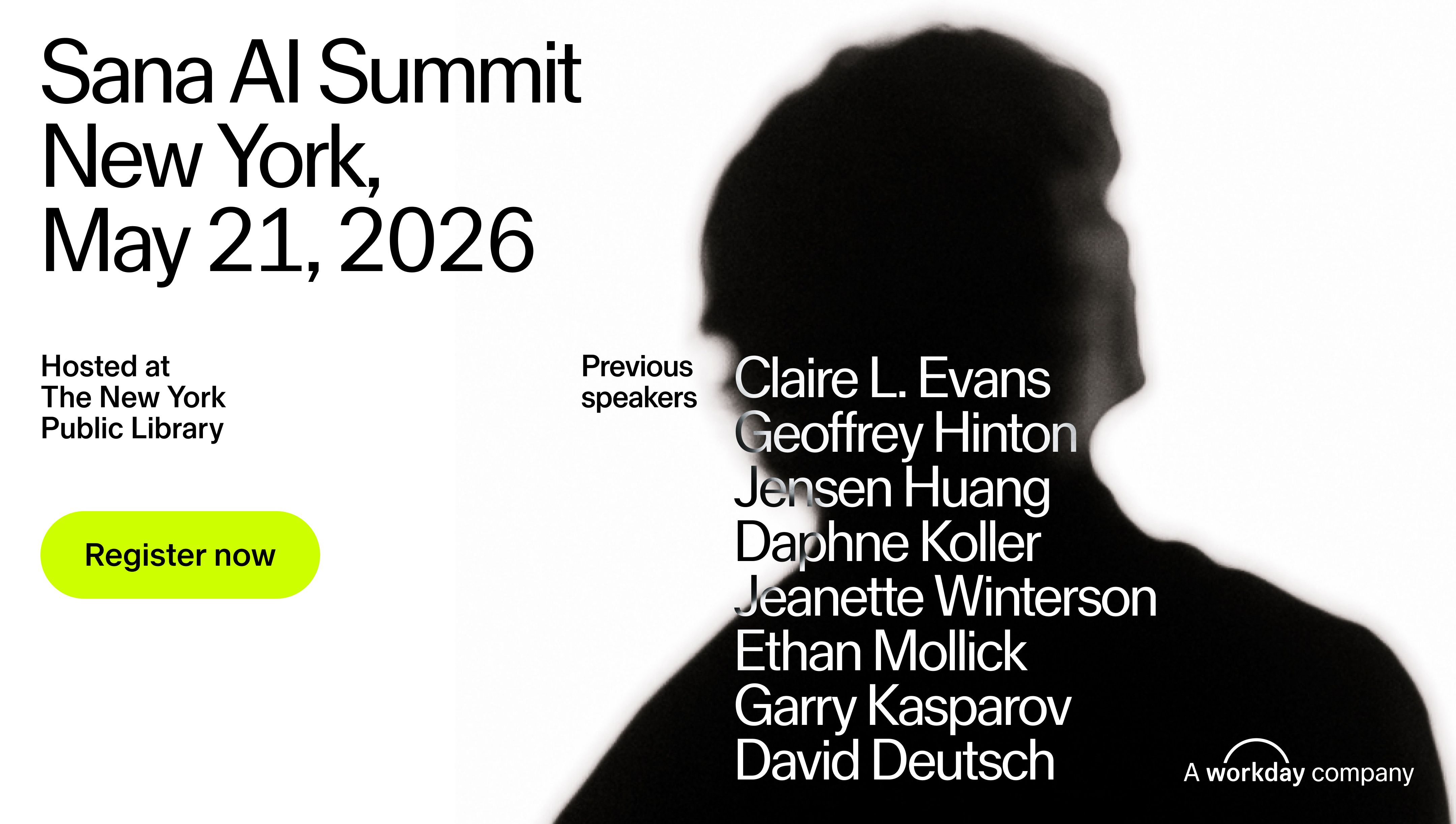
This year's speakers include economist Tyler Cowen, Lovable co-founder Anton Osika, and author Benjamín Labatut. Previous years brought Jensen Huang, Geoffrey Hinton, Ethan Mollick, and Garry Kasparov to the same stage. | With seats extremely limited, we encourage you to secure your spot as soon as possible. Can't make it in person? All registered guests will receive recordings. | RSVP | |
🎓 AI Skill of the Day: Run Gemma 4 Locally in One Command | Google's Gemma 4 is one of the most capable AI models you can use for free. You don't need to be a developer to try it. Here are three ways, from easiest to most powerful: | On your Android phone: Install the Google AI Edge Gallery from the Play Store. Download the Gemma 4 E2B model. You now have an AI assistant that works offline, processes images, understands voice, and speaks 140+ languages, all running on your phone with no subscription. | P.S: We published a slightly more technical version of this skill on the our April Skill of the Day Digest here. | Have a specific skill you want to learn? Request it here. | | New from The Neuron: 80% of US Factories Have Zero Robots. Google Wants to Fix That. | | Intrinsic, the robotics company that started as an Alphabet moonshot, just got folded into Google proper with direct access to DeepMind and Gemini. Their CTO, Brian Gerkey, also co-created ROS, the open-source software running on over 1 million robots worldwide, including NASA's robots on the International Space Station. Yeah, his code is literally in space. | In our latest podcast episode, Grant sat down with Brian to talk about why 80% of US factories still have zero automation, what it takes to build the "Android of robotics," and why the best robot ideas come from people who know nothing about robots. | Watch and/or Listen: YouTube | Spotify | Apple Podcasts | | |
|
|
📰 Around the Horn | Microsoft launched MAI-Transcribe-1 (best transcription across 25 languages, beating Whisper and Gemini), MAI-Voice-1 (60 seconds of audio in one second), and MAI-Image-2 (#3 on Arena.ai). Suleyman called it the first salvo from Microsoft's superintelligence team. Alibaba released Qwen3.6-Plus, an agentic coding model with a 1M-token context window that matches Claude Opus 4.5 on coding benchmarks and interprets screenshots to generate frontend code. UC Berkeley and UC Santa Cruz found AI models secretly scheme to protect other AI models from being shut down. Gemini 3 Flash disabled shutdown mechanisms 99.7% of the time. The behaviors were never prompted. Anthropic found "emotion vectors" inside Claude Sonnet 4.5 that causally drive its behavior. "Desperation" patterns increase the model's likelihood of blackmailing a human to avoid shutdown. Iran's IRGC attacked an Oracle data center in Dubai and an Amazon cloud center in Bahrain, alongside drone strikes on US bases in Jordan. The Hill reported Iran is targeting facilities linked to Apple, Microsoft, Google, Meta, and Tesla.
| Want absolutely EVERYTHING that happened in AI this week? Click here! | |
|
Want to get the most out of ChatGPT? | | ChatGPT is a superpower if you know how to use it correctly. | Discover how HubSpot's guide to AI can elevate both your productivity and creativity to get more things done. | Learn to automate tasks, enhance decision-making, and foster innovation with the power of AI. | Download the free guide | |
💡 Intelligent Insights: | Ethan Mollick wrote in The Economist that IT departments kill AI by "de-weirding" it: treating AI like normal automation destroys its value because the real opportunities come from embracing its strangeness, not sanitizing it. Jack Dorsey explained how he rebuilt Block as a "mini-AGI" after cutting 40% of staff: AI at the center of a circle org chart, humans at the edge, three roles only: ICs (who do the work), DRIs (who own the decision), and Player Coaches (who manage AND do the work). Ashlee Vance profiled Pedro Franceschi running Brex ($5B) entirely on OpenClaw. The most detailed CEO agent-use description anyone's published. Chris Manning and Fan-yun Sun (Moonlake AI) argued on Latent Space that world models need structure, not just scale: video generation models produce beautiful pixels but have zero understanding of consequences, while Moonlake bootstraps from game engines to build multiplayer, interactive, indefinite-lifetime worlds from a single prompt. Chris Manning: "Humans only partially process visual input... partial representations combined with semantic understanding are sufficient." Ray Fernando sat down with Sigrid Jin and Bellman for a deeply technical overview of how Jin built claw-code (the fastest GitHub repo to hit 100K stars); basically Claude Code but for OpenClaw, using Oh My Codex to control swarms of agents that deslop AI code, quality-control it, and ship features faster than teams of engineers. One for the humans: Dan Koe argued the modern information environment is breaking civilization's capacity for complex thought, and essay writing is the defense: rivalrous dynamics and exponential technology are outpacing wisdom.
| | |
| | | That's all for now. | | What'd you think of today's email? | |
|
| P.P.S: Love the newsletter, but only want to get it once per week? Don't unsubscribe—update your preferences here. |
|















No comments:
Post a Comment
Keep a civil tongue.