Before META, There Was FB
META is pretty old news now, and its Metaverse is such a failure that they’ve stopped using the term. Reality Labs, Meta’s virtual reality (VR) division, has lost $83.6 billion over the last six years.
But back in 2012, Facebook was all the rage. It’s hilarious to think its biggest problem back then was that they hadn’t yet figured out online advertising. Of course, with the Facebook Pixel, they had mastered that domain and made themselves and their investors so much money they could piss it up a wall on a botched bet on VR costing billions.
Nevertheless, their IPO was hotly anticipated for many reasons, not the least of which was finally determining the company’s worth. Older readers may remember Diane Sawyer famously trying to weasel it out of Zuckerberg in an incredibly awkward interview. Think Mrs. Robinson meets Sheldon Cooper. Ewwww…
Morgan Stanley emerged as the lead bank after doing a lot of work for Facebook at no cost in the years leading up to the IPO. JP Morgan was second, leaving Goldman Sachs embarrassed as the third bank. (Even Facebook executives, with their close government connections, had no love for the “vampire squid.”)
But, as usual, this was an enormous blessing in disguise for Goldman. Morgan Stanley would screw up the IPO so badly that it took the massive reputational hit Goldman was able to avoid. How did Morgan Stanley mess up?
The IPO Numbers
On the surface, Facebook’s IPO looked like a triumph of capitalism. The book was 5x oversubscribed, so Morgan Stanley did exactly what it was paid to do: it raised the price from $28–$35 to $34–$38, jacked the share count 25% to 421 million, and handed Zuckerberg a tidy $100 billion valuation.
Facebook CFO David Ebersman had been quietly gunning for that number all along. Round, iconic, and utterly meaningless as a forward-looking metric, but perfect for a Wall Street dog-and-pony show.
But here’s the rot underneath the paint job: 11 days before the IPO, Facebook quietly whispered to Morgan Stanley that it was slashing its revenue projections. Mobile was eating desktop faster than Zuck’s ad team could monetize it; fewer eyeballs on ads, fewer dollars in the door. That’s a material development.
While Morgan Stanley’s institutional clients got that little heads-up, retail investors lining up to buy the hottest IPO in a decade were left staring at a glossy prospectus built on a lie of omission. The oversubscription number that made the deal look bulletproof? Engineered on asymmetric information.
And this is where the job gets sticky for bankers. On the one hand, you’ve got your issuing client; in this case, that’s Facebook. You want to maximize their take from the IPO. But on the other hand, you’ve got your investing clients, the pension funds, insurance companies, endowment funds, hedge funds, and other long-only asset managers who depend on the 10% first day bounce from the IPO price.
Morgan Stanley had just booked themselves 18 months of ass-kissing and discounts for the IPO buyers.
Was FB’s IPO a Failure?
The honest answer is, “It depends.”
For the IPO buyers? Yes. They got hosed.
For Morgan Stanley? Yes. The equity origination team utterly embarrassed the bank.
For Mark Zuckerberg? Absolutely not. It was the greatest day of his young life.
This brings me back to my conversation with G. I vividly remember saying something to the effect of “Ha! Morgan Stanley! What a failure…”
To which he replied, “Failure? For whom?”
I looked at him quizzically. I was confused.
“Seanie, Facebook raised $16 billion. Zuck never has to go to the market again!”
If you’re a well-worn mining investor, think of how many times you’ve been diluted in the past year alone.
Now, understand that Mark Zuckerberg has never done that to his shareholders. In fact, Zuck has had only one other equity offering, in December 2013, because Zuck had a tax bill due. Here are the stats on that one:
- 27 million shares sold by Facebook itself (~$1.5B, for working capital and general corporate purposes)
- 35 million shares sold by Mark Zuckerberg personally (proceeds used to cover taxes on exercising 60 million Class B stock options)
- 6 million shares sold by Marc Andreessen
That’s it.
So from Facebook’s perspective, it was maybe the greatest IPO of all time.
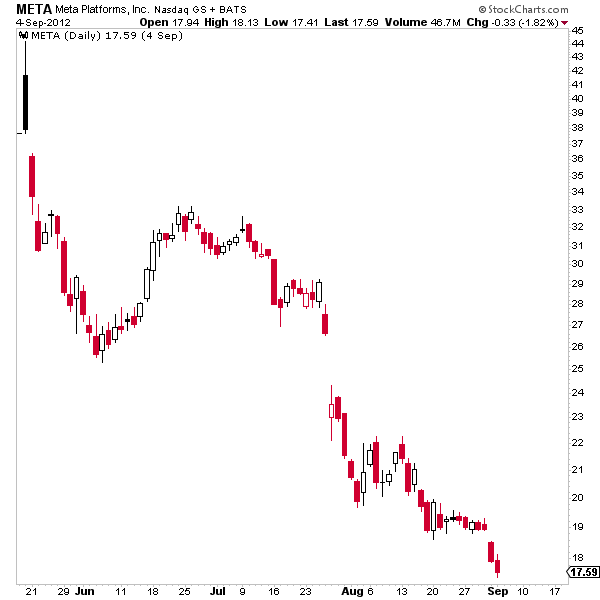
But for those Day One buyers… Ouch!
Let’s look at the chart.





No comments:
Post a Comment
Keep a civil tongue.