We’re not here to speculate on political motives. We’re here to interpret them through the lens of markets.
But when the president uses a nationally televised address to declare economic war on most of the world, you can’t exactly separate politics from investing.
Trump is in the thick of his second term and gearing up to reshape his legacy.
And what better way to do that than to revive the policies that put him on the map in 2016?
Except this time, it’s not incremental. There’s no build-up. No teasing. Just a sweeping, sudden policy that throws sand into the gears of global trade and dares markets to blink.
And blink they did.
The truth is, everyone from Beijing to Brussels knew tariffs were back on the table.
But no one expected this scale — especially not in the middle of a global economic cooldown. The European Commission issued a scathing statement within hours. China, ever the master of measured retaliation, slapped 34% tariffs on all U.S. goods before the sun even set in D.C.
According to the Associated Press and White House transcripts, the policy rollout was deliberate.
The administration stated the move was necessary to "restore competitive fairness" and protect U.S. industries that have long suffered from "decades of imbalanced trade."
But whether it’s fairness or force, the global response was unanimous: retaliation. Europe and Asia are already drafting counters. Even Canada is rumored to be considering agricultural levies.
What complicates the picture further is the domestic narrative.
Tariffs may not poll well with economists, but among certain voter blocs, they play like greatest hits.
The Midwest manufacturing base, battered but not broken, sees this as a comeback. Rust Belt towns are hearing promises of factories spinning again.
And if you're wondering how markets are supposed to digest that kind of emotional fuel — well, they can’t, which is why this story is far from over.
Enrique is always quick to point something like this out. He’s been preparing a series of notes relating to market turmoil and how to take care of it psychologically.
As he always says, if you’re worried about something happening in the market, you’re actually just worried about your portfolio strategy. The latter is the only thing you can change here.
That’s why he gave points to watch on Thursday during any market chaos, whether that’s a tariff spectacle or a meteor about to strike Earth.
And as we’ve been saying, this week’s speech? Pure spectacle.
But that doesn’t mean it didn’t move markets.
Tariffs have become the new rate hikes.
Not because they act the same way, but because they inject the same kind of uncertainty. And uncertainty — especially politically manufactured uncertainty — is kryptonite to stability. This is why the moment the president finished speaking, Wall Street began repricing everything.
Investors suddenly found themselves weighing outcomes not in earnings estimates or GDP forecasts — but in probabilities.
Probabilities that the E.U. would hit back hard. That China might crack down on U.S. companies doing business there. That supply chains (already on shaky post-COVID footing) might start snapping again.
In this way, tariffs act as a multiplier — not just of prices, but of fear.
They don’t move markets in a straight line. They bend them around corners, triggering reactions that cascade through sectors like a domino run.
This week, one of the more under-the-radar casualties was semiconductors.
Intel (INTC), Broadcom (AVGO), and Qualcomm (QCOM) each fell more than 5% — not because their earnings reports were bad, but because their supply chains stretch across Asia like a spider web.
The Magnificent 7 big tech stocks lost over $1 trillion in market cap on Thursday.
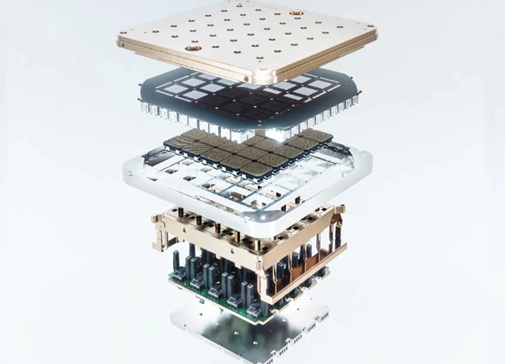
And even though it’s not precisely the reason why Enrique is dubbing a little-known company the “Nvidia Killer”, it helps the thesis.
What’s more, if Nvidia itself loses $1 trillion in market cap over the next 12 months (see here), the market could be in much more pain than what we saw at the end of the week.
And queue the adage… with crisis comes opportunity.
Click here to check out the research.
One wrong move in a retaliatory tariff, and suddenly the whole thing snaps.
Agricultural names also suffered. Deere (DE) and Archer-Daniels-Midland (ADM) slid as traders braced for potential hits to U.S. crop exports.
China is a major buyer of American soybeans and grain — two markets that have historically been the first to get whacked when trade tensions spike.
And when Beijing issued its countermeasures, agricultural tariffs were rumored to be in the first batch.
Even shipping got crushed. Maersk, FedEx (FDX), and UPS (UPS) all dropped sharply as investors recalibrated assumptions around global freight volumes. No one wants to move goods that can’t clear customs without a 34% markup.
All of that trickled into retail, too. Walmart (WMT), Target (TGT), and Costco (COST) — names that had previously been considered stable — each saw 2-4% losses.
And again, not because their customers vanished, but because their imported inventory just got more expensive.
Another overlooked angle was the impact on small-cap stocks.
While the headlines focused on the trillion-dollar names, regional manufacturers, mid-tier retailers, and industrial suppliers got wrecked.
Companies like Generac (GNRC), Steelcase (SCS), and Brunswick (BC) saw significant drawdowns despite having strong balance sheets.
The market didn’t care. The algorithm read “tariff exposure,” and the selling began.
And that feeling? Widespread dread.
Even before the tariffs take effect, portfolios were acting like they already had.






No comments:
Post a Comment
Keep a civil tongue.