| | Welcome, humans. | So, OpenAI's new Atlas browser apparently has a biiit of a RAM problem. By "bit," we mean it ate 72 GB of memory with (allegedly) just four text documents open: | 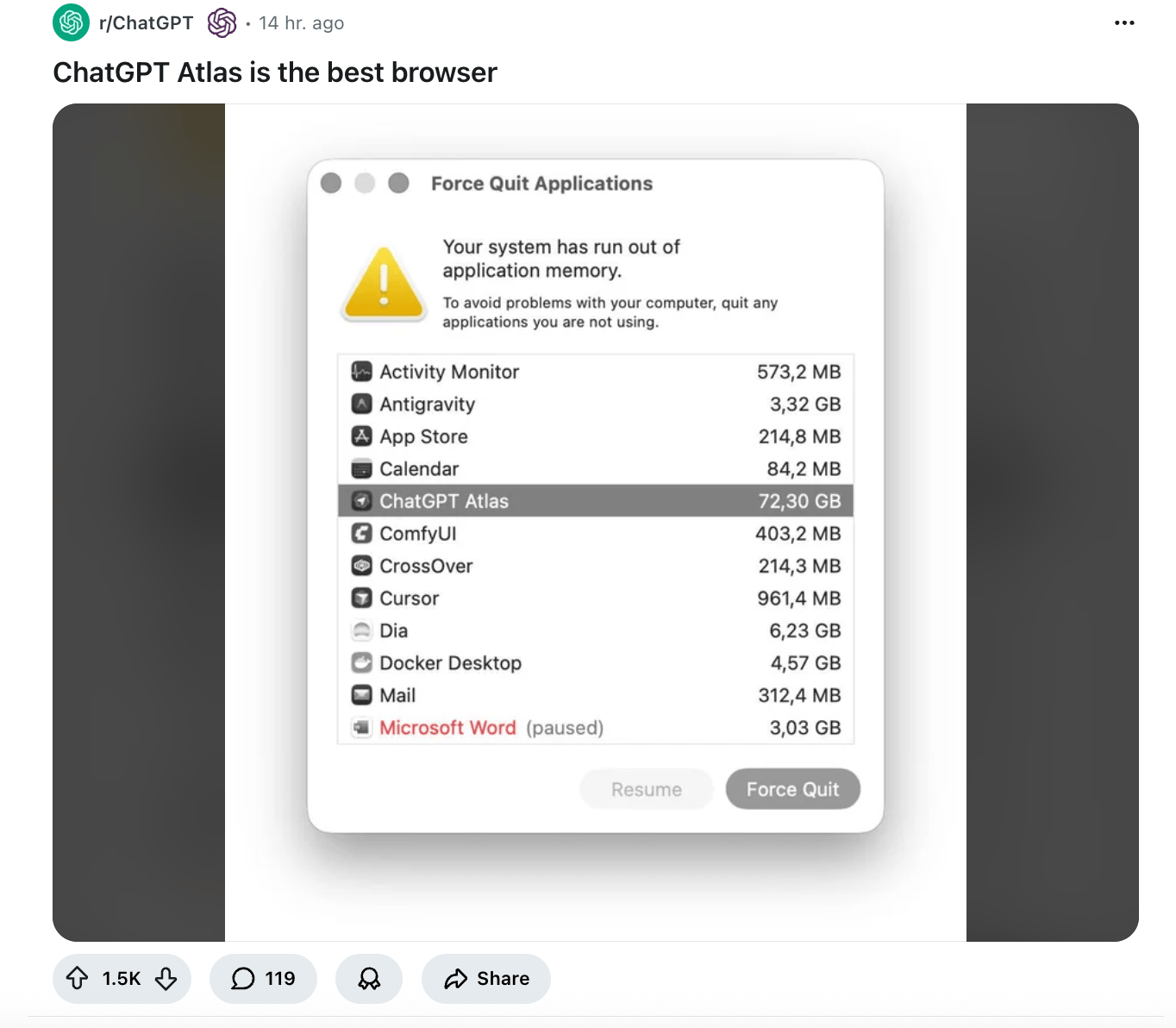 | For context, that's more memory than most computers have… and this user only noticed because they'd bought a souped-up MacBook with 96 GB. |
| The internet had a field day w/ this, obviously. Top comment: "Now we know why OpenAI bought 40% of the worldwide RAM chips until 2029... it's for old-style web surfing!" | So what's the culprit here? The Reddit thread exploded with theories. The obvious answer: classic memory leaks from rushing a Chromium-based browser to market. | Here's a spicier theory: The Information just reported OpenAI's margin for running models (called "inference") is now 70%. up from 50% earlier this year. The company's been on an efficiency push since DeepSeek proved you could run powerful AI models way cheaper, tweaking models to run more efficiently and cutting server costs wherever possible. | Moving computation from OpenAI's expensive servers to your RAM-loaded MacBook? That would deeefinitely help those margins! Just joking of course, that's not how Atlas works (it sends your requests to OpenAI's servers over the cloud)… but distributing compute across the roughly 119 exabytes (if Gemini is to be believed) of personal computers and smartphones available sure wouldn't hurt! | Here's what happened in AI today: | Disney built a walking Olaf robot that learned to manage its own temperature. OpenAI wants to raise $100B and maybe IPO next year at a $1T+ valuation. New York passed the RAISE Act requiring AI safety protocols and reporting. Karpathy identified six 2025 AI paradigm shifts (like RLVR training and "vibe coding").
| | Don't forget: Check out our podcast, The Neuron: AI Explained on Spotify, Apple Podcasts, and YouTube — new episodes air every week on Tuesdays after 2pm PST! | | Disney Built a Walking Olaf Robot That Learned to Prevent Its Own Overheating | 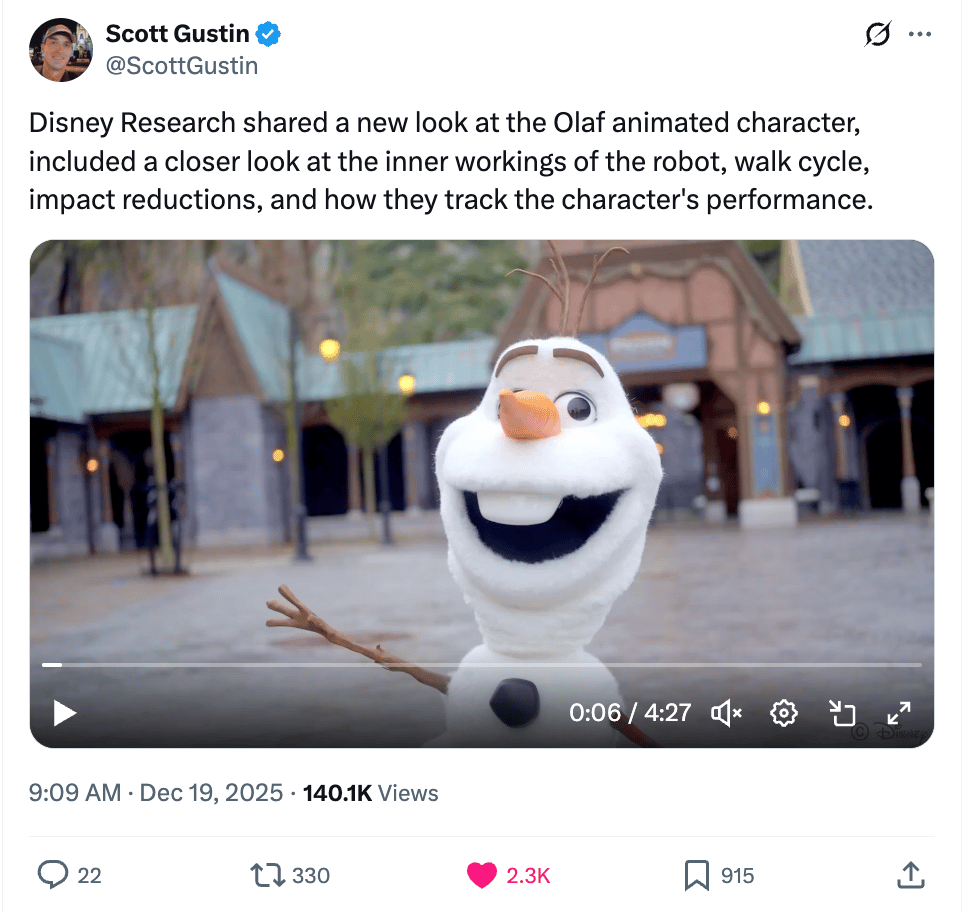 | This is an actual working robot that looks like a 3D animation IRL… it's wild. (video) |
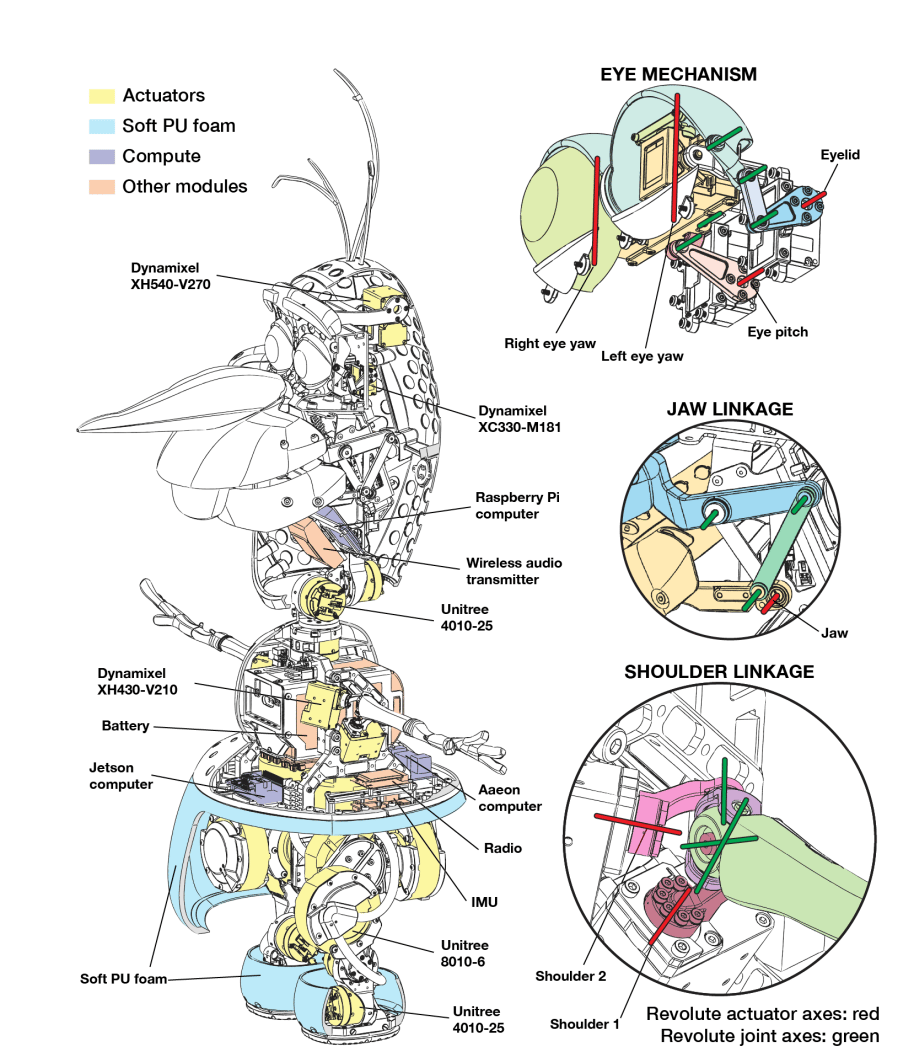
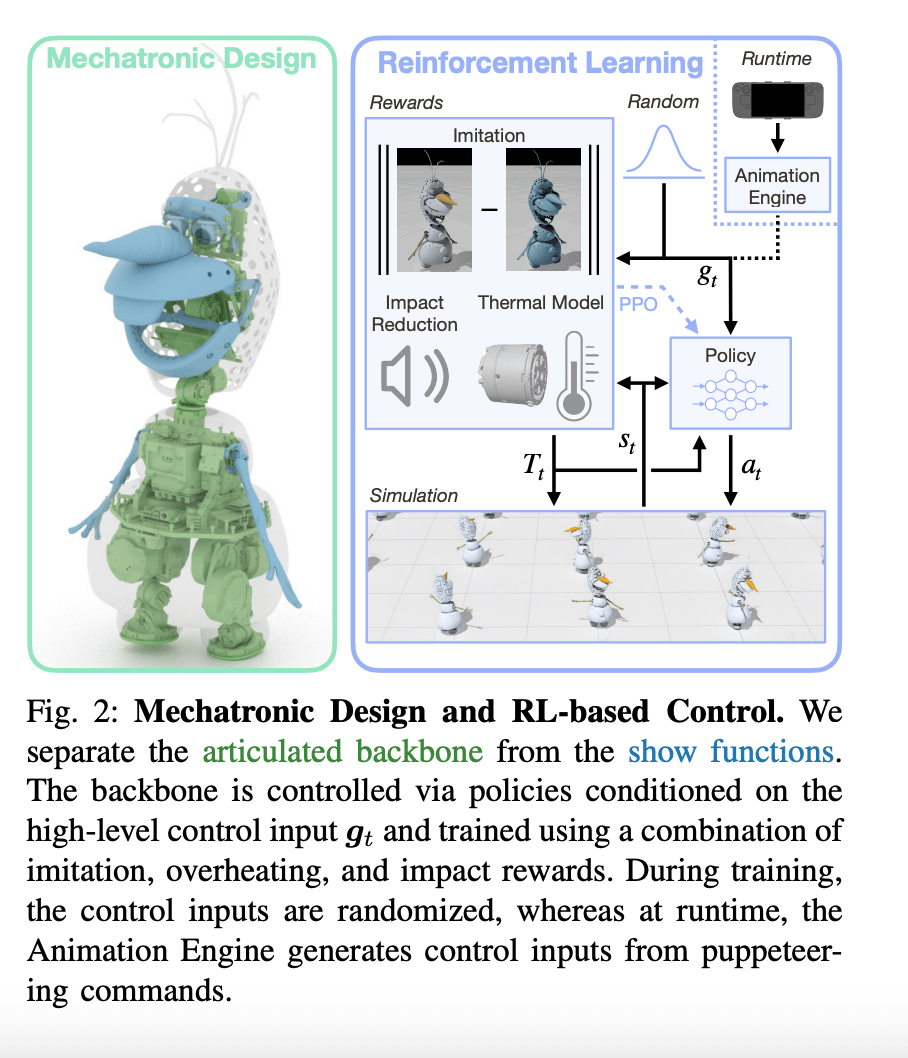
| NEWS BRIEF: Inside Disney's new Life-like Olaf Robot | This is, perhaps, the coolest thing I've seen in AI all year: Disney Research created a fully autonomous walking robot of Olaf from Frozen, solving problems no roboticist has faced before. The character's massive head, tiny body, and floating snowball feet required genuine mechanical innovation; plus an AI that literally learned to manage its own temperature before melting down. | Ironically, the hardest part of building a snowman robot is keeping it from overheating! | The deets: The robot stands ~2 feet 11 inches, weights ~32.8 pounds and has 25 degrees of freedom. But the biggest challenge = Olaf's proportions violate every rule of stable robotics. His heavy head sits on a slim neck with small actuators underneath a heat-trapping costume. Recipe for disaster. | | As for the head management problem, Disney's team invented their own thermal-aware AI policies. Here's how it works: | The robot receives its own actuator temperatures as input alongside normal sensor data. They built a thermal model (T˙ = −α(T − Tambient) + βτ², for the nerds) showing temperature rises with the square of motor torque. Then they used Control Barrier Functions; essentially, soft limits that tell the AI "hey, you're getting warm, ease up." Result = the robot proactively reduces torque before hitting the 80°C danger zone; it gradually adjusts Olaf's head position to lower sustained load while maintaining expressiveness.
| | Some other cool innovations: | Asymmetric hidden legs: Mirror-inverted legs (left has rear hip/forward knee, right has forward hip/rear knee) prevent collisions inside the tight body. Remote actuation: Spherical 5-bar linkages for shoulders, and 4-bar linkages for jaw and eyes; motors placed where there's space, not where joints are. Silent stepping: An impact reduction reward cut footstep noise by 13.5 dB (extremely quiet, just barely above the threshold of human hearing). Magnetic breakaways: Arms, nose, and hair detach on impact to prevent damage (and enable in-character gags, like this one).
| WHY IT MATTERS: First of all, theme parks are gonna be wild in a few years. Imagine life-like 3D characters wandering around the parks more frequently; how cool is that? | But this is bigger than robotic mascots; any machine with heat-sensitive components in tight spaces faces the same problems as Olaf here. We're talking humanoid robots, prosthetics, drones, space applications…and Disney just proved you can teach AI to self-regulate their temperature through reward functions instead of hard-coded limits. | | FROM OUR PARTNERS | Ideas move fast; typing slows them down. | | Wispr Flow flips the script by turning your speech into clean, final-draft writing across email, Slack, and docs. It matches your tone, handles punctuation and lists, and adapts to how you work on Mac, Windows, and iPhone. | Give your hands a break ➜ start flowing for free today. | | Prompt Tip of the Day | Don't ask for "the answer." Ask for a menu. | Most AI prompts accidentally force a single confident path. This one does the opposite: it turns the model into a brainstorming partner that gives you real choices—plus the tradeoffs—so you can pick based on what you actually care about (speed, cost, quality, or risk). | The "Give me options, not one answer" PROMPT Generate 10 distinct approaches to solve [problem]. For each: give a one-line summary, best use case, and one downside. Then recommend the top 2 based on [my priority: speed / cost / quality / risk].
| | Treats to Try | *Asterisk = from our partners (only the first one!). Advertise to 600K readers here! | | *Dell Pro Max with GB10 runs open models like NVIDIA Nemotron models entirely locally. With 128GB unified memory and 4TB storage, it handles workloads that usually require sending everything to OpenAI or Anthropic—except your data never leaves your network. Keep your data local. Intercom answers repetitive support chats for you and routes the rest to the right teammate. Free trial, then $29/seat/month + $0.99 per resolved conversation. Gemini CLI turns your terminal into a "fix this bug / write the tests" chat interface. Adobe Agent Orchestrator lets you set up a team of task-specific agents that use your Adobe customer data to run marketing work—like finding the right audience and kicking off a personalized campaign automatically. CarEdge tells you what to pay and what to say—then negotiates for you if you don't want to. Jeen AI helps you plan and launch digital billboard ads fast—tell it your goal and it builds a DOOH campaign you can run in minutes. Is it Nerfed? tracks whether popular models are getting better or worse by continuously running the same coding tasks and showing failure-rate charts (plus a "vibe check" from users). Sophia Tang's guide teaches you the mathematical foundations of spherical equivariant graph transformers—the rotation-aware architectures you need to understand if you're building ML models that predict molecular structures, design new materials, or simulate atomic interactions (paper, she also mentions EquiLLM, HEGNN, and OXtal). OpenMemory gives you a local, persistent memory store (SQLite + MCP) so assistants can save/retrieve long-term context across tools… but Hacker News debated whether it's meaningfully different from "just use a local vector DB."
| | Around the Horn | OpenAI could be on the verge of raising as much as $100B at a potential $830B valuation, and could IPO as soon as next year at a valuation over $1T, which Sam recently addressed in a way that suggested he'll do it when they have to regarding shareholder limits (and, me speculating here, depending on whether or not they can actually raise $100B privately or not). Governor Kathy Hochul signed the RAISE Act making New York the second state (after California) to enact major AI safety legislation, requiring large AI developers to publish safety protocols and report incidents within 72 hours with fines up to $1M, though an a16z-backed super PAC is challenging co-sponsor Assemblyman Alex Bores and Trump signed an executive order directing agencies to challenge state AI laws. Lenny Rachitsky argues Claude Code is massively underrated for non-technical users because it's really "Claude Local", running on your computer to organize files, enhance images, download YouTube videos, and handle 50+ creative workflows from automatically organizing invoices to synthesizing customer call transcripts. Andrej Karpathy identifies six 2025 paradigm shifts (lots of acronyms here, so bare with us or go read the full article for the full explanation): RLVR emerging as the new training stage after SFT/RLHF, LLMs displaying "jagged intelligence" as "ghosts we're summoning," Cursor revealing a new LLM app layer, Claude Code demonstrating the value of local AI agents (echoing Lenny), "vibe coding" making programming accessible to anyone, and Nano banana hinting at the "LLM GUI" where models speak through images and web apps rather than text. Terence Tao argues current tools don't achieve "artificial general intelligence" but rather "artificial general cleverness", or the ability to solve complex problems via ad hoc means that wouldn't qualify as true "intelligence", yet can succeed at an increasingly wide spectrum of tasks when coupled with stringent verification procedures.
| | FROM OUR PARTNERS | AI-native CRM | | "When I first opened Attio, I instantly got the feeling this was the next generation of CRM."
— Margaret Shen, Head of GTM at Modal | Attio is the AI-native CRM for modern teams. With automatic enrichment, call intelligence, AI agents, flexible workflows and more, Attio works for any business and only takes minutes to set up. | Join industry leaders like Granola, Taskrabbit, Flatfile and more. | 👉Start for free today | | Monday Meme | | | |
| | | That's all for now. | | | What'd you think of today's email? | |
|
| P.S: Before you go… did you know we have a YouTube Channel? |  | Click the image to subscribe! |
| P.P.S: Love the newsletter, but only want to get it once per week? Don't unsubscribe—update your preferences here. |
|


















No comments:
Post a Comment
Keep a civil tongue.