

Neatorama |
| 5 Really Weird Things About Water Posted: 22 Aug 2008 05:19 AM CDT
Water, good ol' H2O, seems like a pretty simple substance to you and me. But in reality, water - the foundation of life and most common of liquid - is really weird and scientists actually don't completely understand how water works. Here are 5 really weird things about water: 1. Hot Water Freezes Faster Than Cold WaterTake two pails of water; fill one with hot water and the other one with cold water, and put them in the freezer. The hot one would be frozen before the cold one. But wait, you say, that's counterintuitive: wouldn't the hot water have to cool down to the temperature of the cold water before proceeding to freezing temperature, whereas the cold one has "less to go" before freezing? In 1963, a Tanzanian high-school student named Erasto B. Mpemba was freezing hot ice cream mix in a cooking class when he noticed that a hot mix actually froze faster than a cold mix. When he asked his teacher about this phenomenon, his teacher ridiculed him by saying "All I can say is that is Mpemba's physics and not universal physics." Thankfully, Mpemba didn't back down - he convinced a physics professor to conduct an experiment which eventually confirmed his observations: in certain conditions, hot water indeed freezes before cold water*. Actually, Mpemba was in good company. The phenomenon of hot water freezing first, now called the "Mpemba effect" was noted by none other than Aristotle, Francis Bacon and René Descartes. But how do scientists explain this strange phenomenon? It turns out that no one really knows but there are several possible explanations, including differences in supercooling (see below), evaporation, frost formation, convention, and effects of dissolved gasses between the hot and cold water. *In reality - of course - it's much more complex than that: hot water freezes first (it forms ice at a higher temperature than cold water), whereas cold water freezes faster (it takes less time to reach the supercooled state from which it forms ice) - see discussion on our previous blog post about this topic. 2. Supercooling and "Instant" IceEverybody knows that when you cool water to 0 °C (32 °F) it forms ice ... except that in some cases it doesn't! You can actually chill very pure water past its freezing point (at standard pressure, no cheating!) without it ever becoming solid. Scientist know a lot about supercooling: it turns out that ice crystals need nucleation points to start forming. These nucleation points could be anything from gas bubbles to impurities to the rough surface of the container. Without these things, water would continue to be a "supercooled" liquid well below its freezing point. When nucleation is triggered, then a supercooled water would "instantly" turn into ice, as this very cool video clip by Phil Medina of MrSciGuy shows:
Note: Similarly, superheated water remains liquid even when heated past its boiling point. 3. Glassy Water
Remember the supercooling we talked about before? Well, it turns out that no matter what you do, at -38 °C even the purest supercooled water spontaneously turns into ice (with a little audible "bang" no less). But what happens if you continue to lower the temperature? Well, at -120 °C something strange starts to happen: the water becomes ultraviscous, or thick like molasses. And below -135 °C, it becomes "glassy water," a solid with no crystal structure. (Source) 4. Quantum Properties of WaterAt a molecular level, water is even weirder. In 1995, a neutron scattering experiment got a weird result: physicists found that when neutrons were aimed at water molecules, they "saw" 25% fewer hydrogen protons than expected. Long story short, at the level of attoseconds (10-18 seconds) there is a weird quantum effect going on and the chemical formula for water isn't H2O. It's actually H1.5O! (Source) 5. Does Water Have Memory?
This made no sense to Madeleine Ennis, a pharmacologist and professor at Queen's University in Belfast, Northern Ireland. Ennis, who also happened to be a vocal critic of homeopathy, devised an experiment to disprove "water memory" once and for all - but discovered that her result is the exact opposite!
So far, other scientists failed to reproduce Ennis' experimental findings (throughout, Ennis herself was skeptical of the result's interpretation that water has a "memory" but maintained that the phenomenon she saw was real). See also Jacques Benveniste's Nature controversy | Louise Rey's thermoluminescence study More recently, a team of scientists at the University of Toronto, Canada, and Max Born Institute in Germany, studying water dynamics using fancy multi-dimensional nonlinear infrared spectroscopy did find that water have a memory of sorts - in form of hydrogen bond network amongst water molecules. Problem for homeopathy was, this effect lasted only 50 femtoseconds (5 x 10-14 seconds)! Bonus: Ice Spikes
Ice spikes are, well, spikes that grow out of ice cube trays. They look like stalagmites found in caves, and you can make 'em yourself using distilled water. Kenneth G. Libbrecht of SnowCrystals explains:
Bonus 2: Make Instant Snow with Boiling WaterWhat do you get when you throw boiling water to the air in subzero weather? Instant snow. Interestingly, it only works with boiling hot water: These aren't the only things weird about water. We didn't talk about how water density changes with temperature (ice, for instance, is less dense than water so it floats - a key property of water that made life possible in the oceans and lakes). Nor did we talk about the weirdly strong surface tension of water, ordered clustering of liquid water, and so on. If you are interested, check out the Anomalous Properties of Water article by Martin Chaplin  | ||||||||||
| Posted: 22 Aug 2008 01:33 AM CDT (Links open in a new browser window/tab)
For more the web’s most interesting videos, check out: VideoSift.  | ||||||||||
| Wizard of Oz propaganda-style poster Posted: 21 Aug 2008 10:53 PM CDT  Oz at War propaganda poster by tocath. It’s the theme post for a recruitment poster photoshop contest at Worth 1000. *Previously: Godzilla in Gallilee.  | ||||||||||
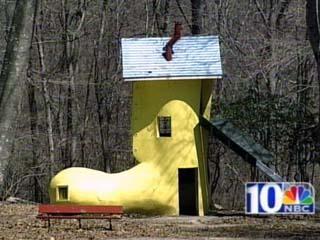
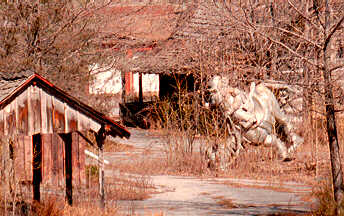
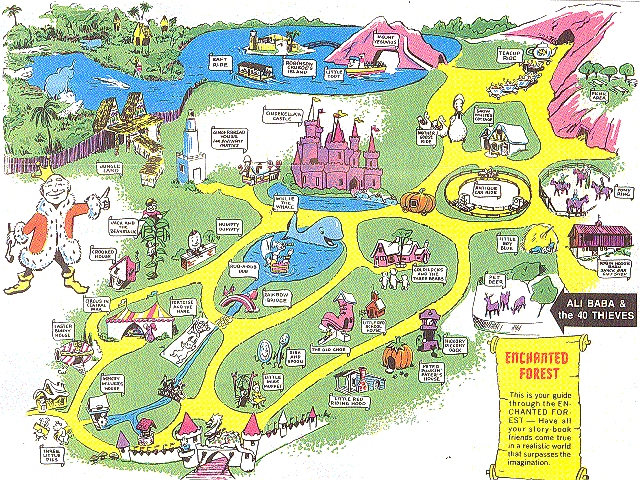
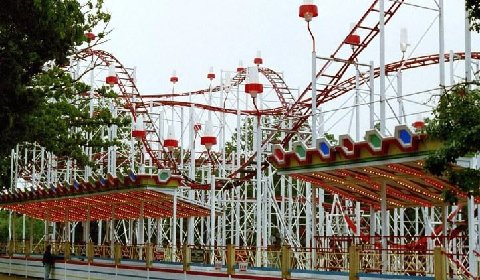
| Five Amusement Parks that are No Longer Amusing Posted: 21 Aug 2008 03:56 PM CDT There's something fascinating about large structures that have been completely abandoned. But abandoned amusement parks are especially creepy. The fact that such a bustling, busy place full of excitement and fun is now a desolate, quiet graveyard combined with rusted kiddie images and clowns… yeah, that's pretty much a recipe for a horror story. Although these amusement parks are no longer in operation, they're still a source of… well, interest, if not amusement, exactly. The Enchanted Forest, Hope Valley, RI
Chippewa Lake Park, Chippewa Lake, Ohio
Dogpatch, USA
Enchanted Forest, Maryland
Hamel's Amusement Park
 | ||||||||||
| Dissecting Lightning McQueen of Pixar’s Cars Posted: 21 Aug 2008 03:52 PM CDT Jake Parker of Agent44 Blog didn’t just wonder about what Lightning McQueen, the hero of the 2006 movie Cars by Disney and Pixar would looke like on a dissection table … he actually drew one out! Link - thanks kinomozg! Previously on Neatorama: Hyungkoo Lee’s Cartoon Skeleton | Skeletal Systems of Cartoon Characters  | ||||||||||
| Turning Fat Straight Into Muscle (Yay, Science!) Posted: 21 Aug 2008 12:52 PM CDT My old college roommate had a firm belief that if you wait long enough, science will solve all your problems for you. And he may be right: scientists have discovered factors that may help your body turn fat straight into muscles!
 | ||||||||||
| Posted: 21 Aug 2008 12:51 PM CDT
Here’s some of what you get with the Emirates Palace Abu Dhabi’s Million Dollar Package:
More on Wall Street Journal’s The Wealth Report  | ||||||||||
| Parents Let Kid Drop Out to Focus on Video Gaming Posted: 21 Aug 2008 12:50 PM CDT
Matt Ehlers of The News & Observer has the story:
Link - via Wired’s Geekdad, Thanks Marilyn! (Photo: Corey Lowenstein)  | ||||||||||
| 5 Dubious Moments in Olympics History Posted: 21 Aug 2008 11:44 AM CDT
Ah, the Olympics: the intense competition, the thrill of victory, the agony of defeat, and ... a butt pinch by Hitler? If you are sick and tired of the greatest moments in the Olympic Games sort of stories, this Neatorama list is for you. Here are the 5 Dubious Moments in Olympics History: 1. Eddie "The Eagle" Edwards, Ski Jump If, at 5 feet 8 inches and 181 lb, Eddie "The Eagle" Edwards looked more like a construction worker than an world class athlete, that's because he was one. The then 25-year-old plasterer from Cheltenham, England, was the only British applicant for the 1988 Winter Olympics ski jumping competition in Calgary, so he was accepted. This was even more remarkable when you realize that there was no ski jumps in Britain at the time. Almost immediately upon arriving in Calgary, things started to go wrong for Eddie: his plane landed late and his bag ripped open on the airport carousel, so he had to jump on and chase his pants. Then it got worse:
Olympics purists were also appalled that Eddie was making a mockery of their sport. True to form, Eddie the Eagle's thick glasses fogged up so much as he wobbly jumped that he couldn't see. Needless to say, he landed dead last (though he didn't crash). Eddie's warm demeanor, fun personality, and, let's face it, lack of success, made him a darling to the press and to people around the world. So he became a legend:
Afterwards, the Olympics committee instituted the "Eddie the Eagle rule," stipulating that athletes must place in the top 30% or be in the top 50 to qualify for the games. Nevertheless, it was Eddie's moment in the sun:
2. Jamaican National Bobsled Team, Bobsleigh The 1988 Winter Olympics in Calgary, Alberta, Canada also saw another great example of guts over glory in the Jamaican National Bobsled Team. Now, the whole thing got started when two Americans, Mayor of Warrenton, Virginia, George B. Fitch and his business partner William Maloney noticed that pushcart derby in Jamaica looked very similar to bobsled (technically called bobsleigh). So they decided to persuade the Jamaicans to train for the winter Olympics. At first, they tried to recruit Olympic-class sprinters, but there were no takers ... but the Jamaican military was game! The first members of the Jamaican National Bobsled Team were soldiers. They started practicing on push carts and makeshift sleds on the flat concrete floor at a military base in Kingston. The epic struggle of the Jamaican bobsledders (they crashed spectacularly in the third heat of the four man bobsleigh event) won the hearts of viewers worldwide. Their courage, determination, tenacity and sheer what-in-the-world-were-they-thinking-bobsledding-in-Jamaica even landed them a movie deal: the Jamaican National Bobsled Team were immortalized in the 1993 Disney comedy Cool Runnings. The Jamaican National Bobsled Team actually improved dramatically afterwards. In 1994 Winter Olympics in Lillehammer, Norway, they placed ahead of the US, Russian, French, and Italian teams! 3. Philip Boit, Cross-Country Skiing
Bitok never qualified for the race, but Boit did. He cross-country skiied in the 10-kilometer classic in Nagano ... and came in dead last. The awards ceremony for the race had to be delayed because the winner, Norwegian cross-country skier and legend in the sport Bjørn Dæhlie, insisted on waiting 20 minutes for Boit to cross the finish line so he could cheer Boit on! Boit's participation in the Winter Olympics was controversial - many people accused Nike of exploiting the Kenyans and making a mockery of the sport. Boit, however, was determined to ski and even when Nike dropped its sponsorship, he continued to train on dry land in Kenya. He qualified for the 2002 Winter Olympics, and finished ahead of 3 competitors in a sprint race. (Image: BBC) 4. Eric "The Eel" Moussambani, Dog Paddle ... er, SwimmingIn an effort to encourage athletes from developing countries to compete, some swimmers were invited to perform even though they never qualified. One of those athletes was Eric Moussambani from Equitorial Guinea. Eric, who later earned the nickname "The Eel" after his epic performance, learned to swim just a few months before the 2000 Summer Olympics in Sydney, Australia. In fact, he had never seen an Olympic-size swimming pool before in his life (he practiced swimming at a hotel's pool, one of the only two pools in the entire country). When his two other competitors were disqualified for a false start, Eric swam all by himself. Technically, he dog paddled:
Later, Eric the Eel said, "The last 15 meters were very dificult." 5. Helen Stephens and the Butt Pinch by HitlerAs promised. here's the story of the Hitler butt pinch:
Eighteen-year-old Helen Stephens, nicknamed "Fulton Flash" after her birthplace of Fulton, Missouri, ran in the 100 m dash in the 1936 Summer Olympics in Berlin ... and won. As was the custom at the time, Stephens made the obligatory visit to Hitler's box after winning gold. In his Complete Book of the Summer Olympics, David Wallechinsky wrote:
Side note: At the Olympics, Helen Stephens beat the reigning champ, Stanislawa Walasiewicz of Poland and there were accusations that Helen was actually a man. After a genital inspection proved otherwise, the matter was dropped. Walasiewicz, who subsequently changed her name to Stella Walsh was killed in an armed robbery many decades later. In an ironic twist of fate, the autopsy showed that she actually had male genitalia (though she had both XX and XY pair of chromosomes). From that point on, she was often referred to as "Stella the Fella."  | ||||||||||
| A Short Illustrated History of the Nerd Posted: 21 Aug 2008 10:47 AM CDT  Where did the nerd originate, both as a word an individual and, possibly, a species? What were the original societal perceptions of the nerd? How have these changed over the decades? Enter the world of the nerd and discover for yourself this fascinating and light hearted illustrated history of the origin of the species. Darwin, eat your heart out. Link -via the Presurfer (image credit: bayat)  | ||||||||||
| Posted: 21 Aug 2008 10:45 AM CDT | ||||||||||
| Posted: 21 Aug 2008 10:44 AM CDT
The snails are tiny, only about a centimeter in length. Link -via Digg  | ||||||||||
| Posted: 21 Aug 2008 10:42 AM CDT  Mr. Grass at Watching Grass Grow (”The Most Boring Website in the World”) trained a webcam on a nest of finches and recorded their progress as they tended their babies. The story is chronicled in a series of pictures. Warning: not all the finches made it. Link -Thanks, Jon!  |

 Quick: how many phases of water are there? If you answer three (liquid, gas, and solid) you'd be wrong. There are at least 5 different phases of liquid water and 14 different phases (that scientists have found so far) of ice.
 In the alternative medicine of homeopathy, a dilute solution of a compound can have healing effects, even if the dilution factor is so large that statistically there isn't a single molecule of anything in it except for water. Homeopathy proponents explain this paradox with a concept called "water memory" where water molecules "remember" what particles were once dissolved in it.





 What are you doing for your next vacation? If you’re loaded, may I suggest the $1 million vacation travel package (and that you take a great traveling companion with you. Who? Oh, say, someone like me!):
 Like many 16-year old teenagers, Blake Peebles dreams of being a professional video game player. That’s not unusual. What’s different here is that Blake’s parents actually let him quit school (he’s still homeschooled) to focus on a career as a pro gamer.
 In 1996, Nike decided on a sports experiment / PR stunt - it would pay for two Kenyan long distance runners, Philip Kimely Boit and Henry Bitok, to train in cross-country skiing for the 1998 Winter Olympics in Nagano, Japan. The two Kenyans have never skiied before in their lives - heck, they've never even seen snow until they arrived in Finland to train.


 An alien species has been invading Britain for over 100 years, and they were just now noticed. They are snails!

| You are subscribed to email updates from Neatorama To stop receiving these emails, you may unsubscribe now. | Email Delivery powered by FeedBurner |
Inbox too full?  Subscribe to the feed version of Neatorama in a feed reader. Subscribe to the feed version of Neatorama in a feed reader. | |
| If you prefer to unsubscribe via postal mail, write to: Neatorama, c/o FeedBurner, 20 W Kinzie, 9th Floor, Chicago IL USA 60610 | |


No comments:
Post a Comment
Keep a civil tongue.