| Here are the FeedBlitz blog updates for ignoble.experiment@arconati.us
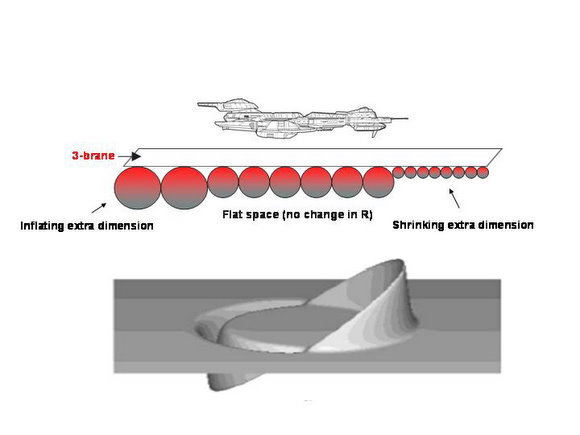
 Distortion of spacetime that may enable warp speed. Credit: Michael Alcubierre Standard in almost every Star Trek episode are warp drives and cloaking devices. But in reality these science fiction gadgets defy the laws of physics. Or do they? Different scientists have been working on developing these two devices and they say they are getting closer to actually creating working prototypes. While warp drive won't be available anytime soon, scientists are gaining a better understanding of how faster-than-light speed could possibly be achieved. And as for cloaking devices, don't look now, but researchers recently cloaked three-dimensional objects using specially engineered materials that redirects light around objects. (...)
Read the rest of Warp Drive and Cloaking Devices: Not Just Science Fiction Anymore? (698 words)
© Nancy Atkinson for Universe Today, 2008. | Permalink | No comment | Add to  del.icio.us del.icio.us  digg digg
Who's linking ?  Technorati Technorati  BlogPulse BlogPulse  Google Google
Want more on these topics ? Browse the archive of posts filed under Science, Space Flight. 

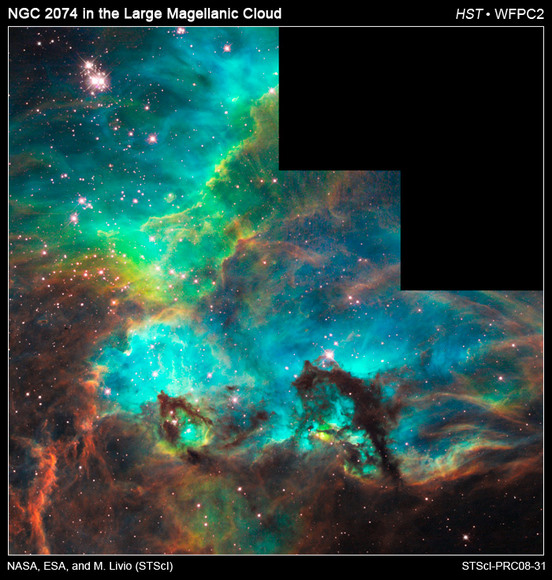
 Hubble's 100,000th Orbit Celebration Image. Credit: NASA, ESA, and the Hubble Heritage Team (STScI/AURA) This morning at 7:42 EDT, the Hubble Space Telescope completed it's 100,000th orbit around the Earth. That's about 4.38 billion kilometers (2.72 billion miles), as it clicks along at 8 km per second (5 miles/s), orbiting Earth once every 90 minutes. Hubble's been in orbit for over 18 years now, since its launch on the space shuttle Discovery on April 24, 1990. To commemorate occasion, scientists at the Space Telescope Science Institute in Baltimore, Md., released a special image taken with Hubble's Wide Field Planetary Camera 2 of a nebula near the star cluster NGC 2074 (upper, left) , showing a dazzling region of celestial birth and renewal. And soon, Hubble will have a little renewal of its own, with the upcoming fifth and final servicing mission in October.
(...)
Read the rest of Hubble's Odometer Hits 100,000 Orbits (264 words)
© Nancy Atkinson for Universe Today, 2008. | Permalink | 4 comments | Add to del.icio.us digg
Who's linking ? Technorati BlogPulse Google
Want more on these topics ? Browse the archive of posts filed under Hubble. 

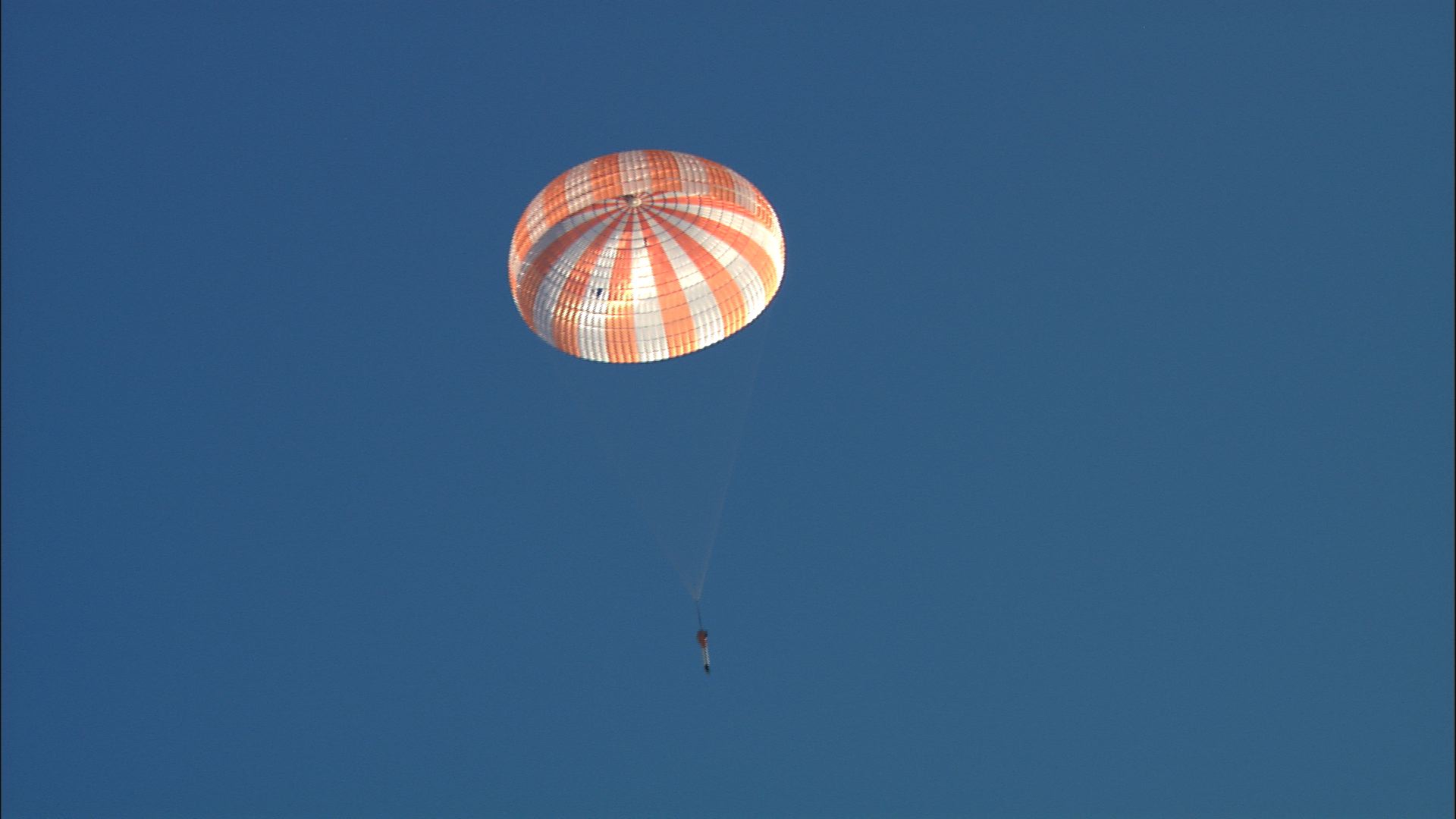
 An early parachute drop test for the Constellation Project (NASA) At the end of last month, the Orion crew module and the Ares I rocket parachute systems underwent a series of drop tests. The "drogue parachute" that will gently slow the descent of the spent first-stage motor of the Ares vehicle appeared to function as expected over the Arizona skies. However, an Orion test failed, "programmer parachute" failing to correct the orientation of the test crew module, allowing the module to drop through the sky upside-down. The programmer parachute is intended to inflate before the main three parachutes are deployed to bring the re-entering Orion astronauts to land safely. This news has come from an internal memo referring to the Orion test drop back on July 31st; the successful Ares I drogue parachute drop was carried out on July 24th. So what went wrong with the Orion test-drop? (...)
Read the rest of Constellation Project Parachute Tests: Ares I Success, Orion Failure (558 words)
© Ian O'Neill for Universe Today, 2008. | Permalink | 2 comments | Add to del.icio.us digg
Who's linking ? Technorati BlogPulse Google
Want more on these topics ? Browse the archive of posts filed under NASA, Space Flight. 

 Fireworks at the 2008 Olympics Opening Ceremony. Credit: Clive Rose, Getty Images Space and the Olympics might not be synonymous in most people's minds — although this image of the Opening Ceremony fireworks makes it look like Olympic Stadium is going supernova — but there are a few connections between the two for this year's Summer Olympics in Beijing, China. Google Earth recently updated the satellite imagery it uses for the Beijing area to provide users with better maps. They also used satellite imagery to create a 3-D tour of all the facilities for the 2008 Olympics (see video below). Other space connections include several space explorers who carried the Olympic torch on its running tour around the world, and NASA space spinoff technology used in some of the clothing and equipment for Olympic use. (...)
Read the rest of From Space to the Olympics (281 words)
© Nancy Atkinson for Universe Today, 2008. | Permalink | 7 comments | Add to del.icio.us digg
Who's linking ? Technorati BlogPulse Google
Want more on these topics ? Browse the archive of posts filed under Satellites. 


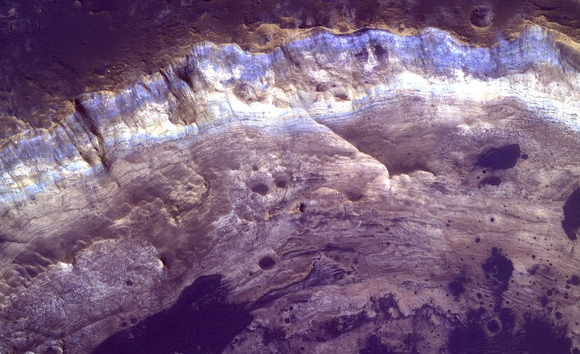
Images and data from the Mars Reconnaissance Orbiter (MRO) have revealed layers of clay-rich rock that suggests abundant water was once present on Mars. Scientists from the SETI Institute, the Jet Propulsion Laboratory and several universities have been studying data focused on the Mawrth Vallis area on Mars' northern highland region. This is a heavily cratered, ancient area of the Red Planet whose surface geology resembles a dried-up, river valley through which water may have flowed. While their findings don't provide evidence for life, it does suggest widespread and long-term liquid water in Mars' past.
(...)
Read the rest of Evidence for Widespread Water on Early Mars (427 words)
© Nancy Atkinson for Universe Today, 2008. | Permalink | 5 comments | Add to del.icio.us digg
Who's linking ? Technorati BlogPulse Google
Want more on these topics ? Browse the archive of posts filed under Mars, Missions. 

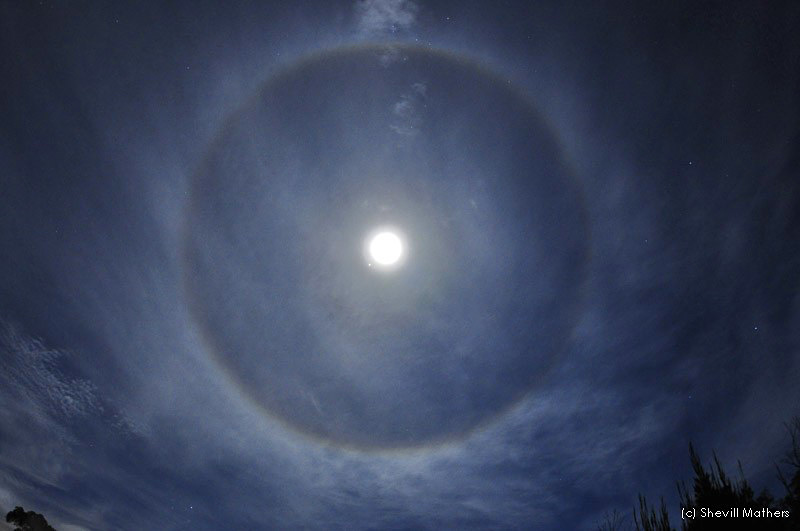
 'Nimbus' - Shevill Mathers Greetings, fellow SkyWatchers! Are you ready for another weekend? As the seasons slowly begin to change for both hemispheres and the Moon grows more full, look for an optical phenomena known as a "nimbus" - or halo around the Moon. While it's nothing more than a thin layer of ice crystals in the upper troposphere, it is a wonderfully inspiring sight and was once used as a means of weather forecasting. If you see a nimbus, try counting the number of stars visible inside the halo and see if it matches the number of days before bad weather arrives! In the meantime, follow me as we head out on our next weekend journey into the night… (...)
Read the rest of Weekend SkyWatcher's Forecast - August 8-10, 2008 (1,227 words)
© Tammy Plotner for Universe Today, 2008. | Permalink | No comment | Add to del.icio.us digg
Who's linking ? Technorati BlogPulse Google
Want more on these topics ? Browse the archive of posts filed under Observing, What's Up. 


Next week, Boulder, Colorado will play host to the eleventh annual Mars Society conference. There will be a huge array of speakers, lectures and workshops anyone can get involved in to learn more about the future of manned exploration on Mars. The Mars Society is an international organization working to raise public awareness about the opportunities we have on Mars and push for eventual manned settlements. Primarily, the Mars Society is pushing for better governmental spending in planetary missions, but there is an increasing awareness that many aims can only be achieved through private enterprise. The organization doesn't limit itself to political activities. For years the organization has managed a series of "Mars Analogues," isolated habitats where volunteers carry out extended experiments, studying everything from human psychology in confined living conditions to working in extreme environments (such as desert plains). It is therefore of huge significance that the eleventh Mars Society conference will be bigger and better than ever, with a very impressive list of delegates…
(...)
Read the rest of 11th Annual Mars Society Convention on 14th-17th August (489 words)
© Ian O'Neill for Universe Today, 2008. | Permalink | 3 comments | Add to del.icio.us digg
Who's linking ? Technorati BlogPulse Google
Want more on these topics ? Browse the archive of posts filed under Mars, Space Exploration. 

 Rendering of a blue liquid metal... could this be what metallic helium looks like? Source: http://tinyurl.com/6lffol (waxellis) The interiors of the two gas giants, Jupiter and Saturn, are pretty extreme places. With atmospheric pressures of around 70 million Earth atmospheres, the phases of material become a bit difficult to understand. Usually when we think of a liquid metal, we have thoughts about liquid mercury at room temperature (or the reassembling liquid metal T-1000 played by Robert Patrick in the film Terminator 2), rarely do we consider two of the most abundant elements in the Universe to be a liquid metal in certain conditions. And yet, this is what a team of physicists from UC Berkley are claiming; helium and hydrogen can mix together, forced by the massive pressures near the cores of Jupiter and Saturn, forming a liquid metal alloy, possibly changing our perception of what lies beneath those Jovian storms… (...)
Read the rest of Could Jupiter and Saturn Contain Liquid Metal Helium? (690 words)
© Ian O'Neill for Universe Today, 2008. | Permalink | 14 comments | Add to del.icio.us digg
Who's linking ? Technorati BlogPulse Google
Want more on these topics ? Browse the archive of posts filed under Jupiter, Physics, Saturn. 

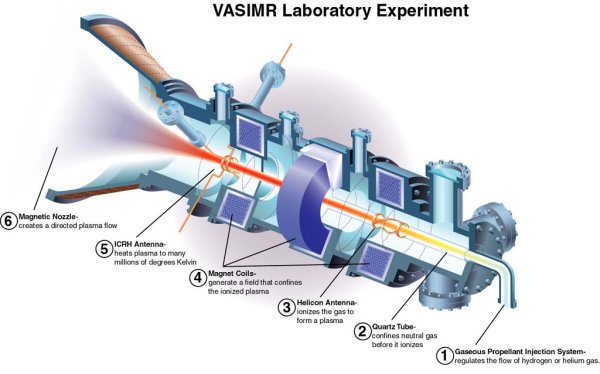
 The Vasimir experiment (Ad Astra Rocket Corporation) NASA Administrator Michael Griffin has announced his intentions to send an advanced spaceship propulsion prototype to the International Space Station for advanced testing. The Variable Specific Impulse Magnetoplasma Rocket (Vasimir) is currently in an experimental phase, but Griffin hopes that a scale model will be ready for one of the remaining Shuttle-ISS missions before 2010. The Vasimir concept bridges the gap between conventional (fuel hungry, high thrust) rockets and economical (fuel efficient, low-thrust) ion engines. Vasimir achieves this by using an ingenious method of ionizing and heating a neutral gas fuel…
(...)
Read the rest of Next Generation Magnetoplasma Rocket Could be Tested on Space Station (388 words)
© Ian O'Neill for Universe Today, 2008. | Permalink | 12 comments | Add to del.icio.us digg
Who's linking ? Technorati BlogPulse Google
Want more on these topics ? Browse the archive of posts filed under NASA, Space Flight, Space Station. 

 The Large Hadron Collider will go on-line in one month (CERN/LHC) It's official, the Large Hadron Collider (LHC) will begin operations in a little over a month. On September 10th, the most sophisticated particle accelerator will go online, injecting the first circulation of accelerated particles. Actual experiments involving collisions will occur once scientists are satisfied the LHC is fully optimized and calibration is complete. The LHC has been undergoing "cool-down" for some time, ensuring the LHC's eight sectors are approaching the 1.9K (-271°C) operational temperature (that is 1.9 degrees above absolute zero). All going well, on September 10th, the first beam will be accelerated to an energy of 450 GeV (0.45 TeV), the preliminary step on the path to attaining particle energies of 5 TeV, a record breaking target… awesome. (...)
Read the rest of Get Ready for September 10th: CERN Announces LHC Switch-On (236 words)
© Ian O'Neill for Universe Today, 2008. | Permalink | 31 comments | Add to del.icio.us digg
Who's linking ? Technorati BlogPulse Google
Want more on these topics ? Browse the archive of posts filed under Physics. 


We humans like to think we're special, but astronomically speaking we've been shot down quite severely and humbly put in our place. We're not at the center of our solar system, nowhere near the center of our galaxy and certainly not at the center of the universe. But now comes great news for the human psyche from scientists trying to explain solar system formation. As far as solar systems go, we have thought ours was just average and that all solar systems were like ours. But in looking at the 300 plus extrasolar planets that have been discovered and the systems they are in, none so far are anything like our home solar system. In fact, say scientists at Northwestern University, we may be special after all. In a study using computer simulations (this is the week for computer simulations, see here and here), researchers ran more than a hundred simulations, and the results show that the average planetary system's origin was full of violence and drama but that the formation of something like our solar system required conditions to be "just right" and quite special indeed.
(...)
Read the rest of Our Solar System: An Island of Calm in a Violent Universe (and it's special, too) (474 words)
© Nancy Atkinson for Universe Today, 2008. | Permalink | 18 comments | Add to del.icio.us digg
Who's linking ? Technorati BlogPulse Google
Want more on these topics ? Browse the archive of posts filed under Astronomy. 

Update: A recorded version of the interview is available here or just listen in the embedded media below. Nancy will be on the Starlight Zone today at 3:50 Central time (20:50 GMT) for a 5 minute interview with Col Maybury about the new Phobos images from Mars Express. The Starlight Zone is on Australian radio station 2NUR from the Univeristy of Newcastle. Here's the link to the radio station's webpage, and to listen live, click on "Listen" link on the left nagivation bar. I'll also post the link to a recorded version when its available.
© Nancy Atkinson for Universe Today, 2008. | Permalink | No comment | Add to del.icio.us digg
Who's linking ? Technorati BlogPulse Google
Want more on these topics ? Browse the archive of posts filed under Astronomy. 


Saturn's tiny moon Enceladus is of big interest to planetary scientists trying to understand the dynamics of the moon's geysers and fissures. On August 11, the Cassini spacecraft will swoop by Enceladus for a close flyby, just 50 kilometers (30 miles) from the surface, with the fractures, or "tiger stripes" near the moon's south pole, where icy jets erupt as the target of study for the Cassini instruments. "Our main goal is to get the most detailed images and remote sensing data ever of the geologically active features on Enceladus," said Paul Helfenstein, a Cassini imaging team associate at Cornell University in Ithaca, NY. "From this data we may learn more about how eruptions, tectonics, and seismic activity alter the moon's surface. We will get an unprecedented high-resolution view of the active area immediately following the closest approach."
(...)
Read the rest of Cassini Prepares For Close Flyby of Saturn's Geyser-Spewing Moon (299 words)
© Nancy Atkinson for Universe Today, 2008. | Permalink | 7 comments | Add to del.icio.us digg
Who's linking ? Technorati BlogPulse Google
Want more on these topics ? Browse the archive of posts filed under Missions, Saturn. 

 The Bullet Cluster. Credit: NASA One of the leading theories for how the universe evolved after the Big Bang is the Cold Dark Matter Theory (CDM). This theory proposes that chilly dark matter moved slowly in the early universe, allowing matter to clump together to form the clusters of galaxies that we see, instead of matter being distributed evenly across the universe. Using the properties of the CDM theory, astronomers recently ran an intensive computer program using one of the world's most powerful supercomputers to simulate the halo of dark matter that envelopes our galaxy. The simulation revealed dense clumps and streams of the mysterious dark matter lurking within our Milky Way galaxy, including the region of our solar system. (...)
Read the rest of New Study Finds Clumps and Streams of Dark Matter in the Milky Way (273 words)
© Nancy Atkinson for Universe Today, 2008. | Permalink | 39 comments | Add to del.icio.us digg
Who's linking ? Technorati BlogPulse Google
Want more on these topics ? Browse the archive of posts filed under Astronomy. 

 Obama wants NASA to plug the 5-year gap between the Shuttle and Constellation (NASA/AP) Over the weekend, Democratic senator Barack Obama made a public statement during his presidential campaign trail in Titusville, Florida. Whilst responding to a question about oceanic research, Obama elaborated on his plans for the future of NASA. Previously, there have been hints that a possible Obama Presidency would see a reduction in space funding in favour of a boost in education spending. However, Saturday's statement was followed by some detailed text on Obama's campaign blog outlining his priorities for the US dominance in space, the possibility of extending the Shuttle's operations and speeding up development of the Constellation program… (...)
Read the rest of The Politics of Space: Obama Wants to Increase NASA Funding (800 words)
© Ian O'Neill for Universe Today, 2008. | Permalink | 34 comments | Add to del.icio.us digg
Who's linking ? Technorati BlogPulse Google
Want more on these topics ? Browse the archive of posts filed under NASA. 

 James Randi and Phil Plait. Credit: Bad Astronomy Blog This news came out last week, but I've been out of town and now want to offer congratulations to the Bad Astronomer Phil Plait who is adding one more item to his long list of credientials and accomplishments. Phil will now be taking on the role of President….. of the James Randi Educational Foundation (JREF). If you're not familiar with JREF, (you should be!), the goals of the Foundation are to bring critical thinking to the public, expose pseudoscientific frauds, and promote real science and rationality. If you've been reading Phil's Bad Astronomy blog, you know that those are his goals as well, so this new role seems like a perfect fit for both Phil and JREF. Phil says he owes everything to Randi: "He opened my eyes – and my brain – to the idea that reality is a better place to live in than fantasy. I owe it all to Mr. Randi, so I am very excited and deeply honored to continue his vision with the JREF." Congrats Phil! We know you'll "Phil" Randi's shoes just fine. But you've got some work ahead of you on your beard….
(...)
Read the rest of Phil Plait for President (222 words)
© Nancy Atkinson for Universe Today, 2008. | Permalink | 11 comments | Add to del.icio.us digg
Who's linking ? Technorati BlogPulse Google
Want more on these topics ? Browse the archive of posts filed under Astronomy. 

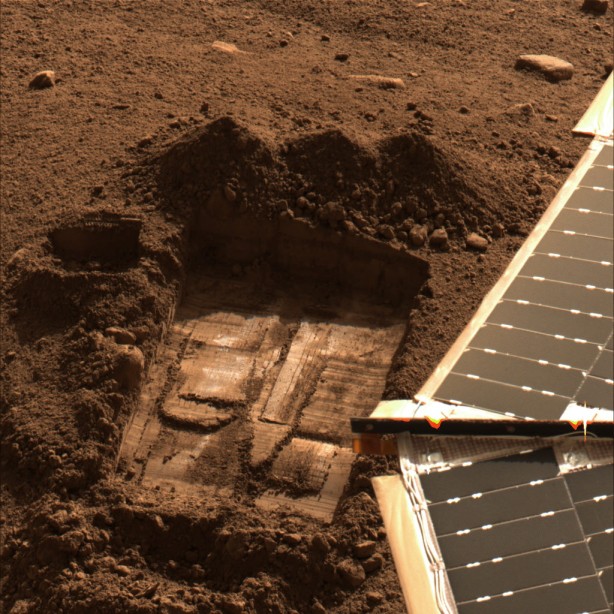
 The trench known as Snow White on Sol 43 (NASA/JPL/UA) It's been a busy few days for the Phoenix Mars lander rumour-mill. On Friday, an article was published in Aviation Week reporting an undisclosed source from the NASA team analysing results from the Microscopy, Electrochemistry, and Conductivity Analyzer (MECA) had come forward saying Phoenix scientists were in communication with the White House. Apparently there had been new, "provocative" results to come from the MECA, possibly a bigger discovery than last Thursday's announcement about the scientific proof of water in the Martian regolith. Naturally, the blogosphere went crazy in response to this news. Yesterday, the Phoenix team issued a press release focussing on conflicting results from the MECA and Thermal and Evolved-Gas Analyzer (TEGA) instruments. A MECA sample was found to contain a toxic substance known as perchlorate, usually an oxidizing by-product from industrial processes here on Earth. However, a recently analysed sample from the TEGA turned up no supporting evidence for perchlorate. The study is ongoing. Today, the Phoenix team organized a press conference to discuss a more positive view on the possible discovery of perchlorate, and fired back at recent allegations that science was being withheld from the public… (...)
Read the rest of Perchlorate on Mars Could be Potential Energy Source for Life; Phoenix Team Fires Back at Allegations (449 words)
© Ian O'Neill for Universe Today, 2008. | Permalink | 31 comments | Add to del.icio.us digg
Who's linking ? Technorati BlogPulse Google
Want more on these topics ? Browse the archive of posts filed under Extreme Life, Mars. 

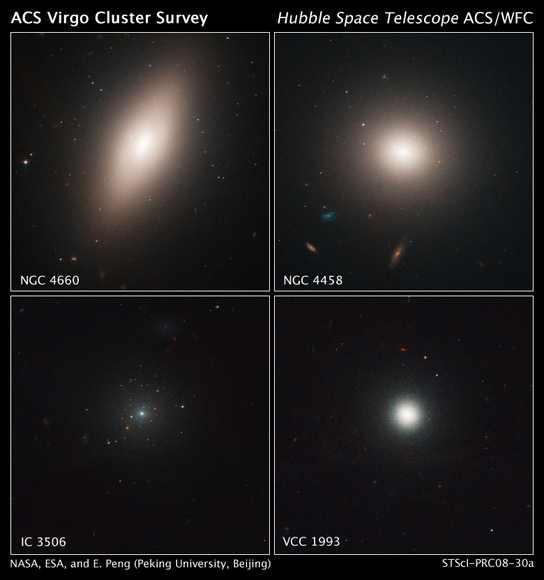
 Globular Clusters. Credit: NASA, ESA, and E. Peng Globular clusters are gravitationally bound, dense concentrations of stars. There can be hundreds of thousands of stars in a cluster, and they are so close together that it's hard to distinguish globular clusters outside of our galaxy from stars within our own galaxy just using ground-based telescopes: in other words, these big bunches of far away stars can look like a single, nearby star. But astronomers recently used the Hubble Space Telescope's sharp eyes to identify, incredibly, over 11,000 globular clusters in the Virgo cluster of galaxies. And in doing so, they also noticed something interesting about where the globulars are located. Globular clusters don't seem to form uniformly from galaxy to galaxy; instead they like to be where the action is near the center of galaxy clusters. The globulars are also more prevalent in dwarf galaxies near the center of the cluster of galaxies.
(...)
Read the rest of Globular Clusters Like to Be Near the Center of the Action (590 words)
© Nancy Atkinson for Universe Today, 2008. | Permalink | 7 comments | Add to del.icio.us digg
Who's linking ? Technorati BlogPulse Google
Want more on these topics ? Browse the archive of posts filed under Astronomy. 

More Recent Articles | 
































No comments:
Post a Comment
Keep a civil tongue.