| Here are the FeedBlitz blog updates for ignoble.experiment@arconati.us

One of the most important goals of the International Year of Astronomy is to “promote widespread access to the universal knowledge of fundamental science through the excitement of astronomy and sky-observing experiences.” What’s the objective? “Enable as many laypeople as possible, especially children, to look at the sky through a telescope and gain a basic understanding of the Universe.” And how is this going to be facilitated? By the “number of laypeople, especially young people and children, viewing the Universe through a telescope at street astronomy events, star parties, professional observatory webcasts etc.” and the “number of ‘cheap’ new telescope kits produced, assembled and distributed. Well, the Celestron FirstScope Telescope hits the mark perfectly as aimed at any one, able to view the Universe and inexpensive, but it’s anything but cheap… (...)
Read the rest of The Celestron “FirstScope” Telescope: Official Product of International Year of Astronomy (1,238 words)
© tammy for Universe Today, 2009. | Permalink | No comment | Add to del.icio.us
Post tags:
Feed enhanced by Better Feed from Ozh 

 Scott and Danru on Pumor RI with Everest Behind Them. Credit: OnOrbit.com Former astronaut Scott Parazynski is making an attempt to climb Mt. Everest, and has been sharing his adventures via Twitter, and his blog on OnOrbit.com. As we reported in in our article about Parazynski in March, he wants to share his experiences with as many people as possible. Earlier today, his “media sherpa,” Keith Cowing from NASA Watch.com joined Parazynski at base camp and both Cowing and Parazynski have agreed to take questions from readers of Universe Today and answer them during their time on Mt. Everest. Parazynski has been blogging and Twittering during his preparations for the climb, and he even wants to Twitter from the summit. "I want to tell the story of exploration here on Earth and the corollaries it has with space exploration," Parazynski told Universe Today before he left for Kathmandu, Nepal. "The intent is to share the story with as many people as we can, particularly young people." So submit your questions in the comments section and we’ll relay them on. Questions can be about mountain climbing or space exploration. (...)
Read the rest of Submit Your Questions for Scott Parazynski and Keith Cowing (60 words)
© nancy for Universe Today, 2009. | Permalink | No comment | Add to del.icio.us
Post tags:
Feed enhanced by Better Feed from Ozh 

 COROT-exo-7b, bottom left dot shadows in front of his central star (artist's impression). Because of its proximity to the star, researcher believe it will be pulled into the star and destroyed. Image: Klaudia Einhorn. A new era on astronomy began in 1995 when the first extrasolar planet was detected. To date, 346 planets have been found orbiting stars other than our sun. But new research indicates astronomers might have found even more extrasolar planets except for one thing: some planets have either been pulled into their parent star and devoured or gravitationally torn apart. .And astronomers say the most Earth-like planet detected so far, CoRoT-7 B will inevitably be destroyed by the star it orbits. (...) Read the rest of The Case of the Missing Planets: Are Stars Eating Their Young? (554 words)
© nancy for Universe Today, 2009. | Permalink | No comment | Add to del.icio.us
Post tags:
Feed enhanced by Better Feed from Ozh 

 Artists concept of a gamma ray burst. Credit: UC Berkeley According to the Sky and Telescope blog, NASA’s Swift satellite captured a faint gamma-ray burst (GRB) last Thursday which has smashed the record for the earliest, most distant known object in the universe. Various ground-based telescopes following up on Swift’s initial detection of the GRB have measured redshifts of the object, varying from 7.6 to 8.2. Whatever the final determination is of how much this GRB’s afterglow has been redshifted by the expansion of the Universe, it will set a record. In September 2008, Swift captured GRB 080913, the most distant gamma-ray burst ever detected, with a redshift of 6.7. Astronomers using the Very Large Telescope in Chile have determined that this current GRB (090423) went off about 600 million years after the Big Bang. (...) Read the rest of Most Distant Object Ever Seen (131 words)
© nancy for Universe Today, 2009. | Permalink | 7 comments | Add to del.icio.us
Post tags:
Feed enhanced by Better Feed from Ozh 

 In 1979, the huge Chicxulub crater, measuring about 180 km (112 miles) in diameter, was discovered on the northern Yucatan Peninsula, Mexico. Scientists made the obvious conclusion that something rather large had hit the Earth in this location, probably causing all kinds of global devastation 65 million years ago. At around the same time, 65% of all life on the face of the planet was snuffed out of existence. The dinosaurs that roamed the planet up to that point were no more. In 1979, the huge Chicxulub crater, measuring about 180 km (112 miles) in diameter, was discovered on the northern Yucatan Peninsula, Mexico. Scientists made the obvious conclusion that something rather large had hit the Earth in this location, probably causing all kinds of global devastation 65 million years ago. At around the same time, 65% of all life on the face of the planet was snuffed out of existence. The dinosaurs that roamed the planet up to that point were no more.
The timing of asteroid impact and the time of the mass extinction was too much of a coincidence to be ignored. When particles from the asteroid impact were discovered just below the Cretaceous-Tertiary (K-T) boundary, there was a strong causal link: the effects of the asteroid impact had driven the dinosaurs to extinction. However, a problem with this theory has come to light. It turns out the Chicxulub impact may pre-date the K-T boundary by 300,000 years…
(...)
Read the rest of Were the Dinosaurs Really Wiped Out by an Asteroid? Possibly Not (Update) (481 words)
© ian for Universe Today, 2009. | Permalink | 5 comments | Add to del.icio.us
Post tags:
Feed enhanced by Better Feed from Ozh 


A world record model rocket launch attempt on Saturday lifted off — and landed — successfully. Steve Eves worked for two years building the rocket, a 36-foot (10.9-meter) tall, 1:10 scale Saturn V model rocket. Eves now holds the world record for the largest amateur rocket to ever be launched. The picture-perfect launch took place on a farmer's field near Price, Maryland, about 50 miles (80 km) east of Baltimore, delighting those in attendance. The main body of the rocket even landed upright. See the video below.
(...)
Read the rest of Model Saturn V Rocket Launch a Success (33 words)
© nancy for Universe Today, 2009. | Permalink | 10 comments | Add to del.icio.us
Post tags:
Feed enhanced by Better Feed from Ozh 

 A billion years after the big bang, hydrogen atoms were mysteriously torn apart into a soup of ions. 380,000 years after the Big Bang, the Universe cooled from being a hot soup of plasma, to a temperature where protons and electrons could combine to form atoms. This calm period of neutral hydrogen in universal history didn’t last for long however. The neutral hydrogen atoms were ripped apart once more, by a mechanism that would go on to reionize the entire Universe, a process that eventually ended a billion years after the Big Bang. It is thought the first stars that formed prior to the reionisation epoch probably pumped out some fierce ultraviolet radiation, ionizing the neutral hydrogen, but a new (controversial) theory has been put forward. Did dark matter have a role to play in the reionisation the Universe?
(...)
Read the rest of Did Dark Matter Annihilate Our Early Universe? (404 words)
© ian for Universe Today, 2009. | Permalink | 18 comments | Add to del.icio.us
Post tags:
Feed enhanced by Better Feed from Ozh 

 Ariadnes Colles that lies at about 34° south and 172° east. The ground resolution is about 13 m/pixel. Credits: ESA/ DLR/ FU Berlin (G. Neukum) Click for larger version Wow – what a shot by Mars Express! Mars has several regions of what is called ‘chaotic terrain’. These are areas with large accumulations of rocks of varying sizes, as well as flat-topped features. These erratically shaped rocks are large, too: between 1-10 km in size. Some chaotic terrain on Mars is thought to form when there is a sudden removal of subsurface water or ice, causing the surface material to slump and break into blocks. The region shown here, however — Ariadnes Colles — is not a water-source region, so scientists are still debating whether Ariadnes Colles was formed by the action of water or wind. Either way, this is a very interesting region. See below for a straight on view that’s just as incredible. (...) Read the rest of Mars Express Spies Rocky, Chaotic Terrain on Mars (170 words)
© nancy for Universe Today, 2009. | Permalink | 16 comments | Add to del.icio.us
Post tags:
Feed enhanced by Better Feed from Ozh 

 Image taken by Spirit of a possible location for further scientific study (NASA) It’s been a worrying month for the health of Mars Expedition Rover Spirit. Two weeks ago, the embattled robot failed to wake up after three successive communication sessions, and then over the Easter weekend (April 12th and 13th), mission HQ noticed the rover had rebooted its systems at least twice during use of the high-gain antenna. The same thing happened on April 18th. In addition to this, Spirit has been suffering bouts of what seems to be an ‘electronic amnesia’, where the onboard computers have failed to record data onto their flash memory. Today however, it would appear Spirit is still operational after over two weeks of remaining planted in the same position. It managed to enact commands sent from NASA to start driving once more, trundling 1.7 metres over the Martian regolith. She hasn’t given up the good fight quite yet…
(...)
Read the rest of Mars Rover Spirit is Rolling Again After Memory Problems (469 words)
© ian for Universe Today, 2009. | Permalink | 5 comments | Add to del.icio.us
Post tags:
Feed enhanced by Better Feed from Ozh 


A collection of very odd white dwarfs have been discovered in a local globular cluster. Twenty-four white dwarfs (18 of them are new discoveries) have been spotted. Although these degenerate stars aren’t exactly an uncommon (they are the small sparkling remnants left over after star death), this particular set are unique; they are made from helium, rather than the “standard” carbon and oxygen. And they are small, even smaller than the smallest dwarfs. How did this dense cluster of old stars evolve? It turns out their stellar material is being stolen, stifling their development…
(...)
Read the rest of Hubble Discovers a Strange Collection of White Dwarf… Dwarfs (507 words)
© ian for Universe Today, 2009. | Permalink | 12 comments | Add to del.icio.us
Post tags:
Feed enhanced by Better Feed from Ozh 


If Earthlings discovered a large asteroid heading towards our planet, how would we react? But more importantly would the space agencies and/or world governments be prepared for such an event? “Mankind is now technically able to predict, sometimes several decades in advance, the trajectory of Near Earth Objects (NEOs),” said Frans von der Dunk, professor of space law at the University of Nebraska-Lincoln. “Additionally, existing space technology could deflect the vast majority of threatening asteroids.” But even if a threatening object is discovered, von der Dunk said no mechanism exists for effective international decision-making on how to deal with a threat. To examine these issues, UNL hosted a conference on April 23 & 24, “Near-Earth Objects: Risks, Responses and Opportunities," to look at the legal and institutional challenges of creating an international protocol of dealing with NEOs.
(...)
Read the rest of How Will We Prepare for an Asteroid Impact? (941 words)
© nancy for Universe Today, 2009. | Permalink | 7 comments | Add to del.icio.us
Post tags:
Feed enhanced by Better Feed from Ozh 

I’m sure you all knew this was coming. I enabled comments on Universe Today about 6 months ago, and it was great to have everyone’s feedback. But now people are abusing the system, being rude to each other and advertising their personal theories, so it’s time to crack down. I’m going to implement some new policies that should keep things cleaner. This is a shortened version, inspired by the powerful (but fair) rules over at the Bad Astronomy/Universe Today forum. The writers and I will be deleting any posts that break the following rules: - Be nice - Don’t abuse other readers, the writers, or the Universe in general. Don’t swear, make racist or sexist comments, etc. I think you know when you’re being rude. Stop it.
- Be brief - Don’t write a long rambling comment that’s longer than the original article.
- Don’t advertise - Don’t use the site to promote your product, service, or your own website. If you’d like to promote your stuff, buy advertising.
- Don’t promote your personal, alternative physics theories - This is the same as advertising. You’ve got an idea and you want the world to know about it, then start up your own website, and blog away, but don’t do it here.
I’m also going to make commenters register with the website shortly, so you have to create an account to be able to comment.
© Fraser for Universe Today, 2009. | Permalink | 56 comments | Add to del.icio.us
Post tags:
Feed enhanced by Better Feed from Ozh 

 STS-125 poster. Click for Hi-Res version. Personally, I think this move is just in response to the Onion’s most recent dig at NASA ( “NASA Embarks on Epic Delay”) but mission managers for the upcoming Hubble repair mission are considering moving the launch of space shuttle Atlantis up one day to May 11. This would allow an extra day for launch attempts. May 12 had been the target day, but deputy program manager LeRoy Cain told reporters at a press conference on Thursday that the shuttle will likely be ready a day earlier, which would give Atlantis and extra day for a launch attempt before having to stand down for a week to allow the military to proceed with a previously scheduled launch at the Eastern Test Range. A decision about whether Atlantis will be ready to fly on the 11th will come next week Thursday (April 30) following a mission management review. But an accident at the launch pad that dinged one of Atlantis’ payload bay doors might hinder moving the launch up a day, and engineers are assessing if a repair is necessary. (...) Read the rest of NASA Will Try to Launch Hubble Repair Mission Early (344 words)
© nancy for Universe Today, 2009. | Permalink | 10 comments | Add to del.icio.us
Post tags:
Feed enhanced by Better Feed from Ozh 

 Greetings, fellow SkyWatchers! Are you ready for one grrrrrrreat weekend? Then let’s do a little lion taming while the Moon is out of the picture and hunt down the “Leo Trio”. For you pirates in the crowd, hoist the Jolly Roger, because it’s time we took a look at the “Skull and Crossbones”, too! Prefer to relax? No problem. The Mu Virginid meteor shower will be in town on Saturday night for your kicked back pleasure and Sunday is time for a Herschel challenge. Time to dust off the binoculars and telescopes and I’ll see you in the back yard… (...) Greetings, fellow SkyWatchers! Are you ready for one grrrrrrreat weekend? Then let’s do a little lion taming while the Moon is out of the picture and hunt down the “Leo Trio”. For you pirates in the crowd, hoist the Jolly Roger, because it’s time we took a look at the “Skull and Crossbones”, too! Prefer to relax? No problem. The Mu Virginid meteor shower will be in town on Saturday night for your kicked back pleasure and Sunday is time for a Herschel challenge. Time to dust off the binoculars and telescopes and I’ll see you in the back yard… (...)
Read the rest of Weekend SkyWatcher’s Forecast - April 24 - 26, 2009 (958 words)
© tammy for Universe Today, 2009. | Permalink | 2 comments | Add to del.icio.us
Post tags:
Feed enhanced by Better Feed from Ozh 

…and yes, the picture is in focus.  Blurry Pavonis Mons (HiRISE/NASA) This strange image was captured by the High Resolution Imaging Science Experiment (HiRISE) camera on board NASA’s Mars Reconnaissance Orbiter (MRO) on April 11th. At first it looked like a classic example of my early camera days without a tripod; most of the photos I took were blurry or out of focus (due to my less-than-perfect eyesight). So when I first saw this picture of the summit of one of the huge Martian ex-shield volcanoes, Pavonis Mons, I assumed it was a mistake; HiRISE either had the shakes or it had developed myopia. Actually, this image is in focus, HiRISE is working perfectly. It’s the Martian surface that’s blurry…
(...)
Read the rest of The Blurry Summit of Mars’ Pavonis Mons (270 words)
© ian for Universe Today, 2009. | Permalink | 4 comments | Add to del.icio.us
Post tags:
Feed enhanced by Better Feed from Ozh 


Illustration credit: Robert McCall Peter Smith feels pretty certain we’ll be finding life on Mars within the next decade. Smith, the University of Arizona professor who led NASA’s Phoenix Mars Mission, made his predictions to a spellbound audience during a lecture at the University of Delaware earlier this month, and he discussed his ideas by phone on Thursday. He carries a “sense of optimism” about finding life on Mars, he said, because of the tantalizing clues Phoenix sent to Earth. “Finding life on Mars would be one of the great discoveries of all time,” he said. “We’re not that far away. The next mission could be the one.” (...)
Read the rest of Life Beyond Earth in 10 Years or Less? (593 words)
© anne for Universe Today, 2009. | Permalink | 17 comments | Add to del.icio.us
Post tags:
Feed enhanced by Better Feed from Ozh 


If you are interested in model rocketry, take a look at this. One man hopes to make a world record by launching a 36-foot (10.9-meter) tall Saturn V model rocket. Steve Eves has been working for two years on building the rocket, and he’s counting down to this Saturday, April 25 when the launch is planned. The launch pad is on a farmer's field near Price, Maryland, about 50 miles (80 km) east of Baltimore. The model is 1:10 scale of the original Saturn V rocket.
(...)
Read the rest of Record Launch Attempt for Model Saturn V Rocket (144 words)
© nancy for Universe Today, 2009. | Permalink | 11 comments | Add to del.icio.us
Post tags:
Feed enhanced by Better Feed from Ozh 


If you think tornadoes on Earth are scary, newly found “space tornadoes” sound downright horrifying. But they are likely the power source behind the beautiful Northern and Southern Lights. A new finding by a cluster of five space probes – the THEMIS, or Time History of Events and Macroscale Interactions during Substorms show that electrical funnels which span a volume as large as Earth produce electrical currents exceeding 100,000 amperes. THEMIS recorded the extent and power of these electrical funnels as the probes passed through them during their orbit of Earth. Ground measurements showed that the space tornadoes channel the electrical current into the ionosphere to spark bright and colorful auroras on Earth.
(...)
Read the rest of New Finding Shows Super-Huge Space Tornados Power the Auroras (257 words)
© nancy for Universe Today, 2009. | Permalink | 40 comments | Add to del.icio.us
Post tags:
Feed enhanced by Better Feed from Ozh 

 NICMOS Image of the GOODS North field. Credit: C Conselice, A Bluck, GOODS NICMOS Team. A new survey is revealing how the most massive galaxies formed in the early Universe, and the findings support the theory that Cold Dark Matter played a role. A team of scientists from six countries used the NICMOS near infrared camera on the Hubble Space Telescope to carry out the deepest ever survey of its type at near infrared wavelengths. Early results show that the most massive galaxies, which have masses roughly 10 times larger than the Milky Way, were involved in significant levels of galaxy mergers and interactions when the Universe was just 2-3 billion years old. (...) Read the rest of New Hubble Survey Supports Cold Dark Matter in Early Universe (347 words)
© nancy for Universe Today, 2009. | Permalink | 10 comments | Add to del.icio.us
Post tags:
Feed enhanced by Better Feed from Ozh 

 The image shows in red the X-ray emission produced by high-energy particles accelerated at the shock front where Centaurus A's expanding radio lobe (shown in blue) collides with the surrounding galaxy. (In the top-left corner X-ray emission from close to the central black hole, and from the X-ray jet extending in the opposite direction can also be seen.) Credit: NASA The Chandra X-ray observatory has taken a closer look at the galaxy Centaurus A, and new images have revealed in detail the effects of a shock wave blasting through the galaxy. Powerful jets of plasma emanating from a supermassive black hole at the galactic core are creating the shock wave, and the new observation, have enabled astronomers to revise dramatically their picture of how jets affect the galaxies in which they live. (...) Read the rest of New Image of Jet-Driven Galactic Shock Wave is a Shocker (494 words)
© nancy for Universe Today, 2009. | Permalink | 20 comments | Add to del.icio.us
Post tags:
Feed enhanced by Better Feed from Ozh 


To save on weight, NASA engineers are considering the option to remove two seats from the Orion crew exploration vehicle. According to the manager of the Constellation Program, a possible redesign option has been discussed with the International Space Station (ISS) partners despite the fact that the initial operational capability (IOC) to deliver crew to the ISS calls for a six-seat version. Although the space station crew will have expanded to six by the end of next month, NASA is confident the loss of two seats on Orion won’t cause any operational problems… at least we’ll still have Soyuz.
(...)
Read the rest of Could Orion be Downgraded from a Six to Four Astronaut Vehicle? (399 words)
© ian for Universe Today, 2009. | Permalink | 25 comments | Add to del.icio.us
Post tags:
Feed enhanced by Better Feed from Ozh 


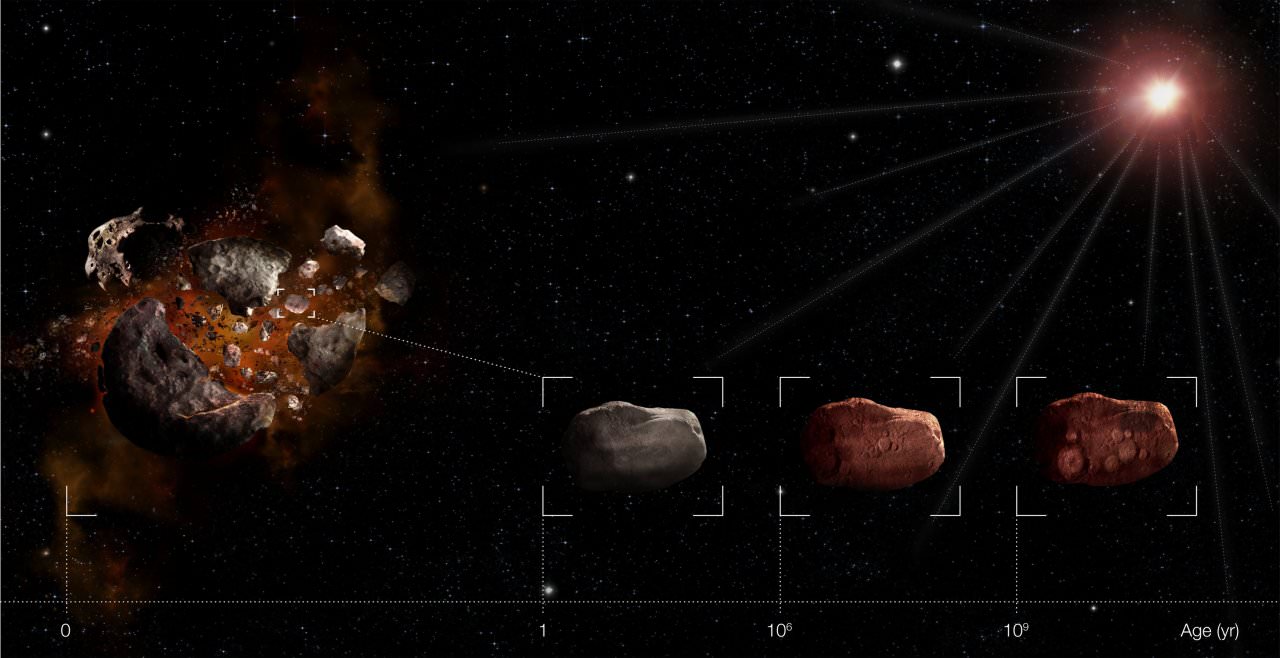
If you stay out in the Sun too long, you’ll eventually get a suntan (or sunburn); your skin will also get damaged and it will show signs of ageing faster. This might sound like a sunblock ad, but the same principal holds true for the small chunks of rock floating around in the Solar System. Yes, a young asteroid’s surface will age prematurely, but it’s not caused by the Sun’s ultraviolet rays, it’s caused by the solar wind…
(...)
Read the rest of Young Asteroids Age Fast with a Solar Wind Tan (360 words)
© ian for Universe Today, 2009. | Permalink | 10 comments | Add to del.icio.us
Post tags:
Feed enhanced by Better Feed from Ozh 


In 2007, something strange happened to a distant star near the centre of our galaxy; it underwent what is known as a ‘microlensing’ event. This transient brightening didn’t have anything to do with the star itself, it had something to do with what passed in front of it. 1,700 light years away between us and the distant star, a brown dwarf crossed our line of sight with the starlight. Although one would think that the star would have been blocked by the brown dwarf, its light was actually amplified, generating a flash. This flash was created via a space-time phenomenon known as gravitational lensing. Although lensing isn’t rare in itself (although this particular event is considered the “most extreme” ever observed), the fact that astronomers had the opportunity to witness a brown dwarf causing it means that either they were very lucky, or we have to think about re-writing the stellar physics textbooks…
(...)
Read the rest of Brown Dwarfs Could Be More Common Than We Thought (307 words)
© ian for Universe Today, 2009. | Permalink | 20 comments | Add to del.icio.us
Post tags:
Feed enhanced by Better Feed from Ozh 

 The HST WFPC2 image of gravitational lensing in the galaxy cluster Abell 2218, indicating the presence of large amount of dark matter (credit Andrew Fruchter at STScI). For all you dark matter and dark energy fans out there, now there’s another new “dark” to add to the list. It’s called “dark gulping,” and it involves a process which may explain how supermassive black holes were able to form in the early universe. Astronomers from the University College of London (UCL) propose that dark gulping occurred when there were gravitational interactions between the invisible halo of dark matter in a cluster of galaxies and the gas embedded in the dark matter halo. This occurred when the Universe was less than a billion years old. They found that the interactions cause the dark matter to form a compact central mass, which can be gravitationally unstable, and collapse. The fast dynamical collapse is the dark gulping. (...) Read the rest of Dark Matter, Dark Energy; Now There’s “Dark Gulping” (470 words)
© nancy for Universe Today, 2009. | Permalink | 41 comments | Add to del.icio.us
Post tags:
Feed enhanced by Better Feed from Ozh 

| 













No comments:
Post a Comment
Keep a civil tongue.