| Here are the FeedBlitz blog updates for ignoble.experiment@arconati.us
 Data from Kaguya's GRS. Credit: JAXA Using data obtained from the gamma ray spectrometer on the Kaguya spacecraft scientists have found signatures of uranium, an element not seen in previous moon-mapping efforts. In addition to uranium, the Kaguya GRS data also is showing clear signatures for thorium, potassium, oxygen, magnesium, silicon, calcium, titanium and iron. "We've already gotten uranium results, which have never been reported before," said Robert C. Reedy, senior scientists at the Planetary Science Institute. "We're getting more new elements and refining and confirming results found on the old maps."
(...)
Read the rest of First Conclusive Signature for Lunar Uranium (105 words)
© nancy for Universe Today, 2009. | Permalink | No comment | Add to del.icio.us
Post tags: Moon
Feed enhanced by Better Feed from Ozh 


 Retrogressive scarps with cuspate niches, long branching spurs and associated fluvial-like tributary channels. Credit:NASA/JPL/UofA Remember the polygon-shaped landforms at Mars north polar region that the Phoenix lander studied? The polygons are produced by seasonal expansion and contraction of ground ice, and these shapes have been found in other regions on Mars as well. New studies of images from the HiRISE camera on the Mars Reconnaissance Orbiter indicates that the Martian surface near the equator experienced freeze-thaw cycles as recently as 2 million years ago. This means Mars had significantly warmer weather in its recent past, and has not been locked in permafrost conditions for billions of years as had been previously thought. (...) Read the rest of Landforms Indicate "Recent" Warm Weather on Mars (294 words)
© nancy for Universe Today, 2009. | Permalink | One comment | Add to del.icio.us
Post tags: HiRISE, Mars
Feed enhanced by Better Feed from Ozh 


 Spirit's night observations from sol 1943. The bright streak is the star Canopus. Credit: NASA/JPL When your rover has abundant energy but can't go anywhere, what's a scientist to do? How about making observations of the evening and night skies on Mars? With the benefit of a boost in electrical power from a wind gust cleaning off her solar panels, the Spirit rover has more energy available than she's had for a couple of years. But unfortunately, Spirit is stuck in a patch of loose soil in the Home Plate region on Mars. While the engineers at JPL work hard at figuring out how to "Free Spirit" ( see the new website dedicated to their efforts) scientists are making observations of her surroundings to aid in the effort to get her out. But there's also enough power to do additional observations, and astronomy was a logical choice. "Certainly, a month or more ago, no one was considering astronomy with the rovers," said Mark Lemmon, planetary scientist at Texas A&M University and member of the rover team. "We thought that was done. With the dust cleanings, though, everyone thinks it is better to use the new found energy on night time science than to just burn it with heaters." Besides, Lemmon added, using all the energy in the daytime might lead to overheating. (...) Read the rest of Spirit Rover Begins Making Night Sky Observations (655 words)
© nancy for Universe Today, 2009. | Permalink | 2 comments | Add to del.icio.us
Post tags: Mars Rovers, Spirit Rover
Feed enhanced by Better Feed from Ozh 


 The HB-SIA. Credit: Solar Impulse A man who circled the globe in a balloon in 1999 has a new global adventure planned. Bertrand Piccard has unveiled a prototype of a solar-powered plane he hopes to fly around the world. Until now, only unmanned solar airplanes have been flown, but Piccard's HB-SIA would be manned. The glider-like plane has solar panels covering the wings, and the wingspan of the prototype reaches 61m, while the entire vehicle weighs only 1,500 kg. The first tests of the plane will be done to prove it can fly at night. Piccard says he wants to demonstrate the potential of renewable energies. (...) Read the rest of Manned Solar Plane Will Attempt Flight Around the World (216 words)
© nancy for Universe Today, 2009. | Permalink | 3 comments | Add to del.icio.us
Post tags: flight, solar power
Feed enhanced by Better Feed from Ozh 


 Sputnik Mania Fear remained in the air even after the great global conflict of World War II ended. This arose because, rather than ushering in peace, the cessation of hostilities brought a new fear, the cold war. The History Channel's 2 DVD set entitled, " Sputnik Mania" shows just how fear permeated throughout the society of the United States and its impact upon the new technological field of rocketry. Whether being rational or even real, fear is shown to be significant catalyst to our journey to the stars. (...) Read the rest of DVD Review: Sputnik Mania (491 words)
© mark for Universe Today, 2009. | Permalink | One comment | Add to del.icio.us
Post tags:
Feed enhanced by Better Feed from Ozh 


Most of us know the name of Charles Messier, the French astronomer and comet hunter who published perhaps one of the most celebrated catalogs of astronomical objects of all times, but how much do you really know about the man? Today is the anniversary of Messier's birth, so why not step inside a take a look a what make this curious astronomical character one of the most celebrated observers of all time. (...)
Read the rest of Happy Birthday, Charles Messier! (1,788 words)
© tammy for Universe Today, 2009. | Permalink | 3 comments | Add to del.icio.us
Post tags:
Feed enhanced by Better Feed from Ozh 


Earth's climate has changed over time, but the cause for the changes has been hotly debated. One idea (Shaviv and Veizer,2003), suggested that perhaps two-thirds to three-fourths of the variance in Earth's temperature over the past 500 million years may be attributable to when our solar system passes through the spiral arms of the Milky Way galaxy. The evidence seemed to fit: there appears to be a 140 million year cycle of global climate change, and that correlates when our solar system seems to move between spiral arms, too. Or at least it used to. Since 2003 we have revised our map of the galaxy, which changes the estimation of when Earth transits through the spiral arms. "Although previous work found a correlation between the 140 Myr climate cycle on Earth and the intersection with spiral arms," write researchers Adrian Melott, Andrew Overholt, and Martin Pohl, "with new data on the structure of the galaxy, this correlation disappears."
(...)
Read the rest of Past Climate Change Cannot Be Tied to Earth Passing Through Galactic Plane (436 words)
© nancy for Universe Today, 2009. | Permalink | 3 comments | Add to del.icio.us
Post tags: Climate Change, Mikly Way Galaxy
Feed enhanced by Better Feed from Ozh 


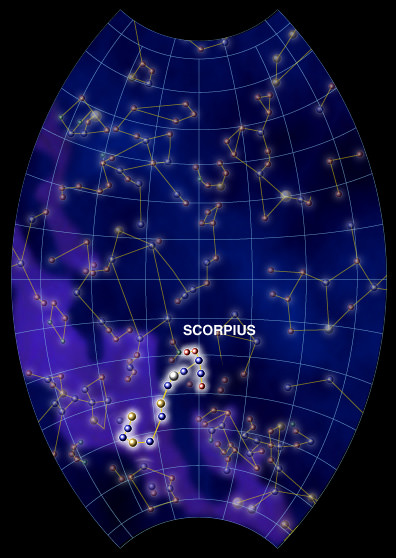
Howdy, kids! Over the last couple of months we've visited with a multitude of wonderful sky characters. We've located the Triangle, met the Dragon, visited in the Royal House, met a King and Queen and their children, a celestial Farmer and his grandchildren, and we've even been to starry river of the Milky Way to see one of summer's favorite passtimes… Grandpa angling along the night sky. If you don't believe he's there, then sit back and listen to the voices on the wind as Sky Wizard Kim tells you where to look to find the "lures" of summer… (...)
Read the rest of Kid's Astronomy: A Summer's Lure – Scorpio (402 words)
© tammy for Universe Today, 2009. | Permalink | No comment | Add to del.icio.us
Post tags:
Feed enhanced by Better Feed from Ozh 


 International Space Station. Credit: NASA Want to know when to stop tweeting and look heavenward for a view of the International Space Station? Follow one more account, then. Several websites carry information about the space station's path through the sky, but until now there's been no service to alert people when the station is near them. Dutch journalists Govert Schilling and Jaap Meijers have built a Twitter page to let people know when to look up. (...)
Read the rest of New Twitter Page To Alert Followers: Look Up Now to See the ISS! (155 words)
© anne for Universe Today, 2009. | Permalink | One comment | Add to del.icio.us
Post tags:
Feed enhanced by Better Feed from Ozh 


The Spirit rover on has been stuck in Martian soil, going nowhere, but that doesn't mean she hasn't been busy or hasn't been making new discoveries. Just the opposite. Scientists have taken advantage of what could be a bad situation to learn more about the Red Planet's environmental history. "By serendipity, Troy (the region where Spirit is stuck) is one of the most interesting places Spirit has been," said Ray Arvidson, deputy principal investigator for the science payloads on the two Mars rovers. "We are able here to study each layer, each different color of the interesting soils exposed by the wheels."
While the rover team remains optimistic about getting Spirit unstuck, they have also acknowledged the possibility that the rover might not ever be able to leave Troy. But engineers at JPL are pulling out all the stops, and will be conducting test at the Mars Yard with the engineering rover. (More on that below.)
(...)
Read the rest of Spirit Rover Going Nowhere, But Still Making Discoveries (510 words)
© nancy for Universe Today, 2009. | Permalink | 3 comments | Add to del.icio.us
Post tags: Mars Rovers
Feed enhanced by Better Feed from Ozh 


Have you ever been inspired by the two planets Mercury and Venus? If so, Peter Grego's book "Venus and Mercury and How to Observe Them" brings to us much of what we've learned about them and much of how each of us can learn some more.
Mercury and Venus are the two planets closer to the Sun than Earth. Because of this, they always appear in close proximity in the sky to the Sun. Bright Venus is easily seen when it's present. Mercury, being quite duller and at best much closer to the horizon is much harder to see. And seeing it as a dot isn't seeing anything spectacular. In fact, neither planet provides details, even to a viewer using a telescope. But, that doesn't mean your planetary inspiration should die.
(...)
Read the rest of Book Review: Venus and Mercury (366 words)
© mark for Universe Today, 2009. | Permalink | One comment | Add to del.icio.us
Post tags:
Feed enhanced by Better Feed from Ozh 


 Sarychev Volcano as seen from the ISS. Credit: NASA These images of Sarychev Volcano were popping up everywhere in the internet yesterday, but unfortunately I was out of intertube contact most of the day. But these images are too awesome not to share! Astronauts on board the International Space Station took these striking views of Sarychev Volcano (Kuril Islands, northeast of Japan) on June 12, 2009. Notice the shock wave around the edge of the volcano's plume and the "hole" the clouds that the eruption caused. Sarychev Peak is one of the most active volcanoes in the Kuril Island chain, and it is located on the northwestern end of Matua Island. Here are few more images taken in sequence as the ISS flew 354 km (220 miles) overhead: (...) Read the rest of Volcanic Shockwave Captured by ISS Imagery (207 words)
© nancy for Universe Today, 2009. | Permalink | 12 comments | Add to del.icio.us
Post tags:
Feed enhanced by Better Feed from Ozh 


Here's this week's image for the WITU Challenge, to test your visual knowledge of the cosmos. You know the drill: take a look at this image and see if you can determine where in the universe this image is from; give yourself extra points if you can name the spacecraft responsible for the image. We'll provide the image today, but won't reveal the answer until tomorrow. This gives you a chance to mull over the image and provide your answer/guess in the comment section. Please, no links or extensive explanations of what you think this is — give everyone the chance to guess.
If you missed the answer to last week's WITU Challenge, find it here.
Look back at all previous 58 Where In the Universe Challenges. UPDATE: The answer has now been posted below.
(...)
Read the rest of Where In The Universe #59 (117 words)
© nancy for Universe Today, 2009. | Permalink | 16 comments | Add to del.icio.us
Post tags:
Feed enhanced by Better Feed from Ozh 


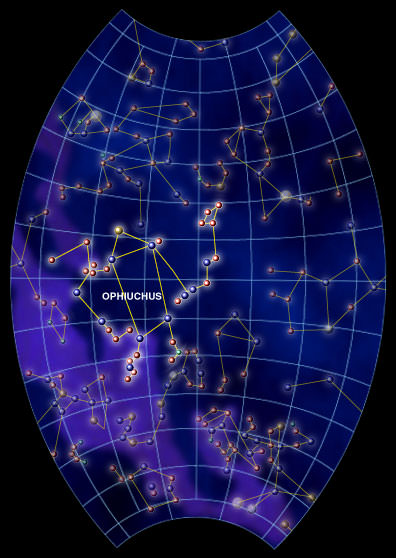
Hey, Kids! Did you see the crescent of the Moon last night? With the heat and humidity much higher in the northern hemisphere, it looked wonderfully like a cool slice of orange cantaloupe hung in the sky! If you're looking for something cool to do, then why not get out your binoculars and try a little star gazing? We've visited with a lot of different sky characters and it's time to learn more. Whenever you're ready, it's time to head out into the dark shadows and listen to the voices on the wind for Sky Wizard Kim… (...)
Read the rest of Kid's Astronomy – Ophiuchus: The "Fisher King" (407 words)
© tammy for Universe Today, 2009. | Permalink | No comment | Add to del.icio.us
Post tags:
Feed enhanced by Better Feed from Ozh 


 Fallen trees from the Tunguska Event in 1908. The 1908 Tunguska event has always been mysterious and intriguing because no one has been able to fully explain the explosion that leveled 830 square miles of Siberian forest. But the latest research has concluded that the Tunguska explosion was almost certainly caused by a comet entering the Earth's atmosphere. And how researcher Michael Kelly from Cornell University came to that conclusion is quite interesting: He analyzed the space shuttle's exhaust plume and noctilucent clouds. (...) Read the rest of 1908 Tunguska Event Caused by Comet, New Research Reveals (529 words)
© nancy for Universe Today, 2009. | Permalink | 16 comments | Add to del.icio.us
Post tags:
Feed enhanced by Better Feed from Ozh 


Two papers in the journal Nature this week come down on opposite sides of the question about whether Saturn's moon Enceladus contains a salty, liquid ocean. One research team, from Europe, says an enormous plume of water spurting in giant jets from the moon's south pole is fed by a salty ocean. The other group, led out of the University of Colorado at Boulder, contends that the supposed geysers don't have enough sodium to come from an ocean. The truth could have implications for the search for extraterrestrial life, as well as our understanding of how planetary moons are formed. (...)
Read the rest of Does Enceladus Harbor a Liquid Ocean? Reasonable Minds Disagree (500 words)
© anne for Universe Today, 2009. | Permalink | No comment | Add to del.icio.us
Post tags:
Feed enhanced by Better Feed from Ozh 


| 









No comments:
Post a Comment
Keep a civil tongue.