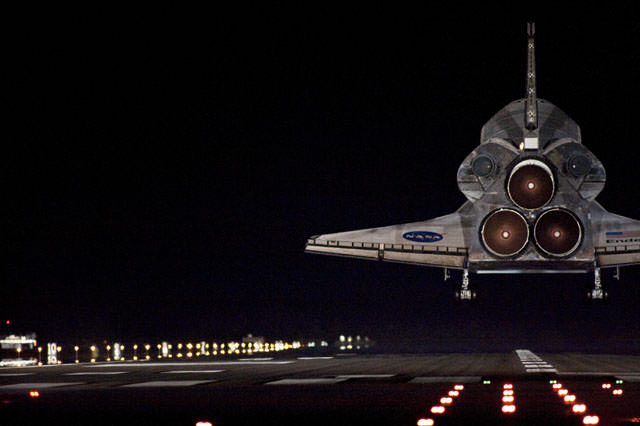
Space shuttle Endeavour lands in darkness on Runway 15 at the Shuttle Landing Facility at NASA's Kennedy Space Center in Florida. Photo credit: NASA/Sandra Joseph and Kevin O'Connell
Congressional legislators in Florida are mounting a campaign to extend space shuttle operations to 2015, adding two flights each year. U.S. Rep. Suzanne Kosmas said a bipartisan plan is in the works, which would require adding another $200 million to the NASA budget for 2010 and between $1.5 – $2 billion a year starting in the 2011-12 budget year. "We're not going to do anything that's not safe," Kosmas was quoted in Florida Today, adding that securing the funding would be difficult in tight budget times, but "we're going to go for it," she said.
At Kennedy Space Center early Monday morning after Endeavour returned home safely following the STS-130 mission, space shuttle program managers confirmed that while the shuttles are in good shape to continue flying, extending the program is not the direction their teams have been headed. (...) Read the rest of Could the Space Shuttle Program Be Extended to 2015? (795 words)
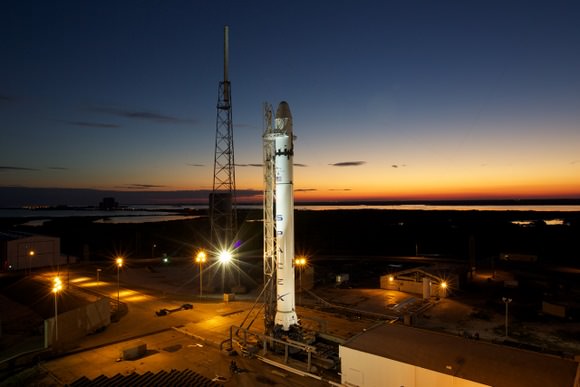
Falcon 9 now vertical on the launchpad at Cape Canaveral. Credit: Chris Thompson/SpaceX
Is the future here? Over the weekend, SpaceX rolled their Falcon 9 launch vehicle out to the launchpad at Space Launch Complex 40, Cape Canaveral. If all systems check out, SpaceX looks to do an engine test sometime this week, which should provide some dramatic rumbling and shaking here in Florida. The rocket measures 47 meters long (154 feet) and 4 meters (12 feet) wide, and for the upcoming test launch (date currently not set), the payload will be a dummy of the company's Dragon capsule being developed to carry equipment to the International Space Station for NASA. (...) Read the rest of Photo Gallery: Falcon 9 Now Vertical on the Launchpad (194 words)
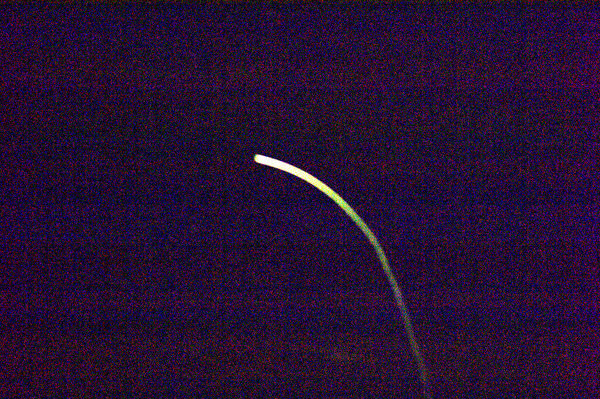
ISS astronaut Soichi Noguchi has been sharing lots of amazing pictures he's taken in space via Twitter, but this one is extra special. Noguchi was able to capture the plasma trail produced by space shuttle Endeavour as it streaked through Earth's atmosphere. "Space Shuttle Endeavour making S-turn during atmospheric re-entry," Noguchi wrote on his Twitpic page, where he post his space photos from Twitter, @Astro_Soichi. "The first time it was photographed from Space Station Cupola. Priceless." (...) Read the rest of ISS Astronaut Captures Shuttle Landing from Cupola (57 words)
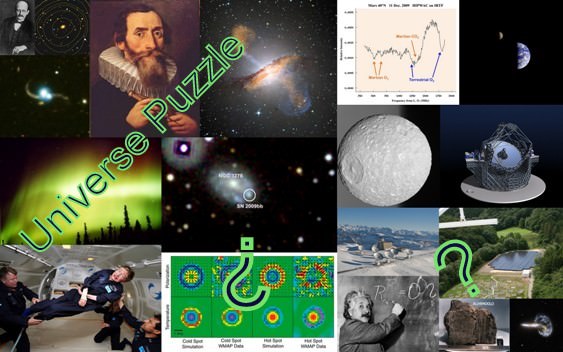
To start your working week, here's a little something to help you sharpen your brain (OK, it's already the end of the day for our viewers in New Zealand and Australia, so for you a little pick-me-up after a hard day's work).
As with last week's Universe Puzzle, something that cannot be answered by five minutes spent googling, a puzzle that requires you to cudgel your brains a bit, and do some lateral thinking. And a reminder: this is a puzzle on a "Universal" topic – astronomy and astronomers; space, satellites, missions, and astronauts; planets, moons, telescopes, and so on.
There are no prizes for the first correct answer – there may not even be just one correct answer! – posted as a comment (the judge's decision – mine! – will be final!), but I do hope that you'll have lots of fun.
What's the next number in the sequence? 1655, 1671, 1672
Post your guesses in the comments section, and check back on Wednesday at this same post to find the answer. To make this puzzle fun for everyone, please don't include links or extensive explanations with your answer, until after the answer has been given. Good luck!
PS There's an open question on last week's puzzle too (scroll down to the bottom of the comments).
Endeavour lands at Kennedy Space Center. Image Credit: Alan Walters
Space shuttle Endeavour loudly announced its arrival with twin sonic booms, then two minutes later emerged like a phantom out of the darkness to touch down beautifully on runway 15 at Kennedy Space Center. The landing at 10:20 p.m. EST Sunday ended the two-week STS-130 mission to the ISS. After early concerns about the weather, conditions were almost ideal for landing.
"STS-130 is mission complete, and we're safe on deck" said Commander George Zamka, speaking on the runway after the crew disembarked from Endeavour. "The Cupola is beautiful in both design and function, and Endeavour was perfect throughout the flight… Now it's time for us to hit the showers and get used to life on Earth again." (...) Read the rest of Endeavour Comes Home to Kennedy Space Center (388 words)
Celestial Conjunction at Paranal (Credit: ESO/Y. Beletsky)
Have you ever wondered if there's easy-to-read coverage of what the world's leading astronomical observatories are up to, material that's longer than the average Universe Today story, and less tied to Press Releases?
Well, assuming that you have the time for such pleasures (!), here are some that I've collected over the years, in the shape of regular PDF newsletters.
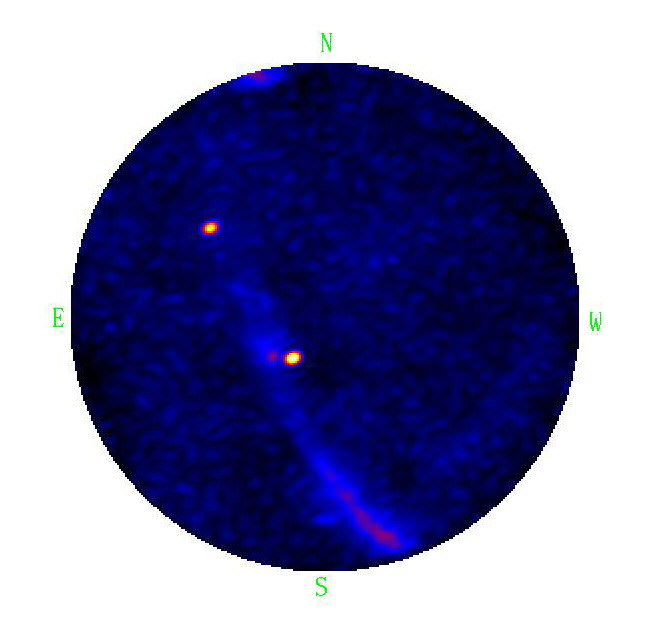
First LOFAR high-band image (Credit: James Anderson, MPIfR)
This image is a software-calibrated image with high signal-to-noise ratio at a frequency of 120 MHz, of the radio sky above Effelsberg, Germany, on November10, 2009. It has North at the top and East at the left, just as a person would have seen the entire sky when lying on their back on a flat field near Effelsberg late in the afternoon on November 10, if their eyes were sensitive to radio waves.
The two bright (yellow) spots are Cygnus A – a giant radio galaxy powered by a supermassive black hole – near the center of the image, and Cassiopeia A – a bright radio source created by a supernova explosion about 300 years ago – at the upper-left in the image. The plane of our Milky Waygalaxy can also be seen passing by both Cassiopeia A and Cygnus A, and extending down to the bottom of the image. The North Polar Spur, a large cloud of radio emission within our own galaxy, can also be seen extending from the direction of the Galactic center in the South, toward the western horizon in this image. "We made this image with a single 60 second "exposure" at 120 MHz using our high-band LOFAR field in Effelsberg", says James Anderson, project manager of the Effelsberg LOFAR station.
"The ability to make all-sky images in just seconds is a tremendous advancement compared to existing radio telescopes which often require weeks or months to scan the entire sky," Anderson went on. This opens up exciting possibilities to detect and study rapid transient phenomena in the universe. (...) Read the rest of All-Sky Radio Image in 60 Seconds, No Moving Parts (566 words)
ISS as seen by the departing Endeavour crew on STS-130. Credit: NASA
The main computer on the International Space Station failed early Sunday, and subsequent multiple computer anomalies prompted communication blackouts. The one main computer has two backup systems, and NASA reported that the three command & control computers are switching between prime, backup and standby. A software issue is suspected, and diagnosis continues. The computer system is critical to all aspects of space station operation. (...) Read the rest of Multiple Computer Failures on the ISS (295 words)
X-ray emission in the COSMOS field (XMM-Newton/ESA)
Galaxy density in the Cosmic Evolution Survey (COSMOS) field, with colors representing the redshift of the galaxies, ranging from redshift of 0.2 (blue) to 1 (red). Pink x-ray contours show the extended x-ray emission as observed by XMM-Newton.
Dark matter (actually cold, dark – non-baryonic – matter) can be detected only by its gravitational influence. In clusters and groups of galaxies, that influence shows up as weak gravitational lensing, which is difficult to nail down. One way to much more accurately estimate the degree of gravitational lensing – and so the distribution of dark matter – is to use the x-ray emission from the hot intra-cluster plasma to locate the center of mass.
And that's just what a team of astronomers have recently done … and they have, for the first time, given us a handle on how dark matter has evolved over the last many billion years. (...) Read the rest of Dark Matter in Distant Galaxy Groups Mapped for the First Time (1,027 words)
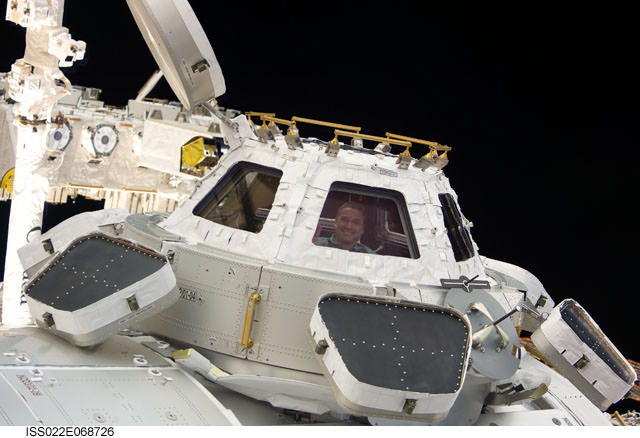
NASA astronaut George Zamka, STS-130 commander, is pictured in a window of the newly-installed Cupola of the International Space Station while space shuttle Endeavour remains docked with the station.
(Editor's Note: Ken Kremer is at the Kennedy Space Center for Universe Today covering the flight of Endeavour)
Key questions relevant to fundamental physics and cosmology, namely the nature of the mysterious dark energy and dark matter (Euclid); the frequency of exoplanets around other stars, including Earth-analogs (PLATO); take the closest look at our Sun yet possible, approaching to just 62 solar radii (Solar Orbiter) … but only two! What would be your picks?
These three mission concepts have been chosen by the European Space Agency's Science Programme Committee (SPC) as candidates for two medium-class missions to be launched no earlier than 2017. They now enter the definition phase, the next step required before the final decision is taken as to which missions are implemented. (...) Read the rest of ESA's Tough Choice: Dark Matter, Sun Close Flyby, Exoplanets (Pick Two) (499 words)
This week Miles O'Brien and team discuss the views from the new Cupola on the ISS, the new images from the WISE mission, and more. And is the new NASA budget and direction proposed by Obama the worst presidential decision since Nixon – or masterstroke? Watch & decide.
Understanding the present-day Martian climate gives us insights into its past climate, which in turn provides a science-based context for answering questions about the possibility of life on ancient Mars.
Our understanding of Mars' climate today is neatly packaged as climate models, which in turn provide powerful consistency checks – and sources of inspiration – for the climate models which describe anthropogenic global warming here on Earth.
But how can we work out what the climate on Mars is, today? A new, coordinated observation campaign to measure ozone in the Martian atmosphere gives us, the interested public, our own window into just how painstaking – yet exciting – the scientific grunt work can be. (...) Read the rest of Ozone on Mars: Two Windows Better Than One (865 words)
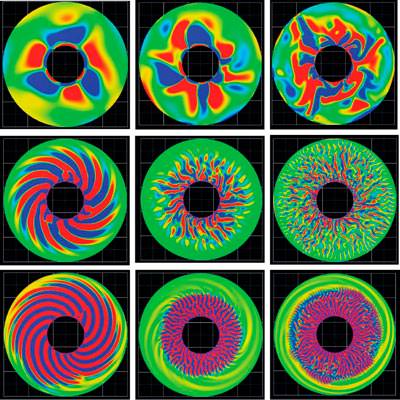
Zonal swishing in the Earth's outer core (Credit: Akira Kageyama, Kobe University)
Why does the Earth's magnetic field 'flip' every million years or so? Whatever the reason, or reasons, the way the liquid iron of the Earth's outer core flows – its currents, its structure, its long-term cycles – is important, either as cause, effect, or a bit of both.
The main component of the Earth's field – which defines the magnetic poles – is a dipole generated by the convection of molten nickel-iron in the outer core (the inner core is solid, so its role is secondary; remember that the Earth's core is well above the Curie temperature, so the iron is not ferromagnetic).
But what about the fine structure? Does the outer core have the equivalent of the Earth's atmosphere's jet streams, for example? Recent research by a team of geophysicists in Japan sheds some light on these questions, and so hints at what causes magnetic pole flips. (...) Read the rest of Does Zonal Swishing Play a Part in Earth's Magnetic Field Reversals? (386 words)
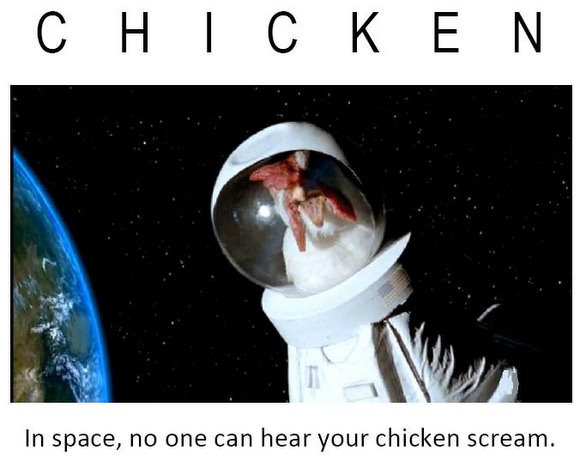
The space chicken seen in the STS-130 execute packages.
With the internet now part of daily life on the International Space Station, inquiring minds want to know! Can astronauts visit any websites they want, and what kinds of download speeds do they have in space? And what about that chicken, seen above, that has been gracing the STS-130 execute packages? And what's the view from the new cupola really like? Astronauts answered those questions and more, at the joint crew news conference last night, where I had the chance to talk the crew members of Endeavour and the ISS. (...) Read the rest of What's the Internet Really Like in Space? (846 words)
Weekend SkyWatcher's Forecast: February 19-21, 2010
Greetings, fellow SkyWatchers! It's a lunatic weekend as we head towards the Moon's surface to study its features. Need more of a challenge? Then we'll take a look at an area of sky where a Sakurai's Object may have appeared. Just into stargazing? Then watch the Pleiades and the Moon dance together as our weekend ends! Whenever you're ready, I'll see you in the backyard… (...) Read the rest of Weekend SkyWatcher's Forecast: February 19-21, 2010 (1,346 words)
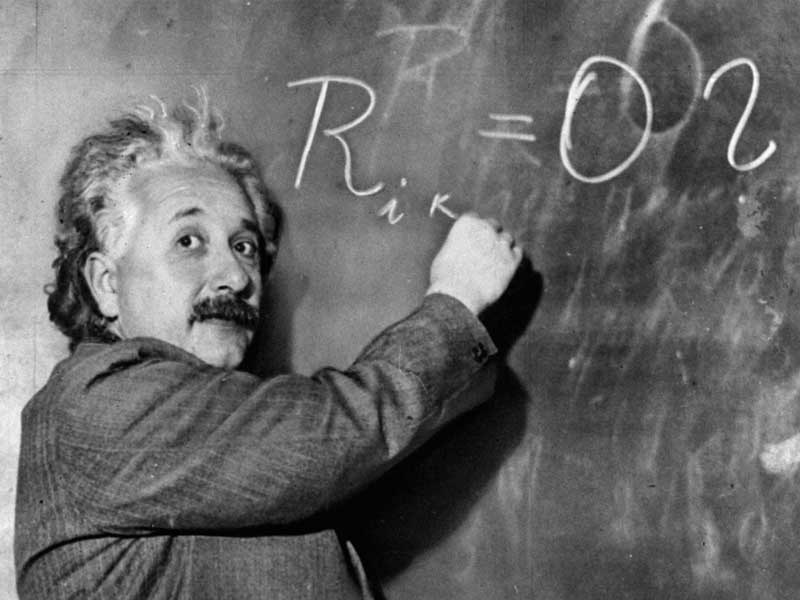
Einstein, whose theory of general relativity has just passed another test
This time it was the gravitational redshift part of General Relativity; and the stringency? An astonishing better-than-one-part-in-100-million!
How did Steven Chu (US Secretary of Energy, though this work was done while he was at the University of California Berkeley), Holger Müler (Berkeley), and Achim Peters (Humboldt University in Berlin) beat the previous best gravitational redshift test (in 1976, using two atomic clocks – one on the surface of the Earth and the other sent up to an altitude of 10,000 km in a rocket) by a staggering 10,000 times?
Space shuttle Endeavour will undock from the ISS on late Friday (7:54 p.m. EST) or early Saturday (00:54 GMT) depending where you live, providing an opportunity to see the two spaceships flying in tandem. This is an incredible sight, and as the shuttle program comes to a close, one that will happen only about four more times. Early morning sightings are favored for those in the northern hemisphere. The two spacecraft will be seen as separate but closely-spaced points of light. The ISS is bigger, so will appear as the brighter object trailing the smaller Endeavour as they move across the sky. Double flybys will continue until the shuttle lands, currently scheduled for late Sunday or early Monday, with the two getting farther apart each day. Of course, your viewing ability will depend on cloud cover. Above, you can watch the ceremony as the shuttle crew returned to Endeavour and closed the hatches from the ISS.
To find out if you'll be able to see spaceships in your area, there are a few different sites to check out: (...) Read the rest of Double Spaceship Sighting Alert! (93 words)
Here's this week's image for the Where In The Universe Challenge, to test your visual knowledge of the cosmos (late again — sorry!) You know what to do: take a look at this image and see if you can determine where in the universe this image is from; give yourself extra points if you can name the instrument responsible for the image. We'll provide the image today, but won't reveal the answer until tomorrow. This gives you a chance to mull over the image and provide your answer/guess in the comment section. Please, no links or extensive explanations of what you think this is — give everyone the chance to guess. (...) Read the rest of Where In The Universe #92 (0 words)
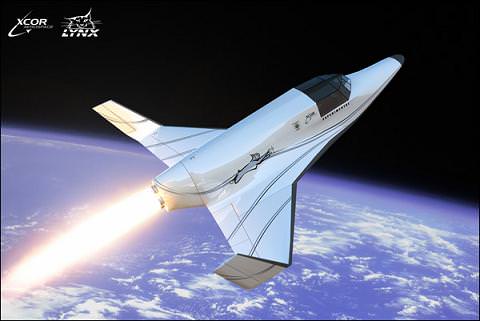
NASA Deputy Administrator Lori Garver announced today the space agency will fund dozens of science and education payloads to fly on commercial suborbital vehicles. If the 2011 budget proposed by President Obama passes, NASA will commit $75 million in funding over five years for the new Commercial Reusable Suborbital Research program (CRuSR). "For everyone who has dreamed of participating in the grand adventure of spaceflight, this $75 million commitment marks the dawn of a new space age," said Alan Stern chair of the Commercial Spaceflight Federation's Suborbital Applications Researchers Group (SARG) and former NASA associate administrator for science. "As the commercial space industry continues to grow, I expect that we will see increasing numbers of payloads and people flying to space." (...) Read the rest of NASA to Invest $75 Million for Suborbital Science Flights (185 words)
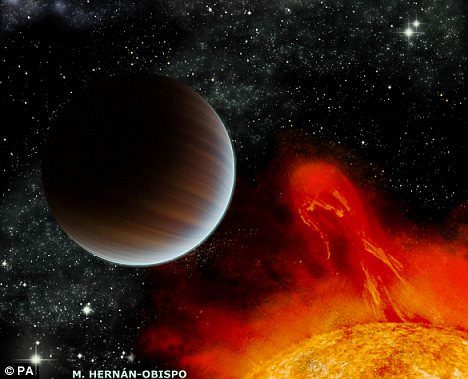
Artist's impression of BD+20 1790b, the youngest exoplanet yet discovered. Credit: M. Hernon Obispo
Overcoming interference from a very active young sun-like star, a group of astronomers were able to find what they determined is the youngest exoplanet yet discovered. BD+20 1790b is 35 million years old (Earth is about 100 times older at 4.5 billion years) and is located about 83 light years away from our planet. Previously, the youngest known exoplanet was about 100 million years old. Studying this planet will help our understanding of planetary evolution. (...) Read the rest of Astronomers Find Youngest Exoplanet Yet (234 words)
You should always put out the old dinner set when you have astronomers around. It all starts innocently enough with imagine this wineglass is the Earth rotating on its axis… But then someone decides that large plate is just right to show the orientation of an orbital plane and more wine glasses are brought to bear to test a solution to the three body problem and…(...) Read the rest of Astronomy Without A Telescope – Don't Make a Meal of It (501 words)
Astronauts on the International Space Station took questions Wednesday from President Barack Obama and a group of children. The astronauts eloquently explained the the science and benefits of the ISS, and discussed if artificial gravity could be developed, their thoughts and feelings about being in space, and what they could see from space. "This is really exciting," said Obama. "We're investing back here on the ground in a whole array of solar and other renewable energy projects. So to find out you're doing this up there at the space station is very exciting."
Obama added, "We wanted to let you know how proud we are of you and how committed we are to continuing human space exploration in the future."
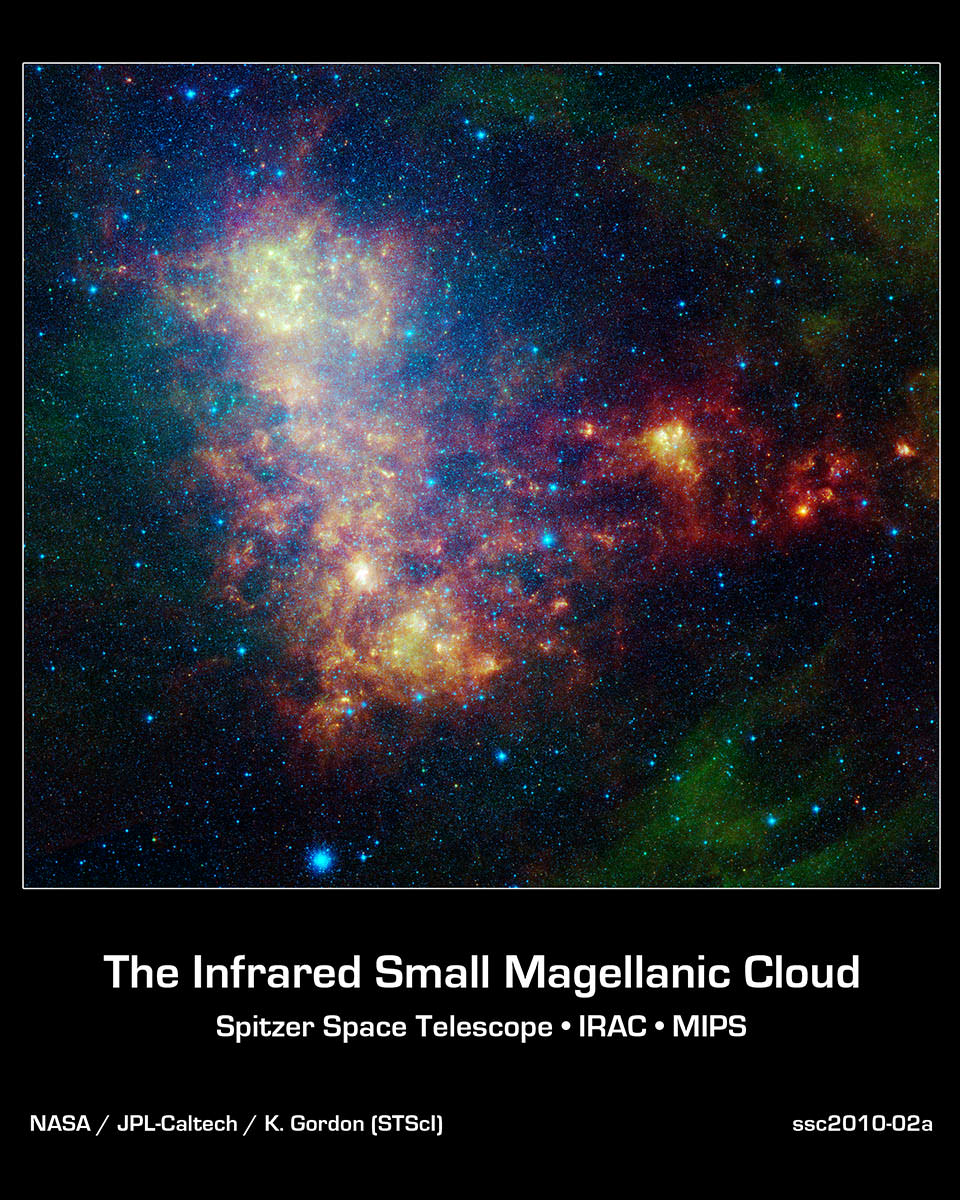
At the end of the proverbial day, space-based missions like Spitzer produce millions of observations of astronomical objects, phenomena, and events. And those terabytes of data are used to test hypotheses in astrophysics which lead to a deeper understanding of the universe and our home in it, and perhaps some breakthrough whose here-on-the-ground implementation leads to a major, historic improvement in human welfare and planetary ecosystem health.
But such missions also leave more immediate legacies, in terms of the pleasure they bring millions of people, via the beauty of their images (not to mention posters, computer wallpaper and screen savers, and even inspiration for avatars).
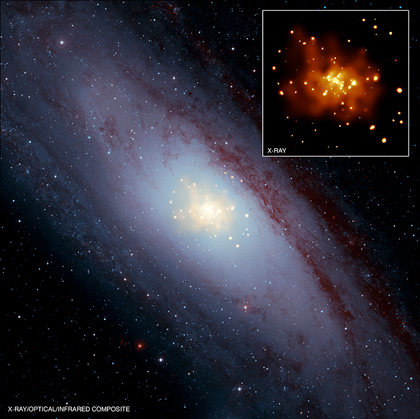
New results from the Chandra X-Ray Observatory suggests that the majority of Type Ia supernovae occur due to the merger of two white dwarfs. This new finding provides a major advance in understanding the type of supernovae that astronomers use to measure the expansion of the Universe, which in turns allows astronomers to study dark energy which is believed to pervade the universe. "It was a major embarrassment that we still didn't know the conditions and progenitor systems of some the most spectacular explosions in the universe," said Marat Gilfanov of the Max Planck Institute for Astrophysics, at a press conference with reporters today. Gilfanov is the lead author of the study that appears in the Feb. 18 edition of the journal Nature. (...) Read the rest of Merging White Dwarfs Set Off Supernovae (456 words)






























No comments:
Post a Comment
Keep a civil tongue.