| Here are the FeedBlitz blog updates for ignoble.experiment@arconati.us
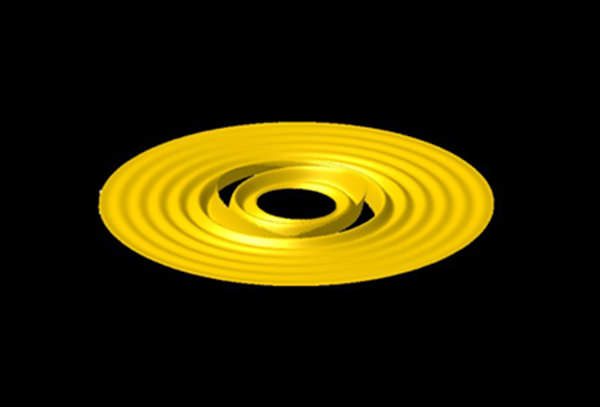
 This graphic shows an angled view of a newly discovered "crack" in one of Saturn's rings, known as the C ring. This view shows the 3-D quality of the puzzling crack associated with a wave-like feature that was discovered earlier by NASA's Voyager 1 spacecraft. Image credit: NASA/JPL/Cornell Saturn's rings have several gaps, most of which are caused by small moons shepherding ring debris into breaks in the rocky rings. But one gap may be caused by gravitational perturbations from Saturn's largest moon, Titan, sending tsunami-like waves up to 3 kilometers (2 miles) high in the C ring, causing it to spin like an uneven vinyl record on a turntable. A new model of this action explains why the gap was narrower than expected and also why is seems to disappear from time to time. "What looked like a 15-kilometer-wide gap actually was this gap with a vertical displacement of about 3 kilometers projected and seen almost edge on," said Phillip Nicholson from Cornell University, speaking at a press briefing at the American Astronomical Society's Division for Planetary Sciences meeting in Pasadena, California. "It's a little like a tsunami propagating away from an earthquake fault."
(...)
Read the rest of Titan-ic Tsunami Causing Crack in Saturn's C Ring (436 words)
© nancy for Universe Today, 2010. | Permalink | No comment | Add to del.icio.us
Post tags:
Feed enhanced by Better Feed from Ozh 

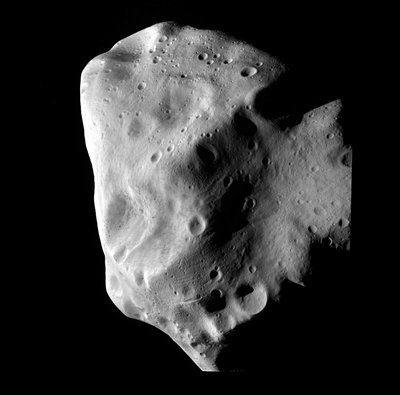
 An image taken by the Rosetta spacecraft on its closest approach to 21-Lutetia in July. Recent analysis of the data shows a thick, dusty blanket coating the asteroid. Image Credit:ESA 2010 MPS for OSIRIS Team MPS/UPD/LAM/IAA/RSSD/INTA/UPM/DASP/IDA If you think that asteroids are boring, unchanging rocks floating in space waiting only to crop up in bad science fiction films, think again. Images and data that are being returned from various asteroid flybys – such as those by the Rosetta spacecraft and Hayabusa sample return mission – show that asteroids are dynamic, changing miniature worlds unto themselves. During the recent flyby of the asteroid 21-Lutetia in July, the ESA’s Rosetta spacecraft took an amazing amount of data. After combing through all of this data over the past few months, astronomers have calculated that the asteroid is covered in a 2000-foot (600 meter)-thick blanket of rocks and dust called regolith. This dust is not unlike the outer layer of the Earth‘s Moon, consisting of pulverized material that has accumulated over billions of years.(...)
Read the rest of Rosetta Uncovers a Thick, Dusty Blanket on Lutetia (481 words)
© nick for Universe Today, 2010. | Permalink | No comment | Add to del.icio.us
Post tags: asteroid flybys, Asteroids, rosetta
Feed enhanced by Better Feed from Ozh 

 Europa, a moon of Jupiter, appears as a thick crescent in this enhanced-color image from NASA's Galileo spacecraft. Credit: NASA A new look at how chemicals on Jupiter's moon Europa may be reacting together could provide new insight to how chemical reactions could be occurring in the moon's icy crust, despite frigid temperatures. Researchers have found that water and sulfur dioxide react together very quickly, even at temperatures hundreds of degrees below freezing. Because the reaction occurs without the aid of radiation, it could take place throughout Europa’s thick coating of ice. If this is occurring, it would revamp current thinking about the chemistry and geology of this moon and perhaps others.
(...)
Read the rest of Acid Rain-Like Chemistry Could Occur in Europa's Ice Crust (560 words)
© nancy for Universe Today, 2010. | Permalink | No comment | Add to del.icio.us
Post tags: Europa
Feed enhanced by Better Feed from Ozh 


If you haven’t heard, former CNN anchor and science reporter Miles O’Brien has signed a deal to join PBS’ NewsHour. That’s great news, as PBS said they wanted to increase their commitment to science journalism. (You can read the press release about Miles’ new job here. So, with that, it is not very surprising that Miles has announced that This Week In Space is taking a hiatus. They are hoping it is not gone for good, but they looking for a way to keep it going and perhaps cover their expenses of creating the weekly video, if not make a little money at it, too. Miles and cohort David Waters make the announcement in the video above. Best wishes to Miles O’Brien in his new job — make sure you look for him on PBS NewsHour.
© nancy for Universe Today, 2010. | Permalink | One comment | Add to del.icio.us
Post tags: This Week In Space
Feed enhanced by Better Feed from Ozh 

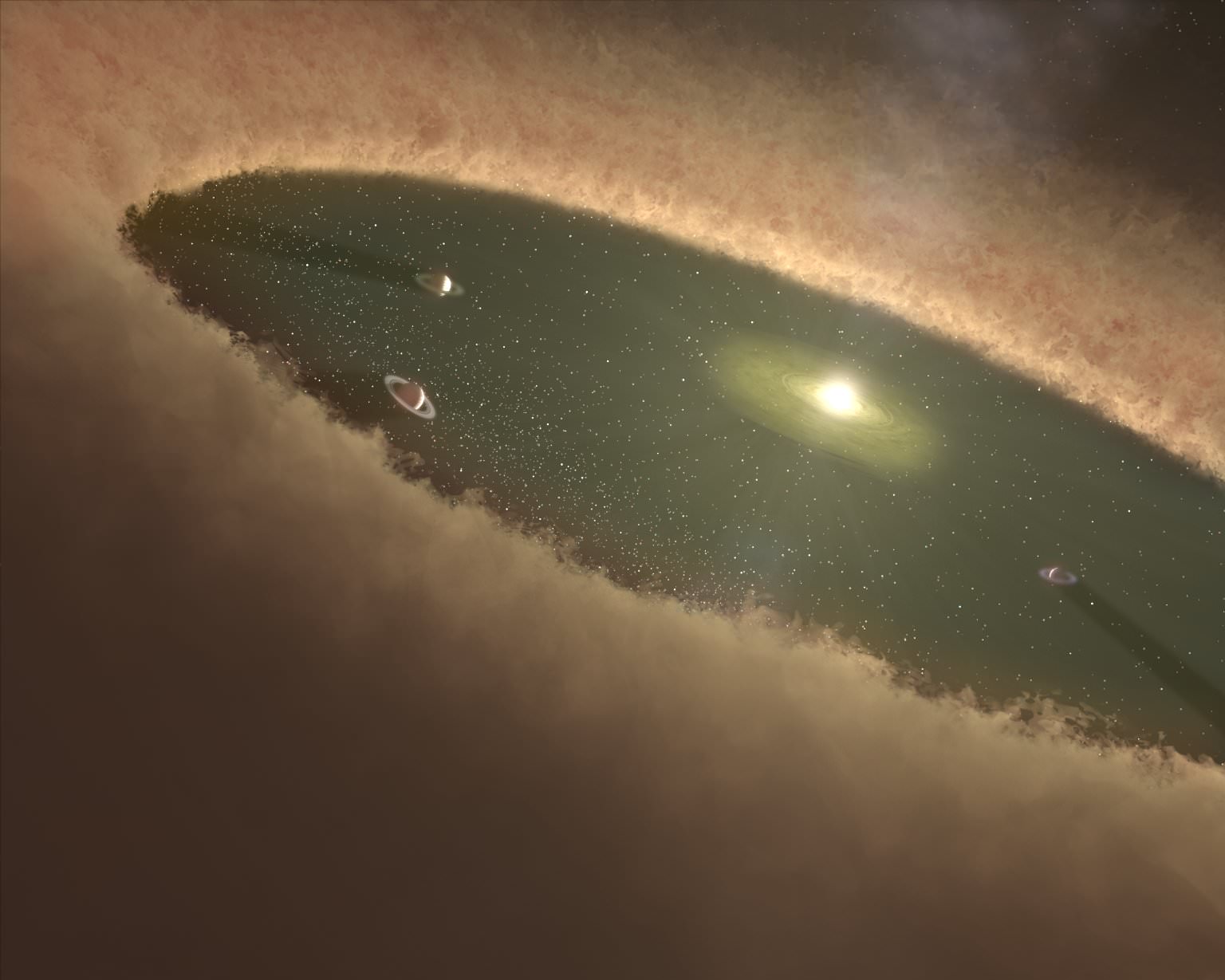
 Planets accreting out of a protoplanetary disk and clearing their orbit. Credit: NASA. Wanna build celestial objects? I mean it sounds easy – you just start with a big cloud of dust and give it a nudge so that it starts to spin and accrete and you end up with a star with a few wisps of dust left in orbit that continue to accrete to form planets. Trouble is, this process doesn’t seem to be physically possible – or at least nothing like it can be replicated in standard theoretical models and laboratory simulations. There’s a problem with the initial small scale accretion steps.
(...)
Read the rest of Astronomy Without A Telescope – A Snowball’s Chance (644 words)
© Steve Nerlich for Universe Today, 2010. | Permalink | 10 comments | Add to del.icio.us
Post tags: accretion
Feed enhanced by Better Feed from Ozh 

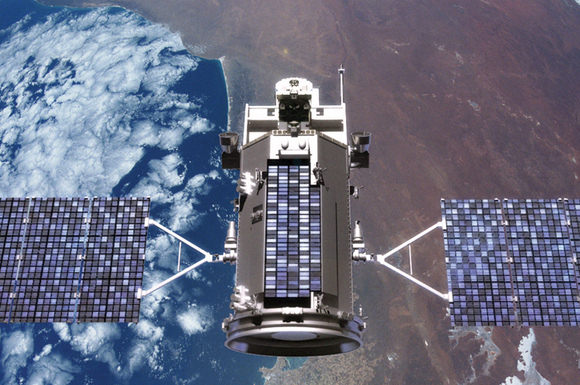
 Artists impression of the Glory satellite at work. Credit: NASA A satellite mission to study climate change on Earth has been delayed due to problems with its solar arrays. The Glory mission was scheduled for a November 22, 2010 launch, but it now has been tentatively pushed back to February 23, 2011. Reportedly, ground testing revealed a problem with a mechanism in one of the two solar panels on the Glory satellite. "The new launch date provides the necessary additional time required to complete preparations for the rocket and the spacecraft," said a NASA status report issued on Friday. The mission is slated to launch on an Orbital Sciences Taurus XL rocket from Vandenberg Air Force Base in California.
(...)
Read the rest of No Glory: NASA Delays Climate Change Satellite Mission (129 words)
© nancy for Universe Today, 2010. | Permalink | 2 comments | Add to del.icio.us
Post tags: Glory Satellite, Missions, Satellites
Feed enhanced by Better Feed from Ozh 

| 















No comments:
Post a Comment
Keep a civil tongue.