| Here are the FeedBlitz blog updates for ignoble.experiment@arconati.us
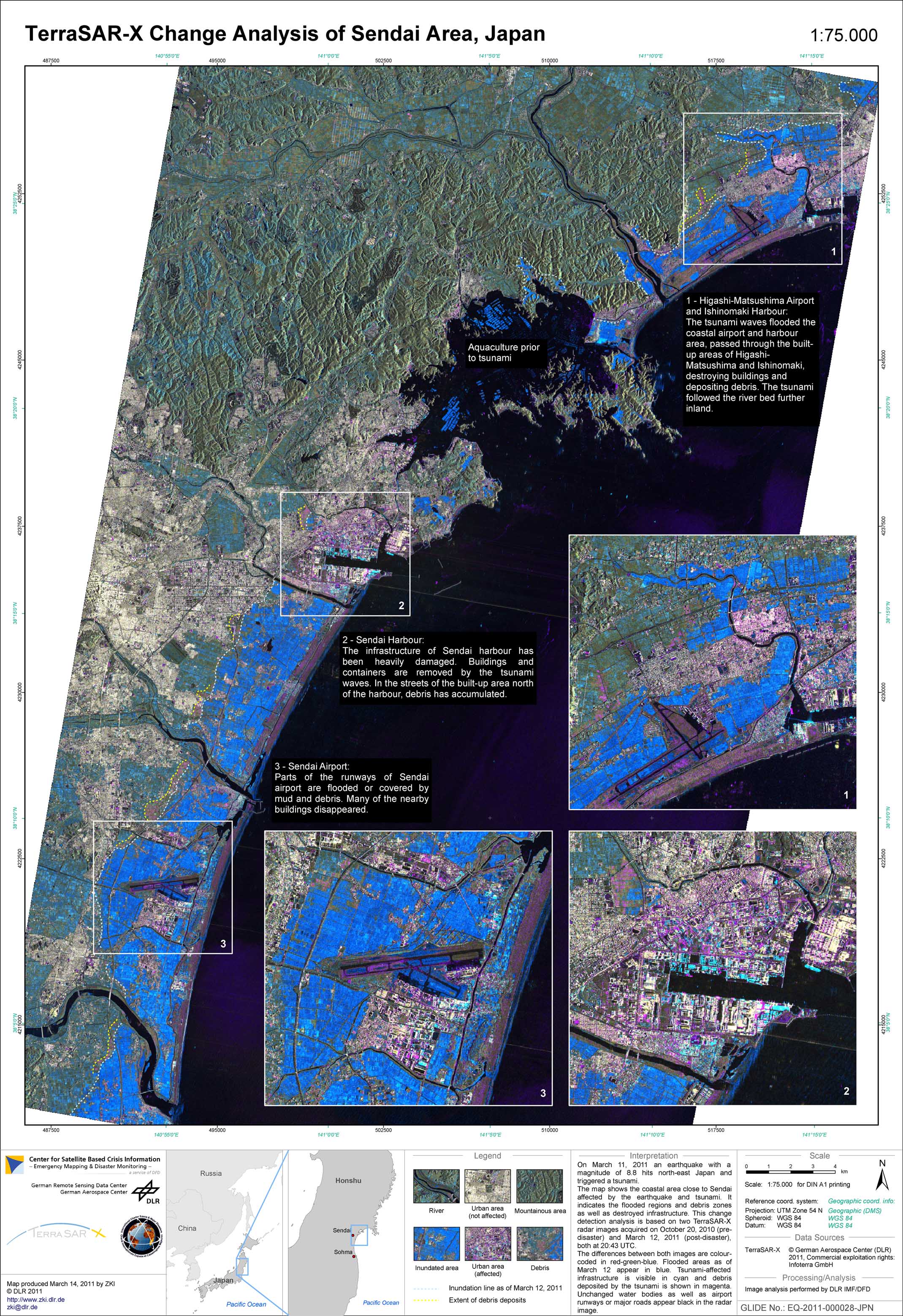
 TerraSAR-X Change Analysis of Sendai Area, Japan.
Map shows coastal area of Sendai effected by 9,0 magnitude Earthquake that triggered ensuing massivly destructive Tsunami, killings untold thousands and threatens the safety of several Japanese Nuclear reactors. Credit: Deutsches Zentrum fur Luft- und Raumfahrt (DLR) - German Aerospace Center From a NASA Press Release: The March 11, magnitude 9.0 earthquake in Japan may have shortened the length of each Earth day and shifted its axis. But don’t worry-you won’t notice the difference. Using a United States Geological Survey estimate for how the fault responsible for the earthquake slipped, research scientist Richard Gross of NASA’s Jet Propulsion Laboratory, Pasadena, Calif., applied a complex model to perform a preliminary theoretical calculation of how the Japan earthquake-the fifth largest since 1900-affected Earth’s rotation. His calculations indicate that by changing the distribution of Earth’s mass, the Japanese earthquake should have caused Earth to rotate a bit faster, shortening the length of the day by about 1.8 microseconds (a microsecond is one millionth of a second). (...)
Read the rest of Japan Quake May Have Shortened Earth Days, Moved Axis (514 words)
© Ken Kremer for Universe Today, 2011. | Permalink | No comment | Add to del.icio.us
Post tags: Japan earthquake, Natural Disasters, Sendai, tsunami
Feed enhanced by Better Feed from Ozh 

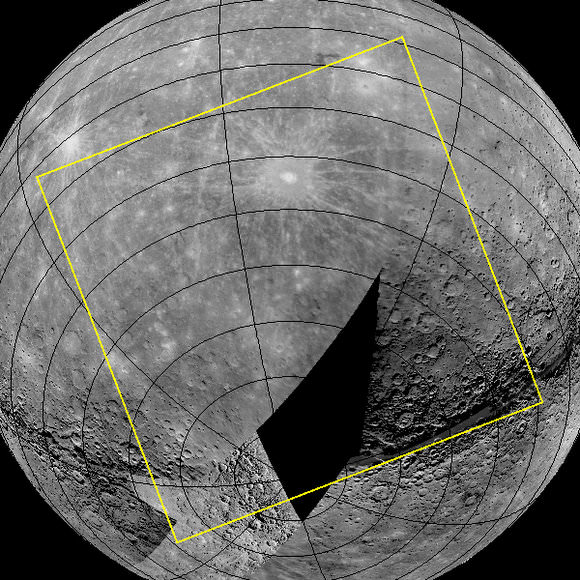
 Footprint for MESSENGER's first image from Mercury's orbit, on March 29, including terrain not previously seen by spacecraft. Credit: NASA/Johns Hopkins University Applied Physics Laboratory/Carnegie Institution of Washington When MESSENGER streaked into the early morning sky over Cape Canaveral on Aug. 3, 2004, very little was known about Mercury. That could soon change. This week, MESSENGER — which stands for MErcury Surface, Space ENvironment, GEochemistry and Ranging — will make history when it becomes the first spacecraft to orbit Mercury. At 8:45 p.m. EDT on Thursday, MESSENGER will execute a 15-minute maneuver that will place it into orbit around Mercury, kicking off a year-long science campaign to understand the innermost planet. The craft will fly around Mercury 730 times in the first year, and may be extended for another year after that. (...)
Read the rest of Bullseye: MESSENGER Gears Up For First-Ever Mercury Orbit (412 words)
© anne for Universe Today, 2011. | Permalink | No comment | Add to del.icio.us
Post tags:
Feed enhanced by Better Feed from Ozh 

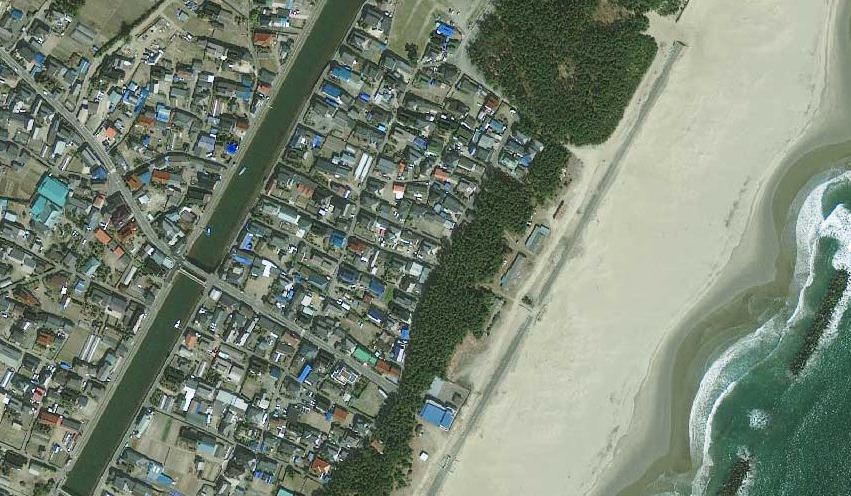
 Arahama, Japan after the disaster. Satellite image courtesy of GeoEye. Photos from the GeoEye satellite imaging company from before and after the March 11 earthquake and tsunami in Japan show sobering views from above of the disaster. Above is the town of Sendai, Japan after the quake, below is how it looked before catastrophe struck.  Arahama, Japan before the disaster. Satellite image courtesy of GeoEye. See more below.
(...)
Read the rest of Satellite Photos Before and After of Japan’s Earthquake, Tsunami (444 words)
© nancy for Universe Today, 2011. | Permalink | No comment | Add to del.icio.us
Post tags: Earth Observation, earthquakes, GeoEye, japan, Natural Disasters, tsunamis
Feed enhanced by Better Feed from Ozh 

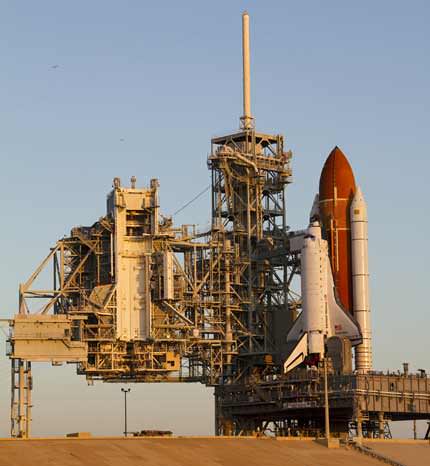
 Shuttle Endeavour at launch pad 39 A. Credit: NASA A worker at the space shuttle launch pad at Kennedy Space Center, pad 39A, fell to his death early Monday morning, according to reports. An employee of United Launch Alliance fell from the launch pad tower near space shuttle Endeavour. NASA released the following statement: “At about 7:40 a.m. EDT this morning, a United Space Alliance worker fell at NASA Kennedy Space Center’s Launch Pad 39A. NASA emergency medical personnel responded, but they were unable to revive the man. Because of medical privacy, currently we’re not able to release any additional details about this fatality. Family members are being notified. All work at Launch Pad 39A has been suspended for the rest of the day, and counseling and other employee assistance are being provided to workers. Right now our focus is on our workers and for the family of the USA employee. The incident is under investigation.” Our condolences to the man’s family and his United Launch Alliance co-workers. UPDATE:
(...)
Read the rest of KSC Launch Pad Worker Falls, Dies (99 words)
© nancy for Universe Today, 2011. | Permalink | 2 comments | Add to del.icio.us
Post tags: STS-134, United Launch Alliance
Feed enhanced by Better Feed from Ozh 

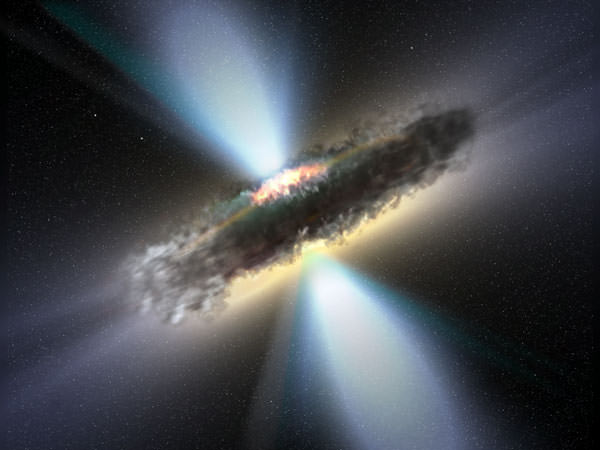
 Black holes - throw something in them and that's the end of the story, right? Well, apparently some physicists just can't seem to leave it there. Credit: NASA. An easy way to think about the entropy of black holes is to consider that entropy represents the loss of free energy – that is, energy that is available to do work – from a system. Needless to say, anything you throw into a black hole is no longer available to do any work in the wider universe.(...)
Read the rest of Astronomy Without A Telescope – Black Hole Entropy (751 words)
© Steve Nerlich for Universe Today, 2011. | Permalink | 47 comments | Add to del.icio.us
Post tags: entropy
Feed enhanced by Better Feed from Ozh 

 Model projections of wave heights from the Japan quake on Friday. Image from NOAA. Click image for higher resolution. The massive magnitude 8.9 earthquake that struck off the east coast Japan’s main island on March 11, 2011 set in motion a fierce tsunami that may have claimed thousands of lives, and sent tsunami warnings all across the Pacific basin, thousands of kilometers away from the quake's epicenter. How do earthquakes trigger such enormous tsunami events, and how can scientists predict where these massive waves might travel? Universe Today talked with Anne Sheehan, who is a professor of geological sciences at University of Colorado at Boulder, and is also affiliated with the Cooperative Institute for Research in Environmental Sciences, as well as getting input from David Admiraal, an associate professor of Engineering at the University of Nebraska Lincoln. Universe Today: How does an earthquake trigger a tsunami?
(...)
Read the rest of The Science Behind a Tsunami (875 words)
© nancy for Universe Today, 2011. | Permalink | One comment | Add to del.icio.us
Post tags: Natural Disasters, tsunamis
Feed enhanced by Better Feed from Ozh 

| 















No comments:
Post a Comment
Keep a civil tongue.