
 Gordon McComb is helping us out on the site this month in support of the release of MAKE Volume 27, our latest robotics issue, and for our monthly Robotics theme here online. Gordon has also just release the fourth edition of his groundbreaking book, Robot Builder’s Bonanza. The first edition of this book was released in 1987 and pretty much launched the hobby robotics field. This was the book that got me into robotics, which lead me into electronics (and Forrest Mims’ book), hardware hacking, and most of my high-tech making interests. Gordon McComb is helping us out on the site this month in support of the release of MAKE Volume 27, our latest robotics issue, and for our monthly Robotics theme here online. Gordon has also just release the fourth edition of his groundbreaking book, Robot Builder’s Bonanza. The first edition of this book was released in 1987 and pretty much launched the hobby robotics field. This was the book that got me into robotics, which lead me into electronics (and Forrest Mims’ book), hardware hacking, and most of my high-tech making interests.
The latest edition of Gordon’s book is fantastic. It reminds me a lot of Make: Electronics, and together with that book, I think makes these two volumes the Robot Builder’s Bonanza (1st Ed)/Getting Started in Electronics combo of the early 21st century. The new Bonanza is over 700 pages and has over 100 projects. It also has great tutorials, covering everything from robot body basics to using today’s microcontrollers, such as Arduino and PICAXE. You’d think that a 700 page tome would be phonebook-sized, but thin, reasonably high-quality paper was used, so it’s a very bench-convenient size (but it IS heavy). Gordon has also put together a great companion website, with code examples, additional projects, and other support materials. To celebrate the release of Volume 27, our online theme, and Gordon’s book, we want to do a giveaway. Gordon was kind enough to send me four inscribed/autographed copies of his book to give to YOU. The eligible commenting period will run until Friday (7/22) at midnight Pacific. We’ll announce the four winners on Monday morning. To be eligible, all you have to do is share with us some vexing question about robotics, some general or technical question about the robot kingdom. E.g. What’s the practical difference between the different types of navigation technologies (sonar/ultrasonic, infrared, radar, etc)? Is the Roomba Create a good platform for beginners? We’ll have our servoheads on staff try and answer. And, as always, readers can answer comment questions to be eligible for the giveaway. Good luck!
From the Pages of MAKE  MAKE Volume 27, Robots! MAKE Volume 27, Robots!
The robots have returned! MAKE Volume 27 features a special package with robotics projects for every age and skill level. They play music; they outwit your pets; they learn from their mistakes! In addition, we’ll show you how to build a special aquarium to keep jellyfish, create pre-Edison incandescent lighting, spy via the internet, and make a go-anywhere digital message board! All this and much, much more, in MAKE Volume 27. On newsstands July 26! Buy or Subscribe  
 Founded in 1987 in Rocklin, California, Parallax, Inc. manufactures the famous BASIC Stamp microcontroller. The Stamp has been popular among electronics hobbyists since the early 1990s, thanks to such user-friendly features as an embedded BASIC interpreter. And though the position of the BASIC Stamp has taken a hit in the wake of the Arduino era, the 2006 introduction of the Propeller multi-core microcontroller has kept Parallax in a leading position. They have major consumer bases in the hobby robotics and education markets, as well as a valuable retail partner in RadioShack. Founded in 1987 in Rocklin, California, Parallax, Inc. manufactures the famous BASIC Stamp microcontroller. The Stamp has been popular among electronics hobbyists since the early 1990s, thanks to such user-friendly features as an embedded BASIC interpreter. And though the position of the BASIC Stamp has taken a hit in the wake of the Arduino era, the 2006 introduction of the Propeller multi-core microcontroller has kept Parallax in a leading position. They have major consumer bases in the hobby robotics and education markets, as well as a valuable retail partner in RadioShack.
On the PR front, Parallax produces a top-notch free tutorial and educational video series to complement their commercial educational materials. The Parallax YouTube channel regularly features electronics and robotics tutorials, hosted by Jessica Uelman, with topics ranging from basic breadboarding to homemade solar panels. Jessica is an excellent, engaging teacher and the quality of these videos is consistently top-notch — we’ve linked to them many times. And so, in recognition of their contribution to our community, we’d like to formally welcome Parallax into the running for the 2011 Makeys. Congratulations! More: If you have a suggestion for a company to be nominated for “Best Education / Outreach Program,” or one of the other three 2011 Makey awards, please send an e-mail to makeys@makezine.com or just leave a comment, below.  


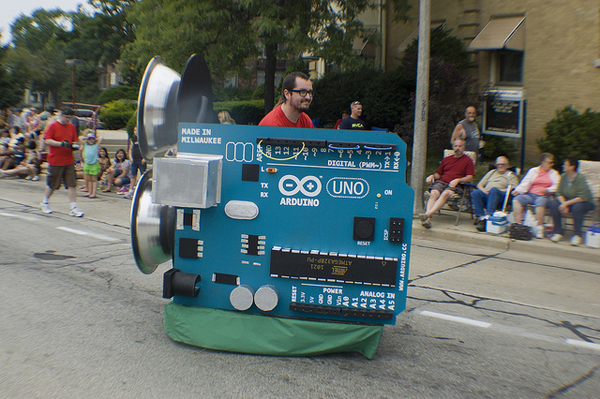
Milwaukee Makerspace brought electric vehicles and floats to Milwaukee, Wisconsin’s South Shore Frolics parade. Milwaukee Makerspace member David Overbeck has loved Milwaukee’s South Shore Frolics Parade since he was a kid, and with the help of other makers, he led a group build of a 9 foot tall “Old Milwaukee Makerspace” beer can to appear in the parade. Jason Gessner also took the lead in building two giant Arduinos which we attached to a vehicle platform. He piloted this through the parade while founders Royce and Tom drove their well-known Power Wheels and the rest of us marched along blasting some tunes, giving out candy, and handing out flyers promoting the makerspace.
Read Pete Prodoehl’s blog post or see more pix in the Milwaukee MakerspaceFlickr pool. [Thanks to Pete Prodoehl for the use of his images.]  
Yury Gitman and Joel Murphy have created a pulse sensor for Arduino:
It can be used by students, artists, athletes, makers, and game & mobile developers who want to easily incorporate live heart-rate data into their projects. After a few months of testing a gaggle of techniques, we developed what we think is an innovative pulse sensor. Our prototype (and accompanying code) plugs right into Arduino and easily clips onto a fingertip or earlobe. It's super small too, button-sized with holes, so can be sewn into a garment as well. We'd like to manufacturer the actual pulse sensor, making it low-cost, and accessible for students, artists, and developers to use in their projects. It also includes software for graphing BPM on screen. Included software also makes it easy to export live BPM data feed to software (or web app) of choice.
We caught up with Yury and Joel at the recent World Maker Faire community meeting at Etsy (video). They’ve started a Kickstarter page to help them launch the pulse sensor as an open source hardware kit. In the Maker Shed:
 LED Yule Log (Fireplace Simulacra) by Yury Gitman  

 Yes, OK, I know that the weapons in Iron Man’s palms are technically repulsor beams, which, at least as I understand them, are a kind of wholly sci-fictional counterpart to the equally sci-fictional “tractor” beam. Yes, OK, I know that the weapons in Iron Man’s palms are technically repulsor beams, which, at least as I understand them, are a kind of wholly sci-fictional counterpart to the equally sci-fictional “tractor” beam.
But this somewhat alarming device from German laserhacker Patrick Priebe, who previously has produced a handheld Nd-YAG pulse laser that will punch holes in sheet steel, counts as “working” in the sense that it is a dangerous, if not deadly, directed energy weapon that you can wear on your palm. It’s built using a 1000mW laser diode plus a thick slab of brass to act as a heatsink. There’s no indication that Patrick has any designs on vigilantism, fortunately, but I’m wondering how long he will be able to resist the temptation. Remember, kids: With great power comes great responsibility. [via Hack a Day]  
 Due to popular demand, the Maker Shed now carries Lego Mindstorms NXT 2.0! This awesome Lego set is much better than than the original Mindstorms that I have. It includes new models, more customizable programming and all-new technologies! Mindstorms NXT 2.0 combines the versatility of the LEGO building system with an intelligent microcomputer brick and intuitive drag-and-drop programming software based on LabVIEW. The new 2.0 toolkit features everything you need to create your first robot in 30 minutes and then thousands of other robotics inventions that do what you want! The intelligent NXT LEGO brick features 32-bit microprocessor, a large matrix display, 4 input and 3 output ports. It connects to your computer using Bluetooth or USB. Due to popular demand, the Maker Shed now carries Lego Mindstorms NXT 2.0! This awesome Lego set is much better than than the original Mindstorms that I have. It includes new models, more customizable programming and all-new technologies! Mindstorms NXT 2.0 combines the versatility of the LEGO building system with an intelligent microcomputer brick and intuitive drag-and-drop programming software based on LabVIEW. The new 2.0 toolkit features everything you need to create your first robot in 30 minutes and then thousands of other robotics inventions that do what you want! The intelligent NXT LEGO brick features 32-bit microprocessor, a large matrix display, 4 input and 3 output ports. It connects to your computer using Bluetooth or USB.
- NXT 32-bit microcontroller with 256k memory
- 3 interactive servo motors with built-in rotation sensors
- 1 ultrasonic sensor
- 2 touch sensors
- Color sensor with triple functionality: color sensor/light sensor/color lamp
- Support for Bluetooth, USB 2.0
- 619 pieces
 

The Milwaukee M-Spector AV M12 Cordless Multimedia Camera is a rugged, digital inspection scope that helps you see things you’d otherwise need x-ray vision to espy. Take, for example, the wand of my vacuum cleaner: 
I’ve had a strong suspicion there was a doll head lodged in there, but the M-Spector proved me wrong. Analog, optical borescopes have long been used to see inside of tubes. The M-Spector adds quite a few features, such as the ability to snap photos and shoot video (and audio) of your inspections. Here’s another neat trick, I used the M-Spector to help me fix the ice machine in our freezer, letting me see deep into a corner without disassembling it: 
A laptop with a webcam and flashlight would do in a bind, but the M-Spector is purpose-built for the job, sporting a bright LED at the business end of the cable, and a heavily ruggedized construction.
The provided 17mm diameter cable is small enough to snake into tight places — I fished it into a conduit to see which CAT-5 cable was binding on the others. The cable can be detached from the unit for compact storage, and there are eight- and three-foot extension cables available. I’ve seen other manufacturers offer a small hook or magnetic tip accessory, which Milwaukee does not. Might not be too hard to improvise, and could be useful for grabbing lost parts. 


The M-Spector stores images and video on an included 2GB SD card, so you can later view media on a computer. You can also hook a USB cable directly to the device. The images weigh in at 1280 x 960 pixels, and while they aren’t as clear as I’m used to from my cell phone, they are just fine considering they’re being taken in a small, dark place 40″ away from the sensor. 
The controls are simple; the primary adjustments you can make are to increase/decrease the LED brightness and camera zoom. You can also flip the image 180 degrees, in case things start to go upside down on you. I would like more granular control on image rotation, since it can get disorienting when you’re snaking the cable into position. The large center button is used to snap a picture or start and stop recording in video mode. 


Running off of the M12 series 12V lithium-ion battery pack (with included charger), the M-Spector has an estimated 12 hours of active run-time. If you’re already using other tools in the series you can swap batteries among them. 
I think the M-Spector will find most of its use when I’m doing wiring work, but it’s also incredibly handy for other household repairs and project work. Plus, it sure is fun poking around under furniture and inside machines. This is the kind of tool to let your friends know you’ve got, so they can borrow it before they go ripping open an entire wall. Milwaukee M-Spector AV M12 Cordless Multimedia Camera MSRP is $399 but I found it on Amazon for around $236 to $299. More:
See our entire Toolbox category here.  
Reader Shaun Crampton sent us the specs for the second prototype of his ArduRoller: - Chassis: laser cut 2.7mm bamboo ply (Ponoko); various M2.5 machine screws from Amazon; Instamorph low-melt-point thermoplastic to fill in the gaps.
- Brains: 1 x Arduino Uno
- Motor driver: 1 x Sparkfun Ardumoto
- Motors: Sparkfun 2 x 24:1 gearmotor
- Wheels: 1 set Sparkfun 70mm — repaired with Instamorph after they cracked around the axle
- Gyro: 1 x ADXRS613 (Sparkfun breakout) mounted at the axis of rotation
- Accelerometer: 1 x ADXL203CE (Sparkfun breakout) mounted at the axis of rotation
- Batteries: 2 x 3.7V Li-poly 850MAh (Sparkfun)
There’s video here, and code and chassis files on GitHub. [Thanks, Shaun!] More:
 | |








No comments:
Post a Comment
Keep a civil tongue.