| Here are the FeedBlitz blog updates for ignoble.experiment@arconati.us

Here’s a look at the Opportunity rover’s three-year trek across 20 km (13 miles) of Meridiani Planum on Mars, using the unique vantage point of the rover itself. During the drive from Victoria Crater to Endeavour Crater, rover planners captured a horizon photograph at the end of each drive. 309 images taken during the journey appear in this video.
© nancy for Universe Today, 2011. | Permalink | No comment | Add to del.icio.us
Post tags: Mars, Mars Rovers, Opportunity Rover
Feed enhanced by Better Feed from Ozh 

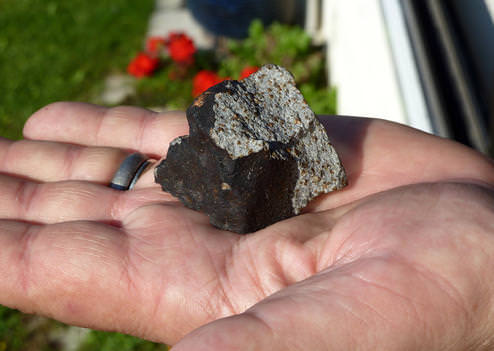
 This egg-sized meteorite broke through the roof of the Comette family When your last name is Comette, I’m sure the occasional astronomy-themed joke is never far away. But it’s no joke that the Comette family living in Draveil, a suburb south of Paris, was paid a visit by a real extraterrestrial a couple of weeks ago – in the form of an 88-gram (3.5 oz.) meteorite that broke through their roof! (...)
Read the rest of A Meteorite Visits the Comettes (346 words)
© Jason Major for Universe Today, 2011. | Permalink | No comment | Add to del.icio.us
Post tags: Comette, meteor, meteorite, Paris, Solar System
Feed enhanced by Better Feed from Ozh 

 Meteor and its Persistent Train. Credit: Randy Halverson Randy Halverson captured this amazing view of a meteor and its persistent train across the stunning Milky Way galaxy on October 2, 2011. “While shooting a Moon set with the Milky Way timelapse near the White River in South Dakota. I caught a meteor with a persistent train. It lasted for 68 frames of the timelapse then moved out of frame to the left. In real time it was over a half an hour.”
Randy took this photo using a Canon 5D Mark II camera with Canon 16-35 lens set at F2.8, ISO 3200 for 30 seconds. It was on a Stage Zero Dolly from dynamicperception.com shooting the timelapse. If Randy’s name sounds familiar, he’s also the creator of the fantastic “DakotaLapse” timelapse videos, such as “Milky Way from the Dakotas” and Tempest Milky Way.” Check out Randy’s website for more photos and videos. Want to get your astrophoto featured on Universe Today? Join our Flickr group, post in our Forum or send us your images by email (this means you’re giving us permission to post them). Please explain what’s in the picture, when you took it, the equipment you used, etc.
© dcast for Universe Today, 2011. | Permalink | No comment | Add to del.icio.us
Post tags: Astrophotos
Feed enhanced by Better Feed from Ozh 

 The Space Shuttle: Celebating Thirty Years Of NASA's First Space Plane is chocked full of great imagery and works to cover each of the shuttle's 135 missions. Photo Credit: Zenith Press The space shuttle program is over. The orbiters are being decommissioned, stripped of the components that allowed them to travel in space. For those that followed the program, those that wished they did and those with only a passing interest in what the program accomplished a new book has been produced covering the entirety of the thirty years that comprised NASA's longest human space flight program. The Space Shuttle: Celebrating Thirty Years of NASA's First Space Plane is written by aerospace author Piers Bizony and weighs in at 300 pages in length.(...)
Read the rest of Book Review: The Space Shuttle: Celebrating Thirty Years of NASA's First Space Plane (822 words)
© Jason Rhian for Universe Today, 2011. | Permalink | No comment | Add to del.icio.us
Post tags: Space Shuttle
Feed enhanced by Better Feed from Ozh 

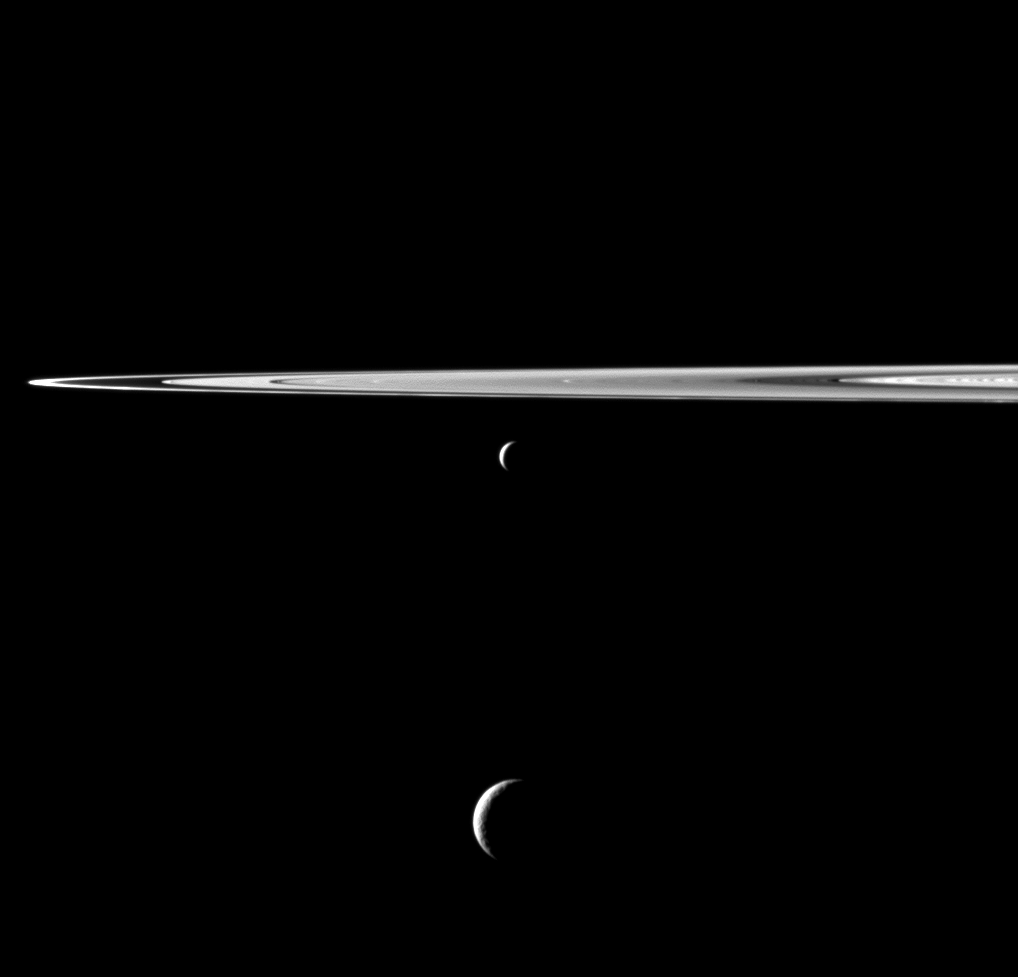
 Enceladus and Tethys hang below Saturn's rings in this new image from the Cassini spacecraft. Credit: NASA/JPL-Caltech/SS Another Cassini stunner! This gorgeous, suitable-for-framing image shows two of Saturn’s moons hanging below the planet’s rings, as if strung on a necklace. Beautiful! Enceladus (504 kilometers, 313 miles across) appears just below the rings, while Tethys (1062 kilometers, 660 miles across) appears below. In this shot, Cassini is also closer to Tethys than Enceladus: the spacecraft is 208,000 kilometers (139,000 miles) from Tethys and 272,000 kilometers (169,000 miles) from Enceladus. This image was taken on September 13, 2011. See below for some raw images from Cassini’s October 1 close fly by of Enceladus, including a great shot of the moon hovering in front of Saturn’s rings, and a view of the geysers. (...)
Read the rest of Suitable For Framing: Latest Eye Candy from Cassini (81 words)
© nancy for Universe Today, 2011. | Permalink | No comment | Add to del.icio.us
Post tags: Cassini, Enceladus, Saturn, saturn images, tethys
Feed enhanced by Better Feed from Ozh 

 In this spectacular image, observations using infrared light and X-ray light see through the obscuring dust and reveal the intense activity near the galactic core. Note that the center of the galaxy is located within the bright white region to the right of and just below the middle of the image. The entire image width covers about one-half a degree, about the same angular width as the full moon. Credit: NASA, ESA, SSC, CXC, and STScI When it comes to my job, I see a lot of astrophotography. I’ve contemplated innumerable nebulae, viewed myriad galaxies and dreamed over abounding star clusters. Each photo is a work of art in its own right – where the palette is a computer program and the canvas is a screen. These creations are stunning, showing us the true nature of what lay just beyond the visible perception of human sight. However, there are very few that when printed seem to have life of their own. This snapshot in time is one of them… (...)
Read the rest of Welcome To The Heart Of The Milky Way… (420 words)
© tammy for Universe Today, 2011. | Permalink | No comment | Add to del.icio.us
Post tags: Imaging the Galactic Center
Feed enhanced by Better Feed from Ozh 

 Milky Way Over the Sea. Credit: Jerónimo Jesús Losada This stunning view of the Milky Way over a sea in Cadiz, Spain was captured by Jerónimo Jesús Losada last August. Jerónimo took the photo using a Canon 1000D camera with the following settings: 8-minute exposure at ISO 800. Monitoring is manual and processing is done in Photoshop. Want to get your astrophoto featured on Universe Today? Join our Flickr group, post in our Forum or send us your images by email (this means you’re giving us permission to post them). Please explain what’s in the picture, when you took it, the equipment you used, etc.
© dcast for Universe Today, 2011. | Permalink | No comment | Add to del.icio.us
Post tags: Astrophotos
Feed enhanced by Better Feed from Ozh 

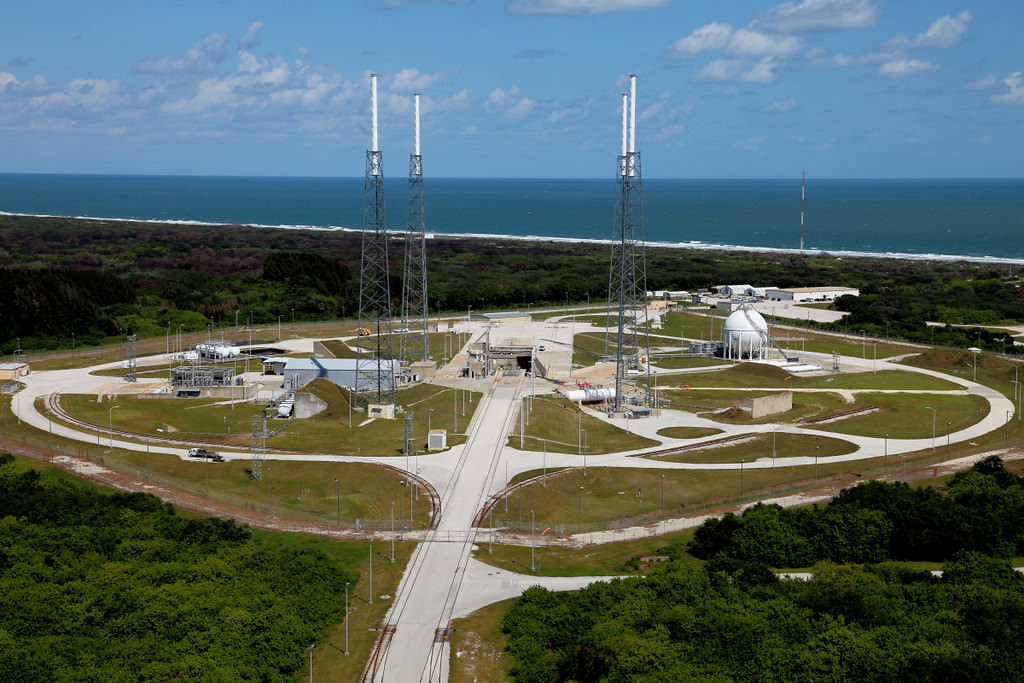
 One of the most incredible things to see at United Launch Alliance's Vertical Integration Facility - is the surrounding area and the adjacent Space Launch Complex-41. Photo Credit: Alan Walters/awaltersphoto.com CAPE CANAVERAL, Fla — One of the more dramatic buildings operated by United Launch Alliance (ULA) at Kennedy Space Center in Florida is the Vertical Integration Facility or VIF as it is more commonly known. It is in this facility that expendable launch vehicles are brought, lying on their sides – and then hoisted into the vertical position for launch. The current resident in the VIF is the Atlas V 541 (AV-028) that is slated to launch the Mars Science Laboratory (MSL).(...) Read the rest of Behind the Scenes: Curiosity’s Rocket Prepared at Vertical Integration Facility (590 words)
© Jason Rhian for Universe Today, 2011. | Permalink | No comment | Add to del.icio.us
Post tags: United Launch Alliance
Feed enhanced by Better Feed from Ozh 

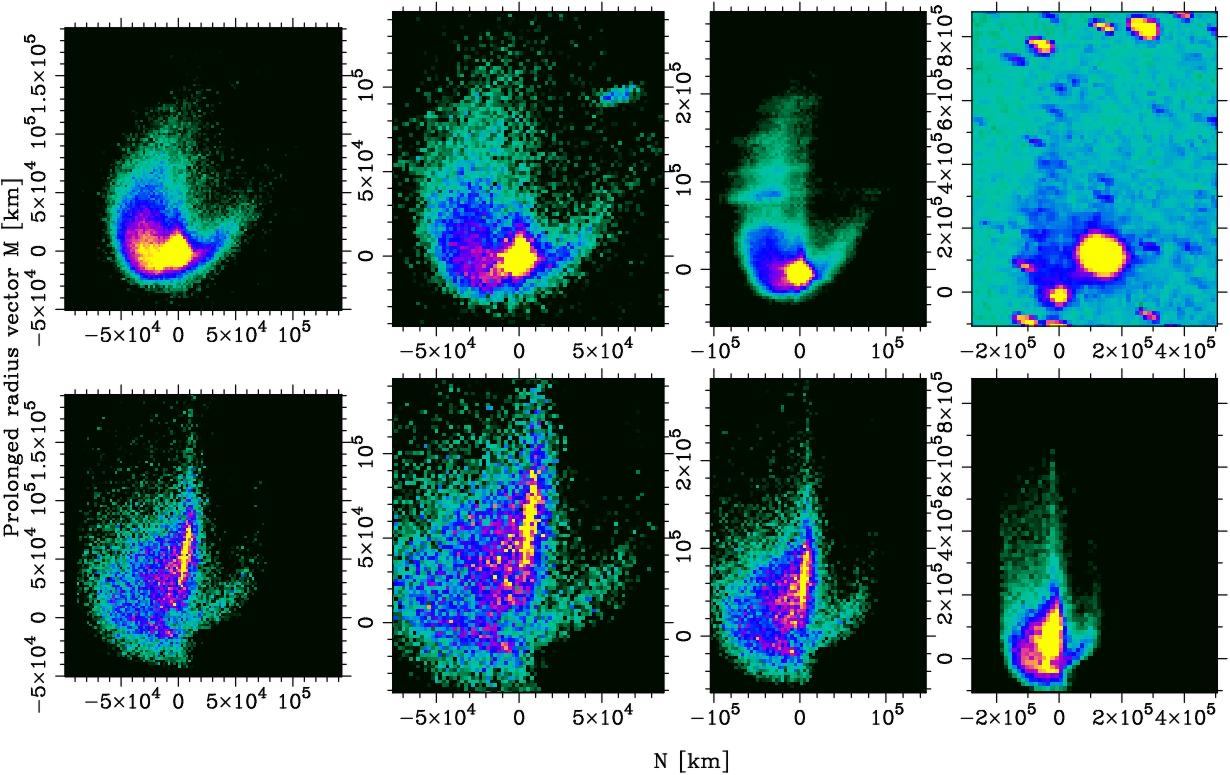
 (Left to right): images of (596) Scheila corresponding to 2010 December 13, 14, 17, and 29. The upper row corresponds to the observations, while the lower row to the models. The tails clearly show a bifid pattern with a central spike in the sunward direction, although it is not detectable in the December 29 image. Except for this latter case, the modeled images are rendered using the same color code for the intensities as the corresponding observed images in the top row. Credit: Fernando Moreno On December 12, 2010, something very unusual happened to asteroid Scheila. For a short period of time, its appearance changed dramatically and it even developed a comet-like tail. Now a group of international scientists headed by Fernando Moreno of the Instituto de Astrofísica de Andalucía in Granada, Spain have created a computer model which may explain this weird activity… an impact. (...)
Read the rest of Impact On Asteroid Scheila? (387 words)
© tammy for Universe Today, 2011. | Permalink | 2 comments | Add to del.icio.us
Post tags: asteroid impact event, Asteroid Scheila
Feed enhanced by Better Feed from Ozh 

| 












No comments:
Post a Comment
Keep a civil tongue.