| Here are the FeedBlitz blog updates for ignoble.experiment@arconati.us
 Dawn Orbiting Vesta
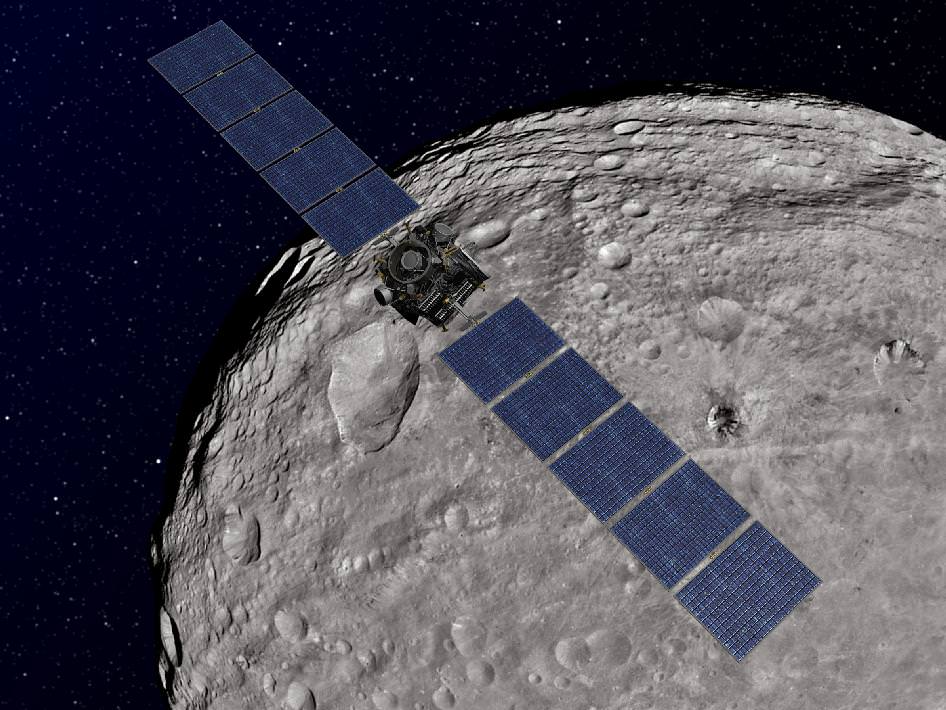
This artist's concept shows NASA's Dawn spacecraft orbiting the giant asteroid Vesta. The depiction of Vesta is based on images obtained by Dawn's framing cameras. Dawn is an international collaboration of the US, Germany and Italy. Credit: NASA/JPL-Caltech NASA's Dawn Asteroid Orbiter successfully spiraled down today to the closest orbit the probe will ever achieve around the giant asteroid Vesta, and has now begun the most critical science observations that will ultimately yield the highest resolution measurements to be obtained of this spectacular body throughout the entire mission. "What can be more exciting than to explore an alien world that until recently was virtually unknown!" Dr. Marc Rayman gushed in an exclusive to Universe Today. Rayman is Dawn's Chief Engineer from NASA's Jet Propulsion Lab (JPL) in Pasadena, Calif.. and a protégé of Star Trek's Mr. Scott. Before Dawn, Vesta was little more than a fuzzy blob in the world's most powerful telescopes. Vesta is the second most massive object in the main Asteroid Belt between Mars and Jupiter.(...)
Read the rest of Dawn swoops to lowest orbit around Vesta – Unveiling Spectacular Alien World (937 words)
© Ken Kremer for Universe Today, 2011. | Permalink | No comment | Add to del.icio.us
Post tags: 1 Ceres, 4 vesta, Asteroids, Dawn Asteroid Orbiter, Dawn mission, Jupiter, Main Asteroid Belt, Mars, NASA
Feed enhanced by Better Feed from Ozh 

 An artists concept of the Phobos-Grunt Mission. Credit: Roscosmos Editor's note: Dr. David Warmflash, principal science lead for the US team from the LIFE experiment on board the Phobos-Grunt spacecraft, provides an update on the mission for Universe Today. It has been trapped in low Earth orbit for more than a month. So low is the orbit that it moves too fast to be contacted – unless controllers on the ground just happen to beam a signal at some unlikely angle. So short does its battery power last that it must be in sunlight while also in position to receive signals. Then, it must still have power to send telemetry back to the ground. Even with these obstacles, Russia's Phobos- Grunt probe did manage to communicate with the European Space Agency's (ESA) antenna in Perth, Australia twice a couple of weeks ago, indicating that some of its systems were functioning. But subsequent attempts at communication have failed, despite the addition of ESA's Canary Islands antenna at Maspalomas to the worldwide effort to reestablish control over the spacecraft.
(...)
Read the rest of A Day in the Sun: Will It Make a Difference for Russia's Phobos-Grunt? (381 words)
© David Warmflash for Universe Today, 2011. | Permalink | No comment | Add to del.icio.us
Post tags: Missions, Phobos-Grunt, Space Flight
Feed enhanced by Better Feed from Ozh 


Climate scientist Michael Mann from Penn State recently spoke at a TED event, and what he says in this video is nearly the same as in the article I wrote a year ago after hearing Mann speak. The real shame here is that he needs to keep telling these same stories despite the overwhelming scientific evidence for anthroprogenic climate change.
© nancy for Universe Today, 2011. | Permalink | 2 comments | Add to del.icio.us
Post tags: Climate
Feed enhanced by Better Feed from Ozh 

 December 10 lunar eclipse by Joseph Brimacombe Photographer Joseph Brimacombe created this stunning image of a ruddy Moon made during the total lunar eclipse of December 10, 2011. Images taken during the penumbral and total phases of the eclipse were combined to create a full-face image of the Moon in color. Beautiful! (...)
Read the rest of A Blood-Red Moon (98 words)
© Jason Major for Universe Today, 2011. | Permalink | No comment | Add to del.icio.us
Post tags: Brimacombe, eclipse, lunar, Moon, red
Feed enhanced by Better Feed from Ozh 

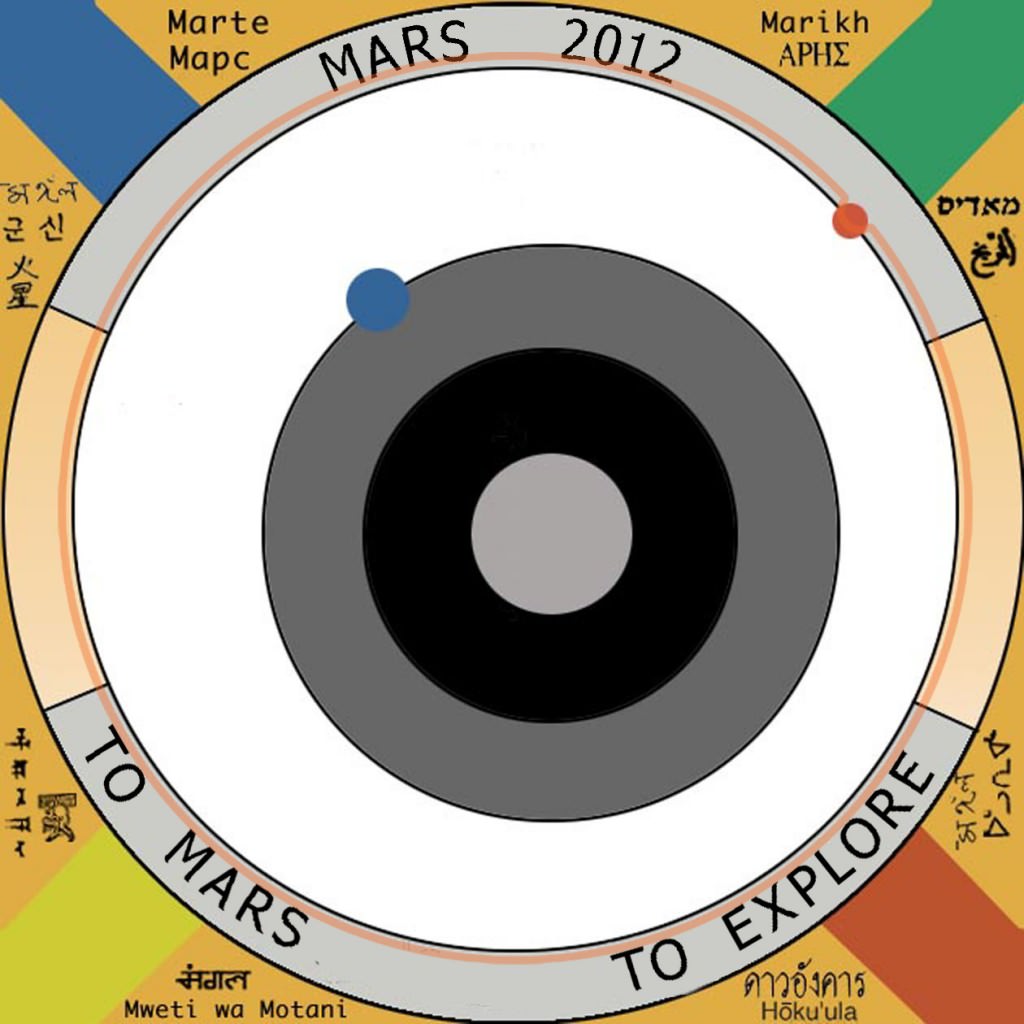
 The Sundial aboard NASA's Curiosity rover. Credit: MER Sundial Team There’s been a lot of artifacts sent to the surface of Mars – and now there’s about to be another one left for future generations to discover. Artist Jon Lomberg has collaborated with a team of space scientists to design a sundial which sports edges with designs and images. These embellishments have been authored by Jim Bell and the MER sundial team with the graphics designed by Lomberg. (...)
Read the rest of Martian Sundial – A New “Curiosity” (587 words)
© tammy for Universe Today, 2011. | Permalink | One comment | Add to del.icio.us
Post tags: Curiosity Rover, Mars Science Lander, Mars Sundial
Feed enhanced by Better Feed from Ozh 

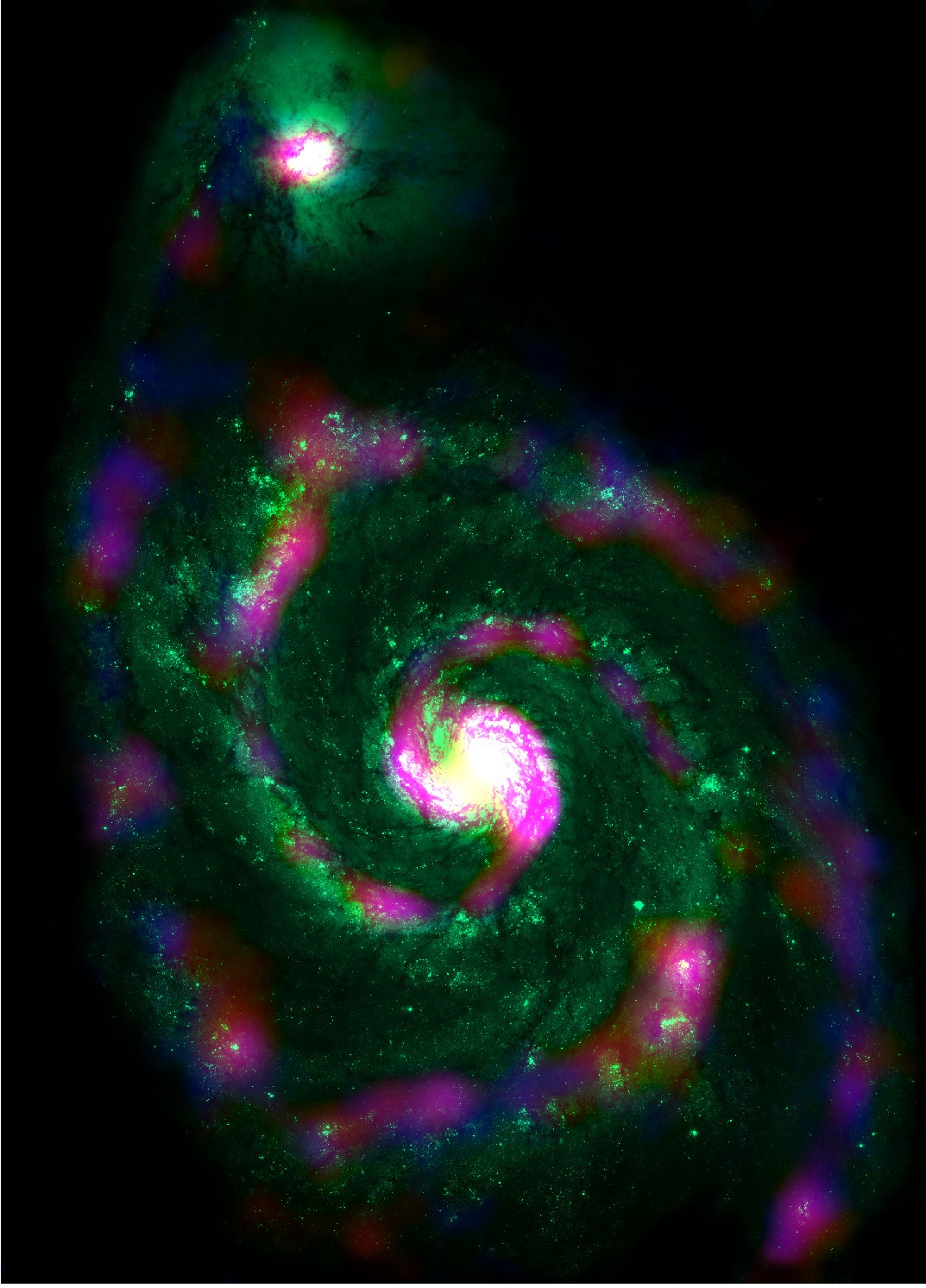
 A composite image of the Whirlpool Galaxy (also known as M51). The green image is from the Hubble Space Telescope and shows the optical wavelength. The submillimetre light detected by SCUBA-2 is shown in red (850 microns) and blue (450 microns). The Whirlpool Galaxy lies at an estimated distance of 31 million light years from Earth in the constellation Canes Venatici Credit: JAC / UBC / Nasa The stars and faint galaxies you see when you look up at the night sky are all emitting light within the visible light spectrum — the portion of the electromagnetic spectrum we can see with our unaided eyes or through optical telescopes. But our galaxy, and many others, contain huge amounts of cold dust that absorbs visible light. This accounts for the dark regions. A new camera recently unveiled at the James Clerk Maxwell Telescope (JCMT) in Hawaii promises to figuratively shed light on this dark part of the universe. The SCUBA-2 submillimetre camera (SCUBA in this case is an acronym for Submillimetre Common-User Bolometer Array) can detect light at lower energy levels, allowing astronomers to gather data on these dark areas and ultimately learn more about our universe and its formation. (...)
Read the rest of New Submillimetre Camera Sheds Light on the Dark Regions of the Universe (599 words)
© Amy Shira Teitel for Universe Today, 2011. | Permalink | 2 comments | Add to del.icio.us
Post tags: Astronomy, galaxies, pictures, Telescopes
Feed enhanced by Better Feed from Ozh 

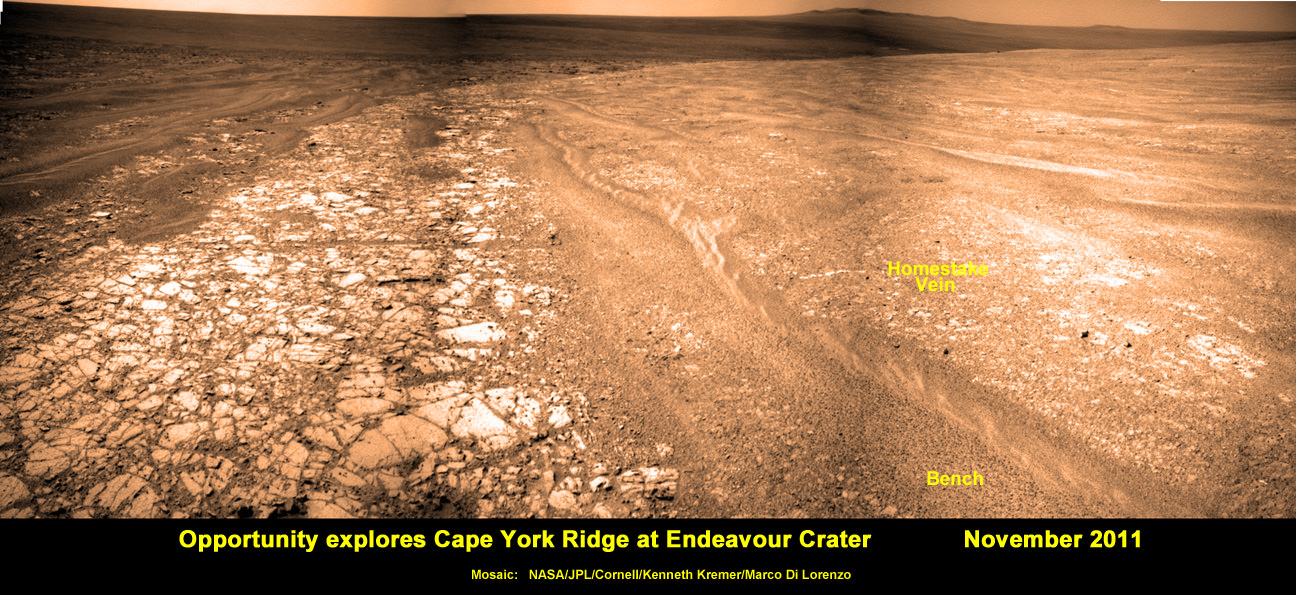
 Opportunity discovers Water related mineral vein at Endeavour Crater - November 2011
Opportunity rover discovered Gypsum at the Homestake mineral vein, while exploring around the base of Cape York ridge at the westerm rim of Endeavour Crater. The vein is composed of calcium sulfate and indicates the ancient flow of liquid water at this spot on Mars. Opportunity drove North (ahead) from here in search of a sunny winter haven. This panoramic mosaic of images was taken on Sol 2761, November 2011, and illustrates the exact spot of the mineral vein discovery.
Credit: NASA/JPL/Cornell/Kenneth Kremer/Marco Di Lorenzo
click to enlarge NASA's long lived Opportunity rover has discovered the most scientifically compelling evidence yet for the flow of liquid water on ancient Mars. The startling revelation comes in the form of a bright vein of the mineral gypsum located at the foothills of an enormous crater named Endeavour, where the intrepid robot is currently traversing. See our mosaic above, illustrating the exact spot. Update: 'Homestake' Opportunity Mosaic above has just been published on Astronomy Picture of the Day (APOD) – 12 Dec 2011 (by Ken Kremer and Marco Di Lorenzo) Researchers trumpeted the significant water finding this week (Dec. 7) at the annual winter meeting of the American Geophysical Union (AGU) in San Francisco. “This gypsum vein is the single most powerful piece of evidence for liquid water at Mars that has been discovered by the Opportunity rover,” announced Steve Squyres of Cornell University, Ithaca, N.Y., Principal Investigator for Opportunity, at an AGU press conference. (...)
Read the rest of Opportunity Discovers Most Powerful Evidence Yet for Martian Liquid Water (1,634 words)
© Ken Kremer for Universe Today, 2011. | Permalink | 8 comments | Add to del.icio.us
Post tags: Cape York, Endeavour crater, gypsum, Jet Propulsion Laboratory (JPL), life on mars, Mars, Mars Rovers, Meridiani Planum, NASA, Opportunity Rover, Spirit Rover, Water on Mars
Feed enhanced by Better Feed from Ozh 

| 















No comments:
Post a Comment
Keep a civil tongue.