| Here are the FeedBlitz blog updates for ignoble.experiment@arconati.us

Greetings, fellow SkyWatchers! With the change in seasons becoming quickly apparent, it’s time to put some early hours dark skies to good use and enjoy some favorite nebulae. If you’ve enjoyed the Mars-mania, then you’ll also enjoy the return of Mars in the pre-dawn hours. Speaking of early mornings, be sure to watch as the Moon and Jupiter head for a splendid conjunction this coming Saturday. When you’re ready, grab your binoculars and set up your telescopes… It’s time to dance! (...)
Read the rest of Weekly SkyWatcher’s Forecast: September 3-9, 2012 (1,851 words)
© tammy for Universe Today, 2012. | Permalink | No comment |
Post tags: Blinking Planetary, nebula, Pillars of Creation, Ring Nebula, Veil Nebula
Feed enhanced by Better Feed from Ozh 


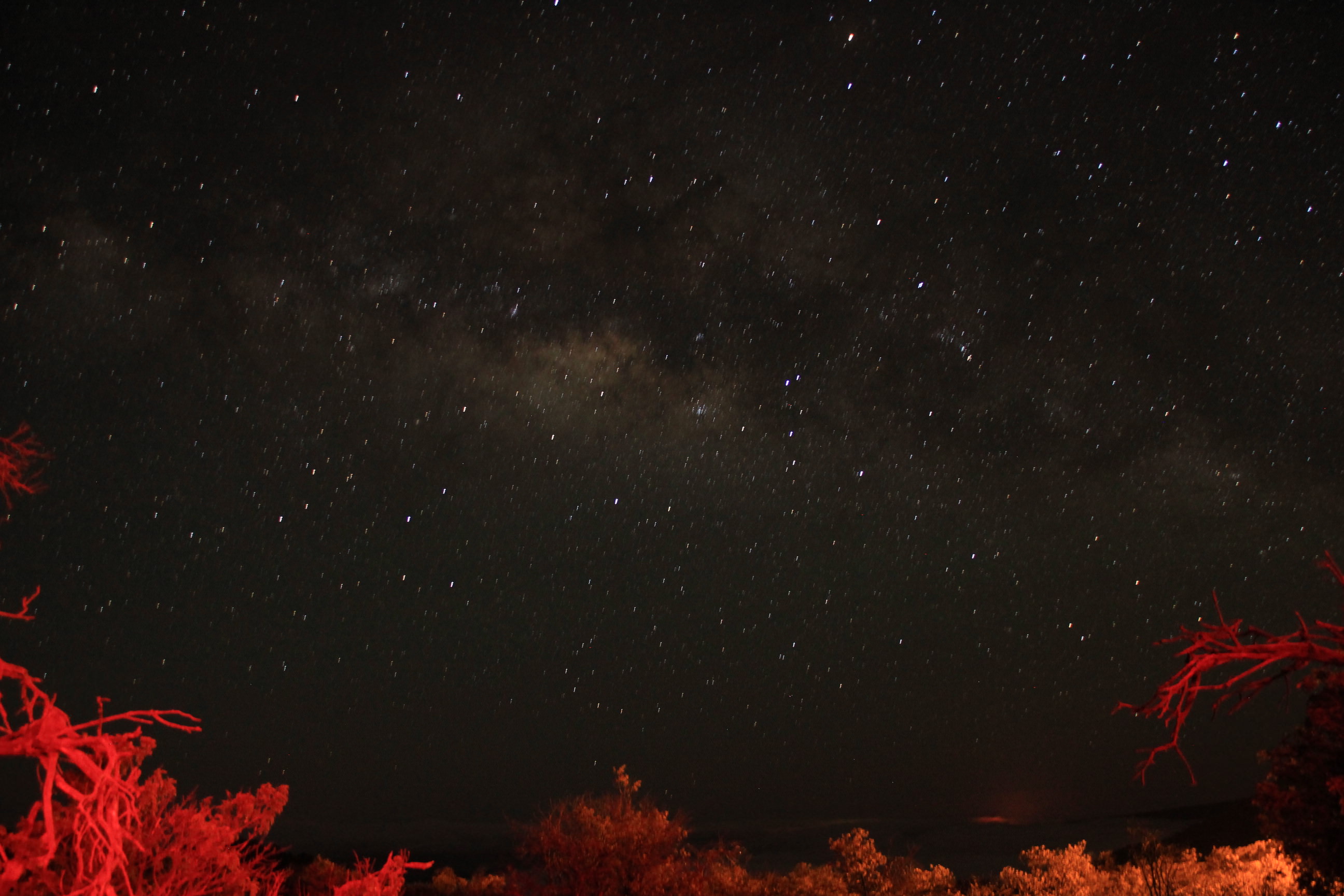
Here’s a great view of the Milky Way from the Onizuka Astronomy Center on the Big Island of Hawaii by astronomical artist Fahad Sulehria. To reach the summit of Mauna Kea, where some of the biggest telescopes on Earth reside, visitors must stop at the Onizuka Center for acclimating to the high altitude. The summit is about 4,200 meters (13,796 feet), and the Onizuka Center is located about 2,740 meters (9,000 feet) above sea level. “The sky is much clearer and less polluted than most places on Earth, making it an ideal place to do stargazing,” writes Sulehria. “In the background you see a red glow, which comes from the Halema’uma’u crater of the famous Kilauea Volcano on Hawaii.” Equipment: Canon 550D with 28-200 mm lens. Exposure: 31s @ ISO 1600/F3.5. See more of Sulehria’s work at his website, Nova Celestia Want to get your astrophoto featured on Universe Today? Join our Flickr group or send us your images by email (this means you’re giving us permission to post them). Please explain what’s in the picture, when you took it, the equipment you used, etc.
© nancy for Universe Today, 2012. | Permalink | No comment |
Post tags: Astrophotos
Feed enhanced by Better Feed from Ozh 


Image Caption: Neil Armstrong at the Kennedy Space Center (KSC) Saturn V Exhibit (Control Room) for the 30th Anniversary of Apollo 11 on July 16, 1999. Credit: John Salsbury In tribute to Neil Armstrong, first human to grace another world here's a new gallery of unpublished photos to enjoy as shared by my good friend – space photographer John Salsbury. Armstrong was the first person to walk on the Moon as the commander of NASA's Apollo 11 flight in 1969. Neil passed away on August 25, 2012 at age 82.(...)
Read the rest of Sharing Memories of Neil Armstrong – Photo Gallery (596 words)
© Ken Kremer for Universe Today, 2012. | Permalink | 21 comments |
Post tags: Apollo, Apollo 11, apollo 11 mission, Buzz Aldrin, kennedy space center, lunar landings, Michael Collins, Neil Armstrong
Feed enhanced by Better Feed from Ozh 


Yikes! Not to be outdone by the Blue Moon, the Sun had some impressive action on August 31, 2012 as well. A solar filament collapsed and and exploded, and the Solar Dynamics Observatory caught the action in dramatic detail. The view in extreme ultraviolet light is simply jaw-dropping! The segment in the 304 angstroms wavelength (where the Sun looks red) covers almost 3 hours of elapsed time. The SDO team says that long filaments like this one have been known to collapse with explosive results when they hit the stellar surface below. According to SpaceWeather.com, the CME propelled by the blast might deliver a glancing blow to Earth’s magnetic field in the days ahead.
(...)
Read the rest of Spectacular Filament Eruption on the Sun Captured by SDO (23 words)
© nancy for Universe Today, 2012. | Permalink | 5 comments |
Post tags: Solar Dynamics Observatory, sun
Feed enhanced by Better Feed from Ozh 


A blue-tinted Moon on August 31, 2012. Credit (and tinting): joeys-astro-gallery on Flickr
Last night’s full Moon was a “Blue Moon” — where the Moon isn’t really blue, but is the name for when there is a second full Moon in a month. Normally, we only get one full Moon a month, but every 2 1/2 years or so, the calendar lines up just right, since the time between full moons is 29.5 days while most months are 30 or 31 days. Since we had a full Moon on August 2 and a second one last night on August 31, Of course the Moon has reason to be “blue” (if we want to anthropomorphize a little) with the recent death of the first Moonwalker, Neil Armstrong. And sometimes the Moon can actually appear to be blue if volcanic ash or forest fire ash are in the atmosphere in your location, since ash particles can scatter away all the warm colors in Moonlight, leaving a pale blue tint to the Moon. Our readers sent in their Blue Moon images from last night, and some, like the one above, used a little image editing magic to make the Moon appear blue, but most are just gorgeous images of our closest neighbor and constant companion in space. Feast your eyes, below:
(...)
Read the rest of Was Last Night’s Moon Blue for You? (326 words)
© nancy for Universe Today, 2012. | Permalink | No comment |
Post tags: Astrophotos, Blue Moon, Moon
Feed enhanced by Better Feed from Ozh 


The feat has never been accomplished before and next week's departure for the Dawn spacecraft from Vesta will be monumental. Dawn is on track to become the first probe to orbit and study two distant solar system destinations. The spacecraft is scheduled to leave the giant asteroid Vesta on Sept. 4 PDT (Sept. 5 EDT) to start its two-and-a-half-year journey to the dwarf planet Ceres. “Thrust is engaged, and we are now climbing away from Vesta atop a blue-green pillar of xenon ions,” said Marc Rayman, Dawn’s chief engineer and mission director. “We are feeling somewhat wistful about concluding a fantastically productive and exciting exploration of Vesta, but now have our sights set on dwarf planet Ceres.
(...)
Read the rest of On to Ceres: Dawn Spacecraft Ready to Say Farewell to Asteroid Vesta (316 words)
© nancy for Universe Today, 2012. | Permalink | 4 comments |
Post tags: ceres, dawn, vesta
Feed enhanced by Better Feed from Ozh 


This video has been in production for a while and was not originally meant to honor Neil Armstrong, but it very well could memorialize the first human explorer to set foot on the Moon. This short video titled “From the Earth to the Moon” provides a stunning and inspirational view of the lunar surface, and "highlights vast portions of the lunar surface that have yet to be explored, and demonstrates how new images are revealing dramatic details of future landing sites suitable for both robotic and human missions," writes lunar scientist David Kring, one of the researchers behind creating this video. All of the footage is from actual images and data from the Lunar Reconnaissance Orbiter; there are no artist renditions or animations. "The scenes in the video are so dramatic that you may find yourself reaching out to pick up a rock and becoming restless to walk among the lunar peaks," writes Kring.
(...)
Read the rest of Dramatic New Video Brings You to the Dazzling Lunar Surface (301 words)
© nancy for Universe Today, 2012. | Permalink | 6 comments |
Post tags: Lunar Reconnaissance Orbiter, Moon
Feed enhanced by Better Feed from Ozh 


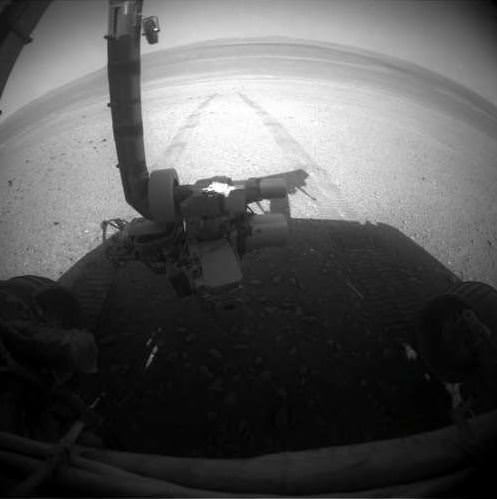
The Opportunity Mars rover looks back at the tracks left along the rim of Endeavour Crater. Credit: NASA/JPL-Caltech
Meanwhile, back in Meridiani Planum … the Opportunity rover keeps on trucking, and has now exceeded over 35 kilometers (21.75 miles) of driving on its odometer! Quite an accomplishment for the Energizer Bunny of Mars rovers, now operating for 3,057 Martian sols. As the MER team says, "Not bad for a vehicle designed for only about 1 kilometer (.6 miles) of distance and 90 sols (days) of lifetime." Oppy is now moving south along the inboard edge of Cape York on the rim of Endeavour Crater surveying exposed outcrop in search of phyllosilicate clay minerals that have been detected from orbit. These outcrops are quite interesting and attention-grabbing; here's a look in color from Stuart Atkinson:
(...)
Read the rest of Opportunity Rover Tops 35 Kilometers of Driving (156 words)
© nancy for Universe Today, 2012. | Permalink | 4 comments |
Post tags: Mars, Mars Rovers, Opportunity Rover
Feed enhanced by Better Feed from Ozh 


A radar map of Mars’ major volcanic regions created by the Arecibo Observatory in Puerto Rico (John Harmon et al., NAIC)
Even though we currently have several missions exploring Mars both from orbit and on the ground, there’s no reason that robots should be having all the fun; recently a team of radio astronomers aimed the enormous 305-meter dish at Puerto Rico’s Arecibo Observatory at Mars, creating radar maps of the Red Planet’s volcanic regions and capturing a surprising level of detail for Earth-based observations. (...)
Read the rest of Researchers Send Mars Some Radar Love (283 words)
© Jason Major for Universe Today, 2012. | Permalink | 3 comments |
Post tags: arecibo, Mars, NAIC, Pavonis Mons, radar, Radio Astronomy, volcano
Feed enhanced by Better Feed from Ozh 

| 









No comments:
Post a Comment
Keep a civil tongue.