| Here are the FeedBlitz blog updates for ignoble.experiment@arconati.us

Another West Coast centric edition of the Virtual Star Party. Not because of a lack of volunteers, but because while we were broadcasting, Hurricane Sandy was tearing up the East Coast of the United States. And as you can probably guess, hurricanes don’t make for great stargazing. Still, we had a wonderful night, with views of the full Moon, California Nebula, Veil Nebula, Crescent Nebula, Ring Nebula, Albiero, Double Cluster, M33, Cave Nebula, Wizard Nebula, Andromeda Galaxy, and many more objects. Click here to see all the pictures from last night’s event. Astronomers: Mike Chasin, Stuart Forman, Gary Gonella, and Roy Salisbury. Commentators: Dr. Thad Szabo, Dr. Phil Plait, Scott Lewis. Host: Fraser Cain We hold our Virtual Star Party every Sunday night when it gets dark on the West Coast, and broadcast live on Google+. Circle the Virtual Star Party page on G+ to get a notification of the event.
© Fraser for Universe Today, 2012. | Permalink | No comment |
Post tags:
Feed enhanced by Better Feed from Ozh 

Here's the view of Hurricane Sandy from an altitude of 254 statute miles from external cameras on the International Space Station. This video was shot as the ISS flew over the US's eastern seaboard at 12:52 Eastern time October 29, 2012. Sandy has yet to officially make landfall, but the huge storm is already battering a region that makes up the most densely populated area of the US. The combination of three different storms has caused it to be dubbed as "Frankenstorm," but it could turn into a “Blizzicane” as a winter storm merges with Sandy. The hurricane itself is strengthening as it barrels toward a landfall along the New Jersey coastline. Below is video of the ISS pass at 11:16 a.m on Monday:
(...)
Read the rest of Video: Hurricane Sandy Seen by Space Station Astronauts (184 words)
© nancy for Universe Today, 2012. | Permalink | 2 comments |
Post tags: Earth Observation, Hurricane Sandy, hurricanes, Space Station, Videos
Feed enhanced by Better Feed from Ozh 


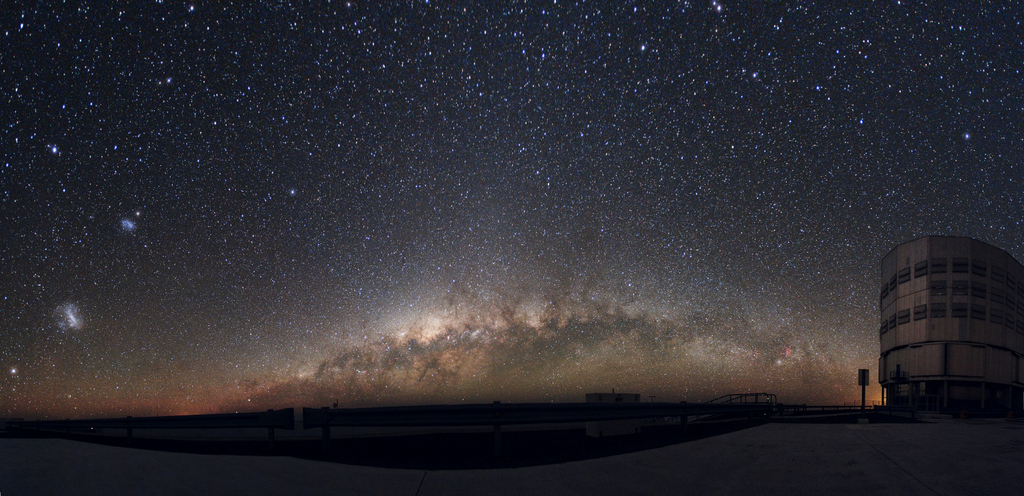
As the Milky Way rises over the horizon at the European Southern Observatory, its companion galaxies also come into view. Credit: ESO/Y. Beletsky
A previously undetected heist of stars was uncovered by astronomers who were actually looking for why an unexpected amount of microlensing events were being seen around the outskirts of the Milky Way. Instead, they found the Large Magellanic Cloud (LMC) had been stealing stars from its neighbor, the Small Magellanic Cloud (SMC), leaving behind a trail of stars. Although the crime was likely committed hundreds of milllions of years ago during a collision between the two galaxies, the new information is helping astronomers to understand the history of these two galaxies that are in our neighborhood. “You could say we discovered a crime of galactic proportions,” said Avi Loeb of the Harvard-Smithsonian Center for Astrophysics. The Large Magellanic Cloud almost got away with it, if it wasn't for those meddling astronomers….
(...)
Read the rest of Astronomers Uncover a Crime of Galactic Proportions (392 words)
© nancy for Universe Today, 2012. | Permalink | 3 comments |
Post tags: galaxies, Large Magellanic Cloud, milky way, Small Magellanic Cloud
Feed enhanced by Better Feed from Ozh 


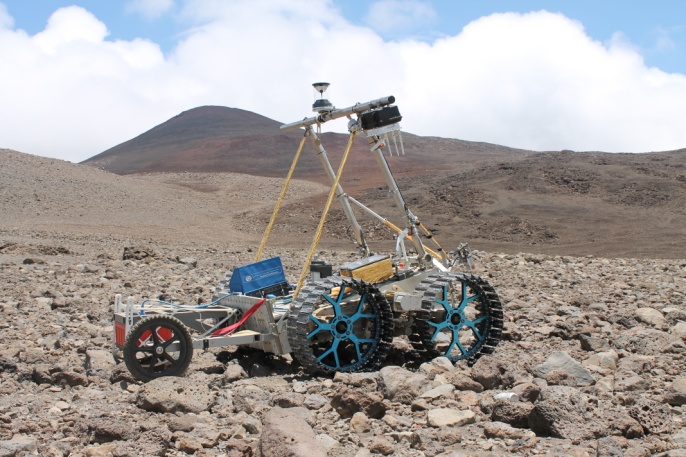
Prototype of the new Juno rover, a 300 kg rover for a mission to Mars or the Moon. Credit: CSA
The Canadian Space Agency is well known for its robotics but they've recently expanded from robotic arms to building prototypes for five new rovers, designed for future lunar and Mars missions. They range from microrovers to full-sized science missions and range in size from 30 kg up to 900 kg. The largest of them, the Lunar Exploration Light Rover, is designed to carry a scientific payload and can be fitted with a robotic arm. It has a range of 15 km, can be operated remotely, or can be used to carry astronauts across a planetary surface.
(...)
Read the rest of Could the Next Planetary Rover Come from Canada? (590 words)
© Evan Gough for Universe Today, 2012. | Permalink | One comment |
Post tags: Canadian Space Agency, rovers
Feed enhanced by Better Feed from Ozh 


The Orion Nebula, or M42 in a hybrid image of old DSLR data with new CCD images. Credit: Astrochuck on Flickr.
This view of the Orion Nebula makes it appear as a bloody mess! Astrochuck on Flickr said he’s been socked in with clouds and rain lately so took this opportunity to combine some older DSLR data with new CCD observations to create this stunning view of M42. Here are the specs: QHY9M & Orion ED102CF refractor 10/21/2012 & 10/22/2012
L- 7×600
R-3×600
G-3×600
B-3×600
(5×2 seconds for the core area) 3/22/12
Canon T3 w/Astronomik Ha filter & ST-80T refractor 5×120,10×300,5×600 @iso 1600
6×60 w/crosshairs for diffraction spikes Images acquired,aligned and stacked with Nebulosity V2.0, Guiding with Orion 50mm mini guider,SSAG and Phd. Combined & post processed with PS6 and StarTools. Want to get your astrophoto featured on Universe Today? Join our Flickr group or send us your images by email (this means you’re giving us permission to post them). Please explain what’s in the picture, when you took it, the equipment you used, etc.
© nancy for Universe Today, 2012. | Permalink | No comment |
Post tags: Astrophotos, Orion Nebula
Feed enhanced by Better Feed from Ozh 


Just released, this mesmerizing animation was created by Kevin Ward from images acquired by NOAA’s GOES-O/14 satellite. It shows the progression of Hurricane Sandy, currently a Category 1 hurricane off the coast of the eastern U.S. that’s poised to make a devastating impact when its heavy rains, winds and storm surges strike the shores of many major metropolitan coastal areas — including New York City and Washington, D.C. Nearly 12 hours of time are compressed into 30 seconds, revealing the evolution of Sandy as it churned over the Atlantic on Sunday, October 28. (...)
Read the rest of Incredible Video of Sandy’s Swirling Progression (310 words)
© Jason Major for Universe Today, 2012. | Permalink | No comment |
Post tags: animation, atlantic, eye, GOES-14, hurricane, Hurricane Sandy, NASA, satellite, storm
Feed enhanced by Better Feed from Ozh 


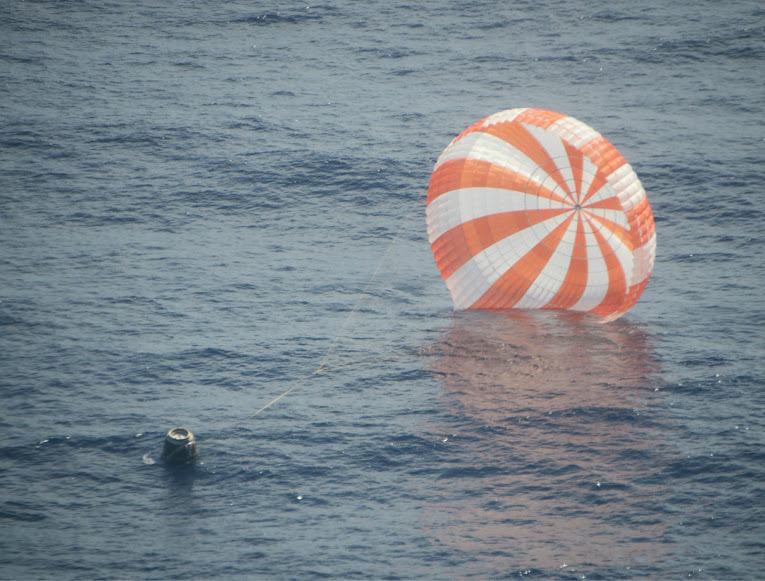
The Dragon capsule after splashing down successfully on October 28, 2012. Credit: SpaceX
After leaving the International Space Station earlier on Sunday, SpaceX's Dragon capsule returned to Earth from the International Space Station, safely splashing down in the Pacific Ocean about 400 kilometers (250 miles) off the coast of southern California. Inside the capsule are 758 kg (1,673 pounds) of return cargo including hardware, supplies, and a GLACIER freezer packed with scientific samples, including blood and urine samples of the astronauts on the space station, being returned for medical analysis. Currently, Dragon is the only craft capable of returning a significant amount of supplies to Earth, and this mission marks the first time since the retirement of the space shuttle that NASA has been able to return research samples for analysis. Both NASA and SpaceX were thrilled with the success of the mission.
(...)
Read the rest of SpaceX’s Dragon Splashes Down Safely (443 words)
© nancy for Universe Today, 2012. | Permalink | 6 comments |
Post tags: Commercial Space, International Space Station (ISS), Space Station, SpaceX
Feed enhanced by Better Feed from Ozh 

 The Andromeda Galaxy Courtesy of Bob Kocar
Greetings, fellow SkyWatchers! Are you ready for some spooky targets this week? Then follow along as we take a look at the “Little Eyes”, the “Skull Nebula” and a star that’s as red as a drop of blood! If the weather permits, we’ll also be enjoying the Taruid Meteor Shower! Time to dust off those optics and meet me in the backyard… (...)
Read the rest of Weekly SkyWatcher’s Forecast: October 29 – November 4, 2012 (2,186 words)
© tammy for Universe Today, 2012. | Permalink | No comment |
Post tags: Andromeda Galaxy, hunter's moon, pleiades, Skull Nebula, Taurid Meteor Shower
Feed enhanced by Better Feed from Ozh 

| 








No comments:
Post a Comment
Keep a civil tongue.