| Here are the FeedBlitz blog updates for ignoble.experiment@arconati.us
 An aurora seen in Norway on Aurora Borealis from September 2, 2013. Credit and copyright: Frank Olsen. Aurora season must have started in Scandinavia! Frank Olsen just posted this fantastic shot of the Aurora Borealis dancing across the sky and reflecting on the water in Norway, and below, astrophotographer Göran Strand recently captured shots of the aurora from northern Sweden. Enjoy these shimmering beauties and we look forward to seeing more aurora as the summer winds down in the northern hemisphere. (...)
Read the rest of Astrophoto: Aurora Dancing on the Water (102 words)
© nancy for Universe Today, 2013. | Permalink | No comment |
Post tags:
Feed enhanced by Better Feed from Ozh
 Comet ISON shows a small, compact coma and short, faint tail in this photo made by Hungarian astrophotographer Krisztian Sarneczky on Aug. 31, 2013. Credit: K. Sárneczky / Konkoly Observatory OK, you’ve waited patiently for Comet ISON to brighten and reappear in the dawn sky. It has. Now you’re chomping at the bit for a look at it in your telescope. Before you set the alarm and venture into the night, let’s prepare for what to expect. The better you know your target, the easier it will be to find.
(...)
Read the rest of Ready, Set, Observe! How to See Comet ISON In The Early Morning Sky (698 words)
© Bob King for Universe Today, 2013. | Permalink | One comment |
Post tags: Beehive, coma, Comet ISON, Mars
Feed enhanced by Better Feed from Ozh

Have a discussion about the origins of the Universe and, ere long, someone will inevitably use the term “the Big Bang” to describe the initial moment of expansion of everything that was to everything that is. But in reality “Big Bang” isn’t a very good term since “big” implies size (and when it occurred space didn’t technically exist yet) and there was no “bang.” In fact the name wasn’t ever even meant to be an official moniker, but once it was used (somewhat derisively) by British astronomer Sir Fred Hoyle in a radio broadcast in 1949, it stuck. Unfortunately it’s just so darn catchy. This excellent video from minutephysics goes a bit more into depth as to why the name is inaccurate — even though we’ll likely continue using it for quite some time. (Thanks to Sir Hoyle.) And you have to admit, a television show called “The Everywhere Stretch Theory” would never have caught on. Bazinga!
© Jason Major for Universe Today, 2013. | Permalink | 17 comments |
Post tags: Big Bang, Cosmology, expansion, Fred Hoyle, minutephysics, religion, Science, space, universe
Feed enhanced by Better Feed from Ozh
 Mars on September 8th. Click on image to enlarge. (Created by the author using Stellarium). Launch season for Mars missions is almost upon us once again. This is a time when spacecraft can achieve an optimal trajectory to reach the Red Planet, expending a minimal amount of fuel and taking the shortest period of time. This window of opportunity, which opens once every two years, always opens up about six months prior to Martian opposition. For you stargazers, this is also the best time to observe the Red Planet as it makes its closest approach to Earth. And no, it won't appear as large as a Full Moon, but it will make for a fine telescopic target. (...)
Read the rest of How to See Mars in September 2013: The Red Planet Pierces the Beehive & More (815 words)
© David Dickinson for Universe Today, 2013. | Permalink | No comment |
Post tags: beehive cluster, Comet ISON, m44, Mars, Mars MAVEN, MAVEN, messier 44
Feed enhanced by Better Feed from Ozh
 Astronaut Drew Feustel reenters the space station after completing an 8-hour, 7-minute spacewalk at on Sunday, May 22, 2011. He and fellow spacewalker Mike Fincke conducted the second of the four EVAs during the STS-134 mission. Credit: NASA It’s easy to take the International Space Station for granted. It’s been planned, under construction and/or operated for decades. Humans have occupied it continuously for 4,684 days (close to 13 years) as of today. According to two space policy experts, however, NASA should already be thinking of what it’s going to do next after the station’s current agreement expires in 2020. Ignoring the deadline, they said, could lead to consequences such as (in one scenario) the end of U.S. government spaceflight altogether. Below are edited excerpts from two officials from George Washington University’s Elliott School of International Affairs. Scott Pace is its director, and John M. Logsdon is a professor emeritus. They spoke with reporters Thursday (Aug. 29) about the coming NASA budget decision and their views on the agency’s future. We’d also like to get your feedback on their ideas, so please leave your thoughts in the comments. (...)
Read the rest of ‘Drift Is The Most Dangerous Thing For NASA’ (879 words)
© Elizabeth Howell for Universe Today, 2013. | Permalink | 22 comments |
Post tags:
Feed enhanced by Better Feed from Ozh
 Are Earthlings really Martians ?
Did life arise on Mars first and then journey on rocks to our planet and populate Earth billions of years ago? Earth and Mars are compared in size as they look today. NASA's upcoming MAVEN Mars orbiter is aimed at answering key questions related to the habitability of Mars, its ancient atmosphere and where did all the water go.
Story updated Are Earthlings really Martians? That's the controversial theory proposed today (Aug. 29) by respected American chemist Professor Steven Benner during a presentation at the annual Goldschmidt Conference of geochemists being held in Florence, Italy. It's based on new evidence uncovered by his research team and is sure to spark heated debate on the origin of life question. Benner said the new scientific evidence "supports the long-debated theory that life on Earth may have started on Mars," in a statement. Universe Today contacted Benner for further details and enlightenment. "We have chemistry that (at least at the level of hypothesis) makes RNA prebiotically," Benner told Universe Today. "AND IF you think that life began with RNA, THEN you place life’s origins on Mars." Benner said (...)
Read the rest of Are We Martians? Chemist’s New Claim Sparks Debate (1,567 words)
© Ken Kremer for Universe Today, 2013. | Permalink | 16 comments |
Post tags: Astrobiology, Curiosity, Curiosity Rover, Gale crater, Mars, Mars MAVEN, Mars Rovers, MAVEN, Mount Sharp, origin of life, Origin of life on Earth, panspermia, Search for Life, Steven Benner
Feed enhanced by Better Feed from Ozh
 The NASA P-3B’s shadow on sea ice off of southeast Greenland during an IceBridge survey on Apr. 9, 2013. Flying at a low altitude allows IceBridge researchers to gather detailed data. Credit: NASA / Jim Yungel There's a "Chuck Norris fact" that says Chuck once went skydiving but promised never to do it again, saying one Grand Canyon is enough. But Chuck must have taken another jump millions of years ago. Data gathered by NASA’s Operation IceBridge, an aerial science observation mission, has uncovered a previously unknown massive canyon in Greenland, hidden under a kilometer of ice.
(...)
Read the rest of Massive ‘Grand Canyon’ Found Hidden Beneath Greenland’s Ice (400 words)
© nancy for Universe Today, 2013. | Permalink | 34 comments |
Post tags: canyons, greenland, Operation IceBridge
Feed enhanced by Better Feed from Ozh
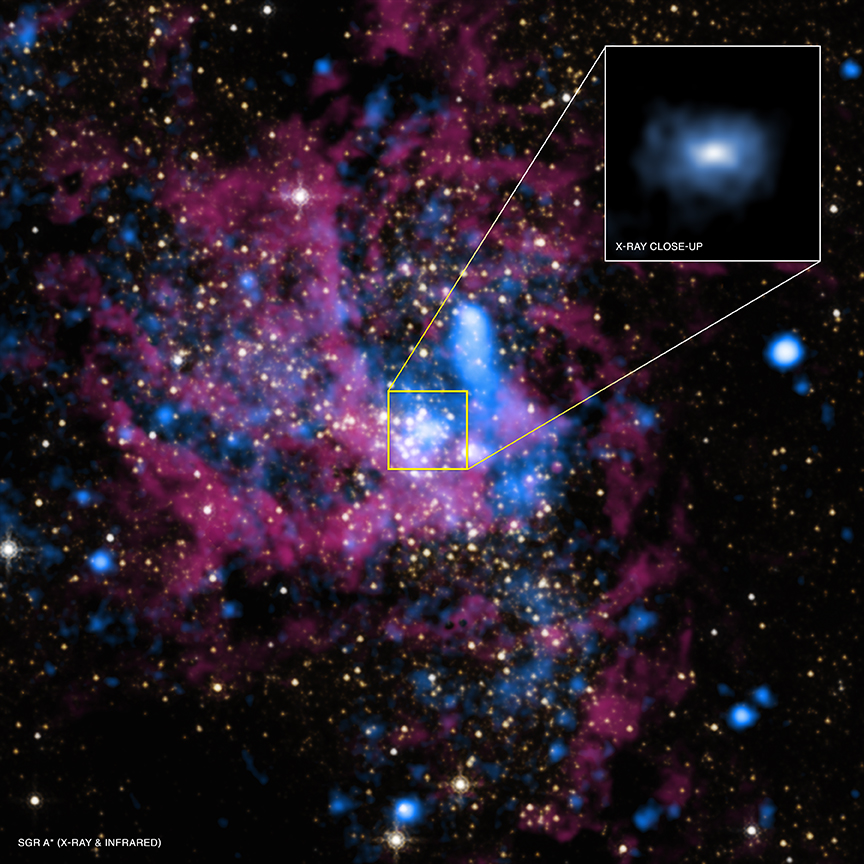
 X-ray (Chandra) and infrared (Hubble) image of Sgr A*, the supermassive black hole in the center of the Milky Way Like most galaxies, our Milky Way has a dark monster in its middle: an enormous black hole with the mass of 4 million Suns inexorably dragging in anything that comes near. But even at this scale, a supermassive black hole like Sgr A* doesn’t actually consume everything that it gets its gravitational claws on — thanks to the Chandra X-ray Observatory, we now know that our SMB is a sloppy eater and most of the material it pulls in gets spit right back out into space. (Perhaps it should be called the Cookie Monster in the middle.*) (...)
Read the rest of Our Galaxy’s Supermassive Black Hole is a Sloppy Eater (492 words)
© Jason Major for Universe Today, 2013. | Permalink | 5 comments |
Post tags: black hole, Chandra, G2, gas cloud, infrared, Physics, Sagittarius, sgr a, SMB, X-ray
Feed enhanced by Better Feed from Ozh
| 









No comments:
Post a Comment
Keep a civil tongue.