| December 17, 2013 | | | | |  | | | The Hundred-Year Forecast | | | - A historical gathering of 80 Fed heads… we watched the hour-long ceremony so you don't have to...
- "Forecast season continues": Ben Bernanke makes a 100-year forecast… and we riposte with our own prediction… (Hint: It doesn't end well for the greenback)...
- Plus, the windmills the U.S. will chase as the dollar is toppled as king of the hill… a look at the Asian "pivot" one year later… and more!
|
| | | | | | | External Advertisement
Is it possible for human beings to live centuries at a time? It's not only possible, but technology is already available to make it happen. Geneticists at Cambridge University and MIT all are predicting we will live far longer than most people believe possible. And one tiny company in Massachusetts holds the key to radically increasing our lifespans… while radically expanding our investment returns. Click here to see what this is all about. | | | | | | | | Addison Wiggin, observing the commemoration of a fateful day in 1913...
 The scene: Yesterday, inside the ornate board room of the Federal Reserve's Eccles building on Constitution Avenue. Thirty-four years' worth of Fed chairmen were present -- Paul Volcker, Alan Greenspan and Ben Bernanke. The occasion? The celebration of 100 years since the signing of the Federal Reserve Act. We watched the whole hour and four minutes on YouTube so you don't have to. The scene: Yesterday, inside the ornate board room of the Federal Reserve's Eccles building on Constitution Avenue. Thirty-four years' worth of Fed chairmen were present -- Paul Volcker, Alan Greenspan and Ben Bernanke. The occasion? The celebration of 100 years since the signing of the Federal Reserve Act. We watched the whole hour and four minutes on YouTube so you don't have to.
Each chairman spoke in turn, nary uttering one ill or critical word of their counterparts:
"In my time," boomed Paul Volcker first, "interest rates were at 20% and we were preoccupied with inflation. Chairman Bernanke is ready to leave office with interest rates at zero."
Then came Greenspan. "The crisis of 1987 was, in my judgment," he said, pretending the '90s and early '00s didn't exist, "the [Fed] operating at its best..."
After him was current chairman Ben Bernanke, who began his last FOMC meeting today. (We could hardly…*sob*... hold back the tears as we watched him speak. Seven years feels like just yesterday…)
"Given the well-known difficulties that economists have in forecasting even the next few quarters," he said ironically to a roomful of laugher, "I will happily point out one important advantage in making a 100-year forecast, which is that I won't be around to explain why the forceast went wrong…"
[More laugher]
Then, in the spirit of "forecast season," Bernanke made a 100-year prediction:
"I can venture one prediction that I don't think is too bold," he said. "The values that have sustained and served the Federal Reserve at its best and have permitted it to make critical contributions to the economic health of our nation during the past century will continue to serve it and the nation well in the century ahead."
| The Fed is going to let the dollar die at the hands of the Chinese far before the next century is over. | Really… We'll take the other side of that bet, thank you very much.
In fact, we're going to cut Bernanke's forecast off at the ankles. Here's our own bold prediction: The Fed is going to let the dollar die at the hands of the Chinese far before the next century is over.
Let's back up a bit...
Our forecast, like most economic forecasts, traces its roots back to a dead economist. This one's name is, rather, was Robert Triffin. Mr. Triffin prophesied China would tank the dollar -- way back in 1960. Back then, he issued a stark warning to Congress all but foretelling the demise of the dollar's role as the world's currency of choice. Triffin prophesied that any reserve currency was ultimately doomed… at the time he cited the cracks he'd already observed in the foundation of the Bretton Woods system established after World War II.
"As the global economy expanded," Reuters columnist John Kemp gives us a head explaining, "demand for reserve assets increased. These could only be supplied to foreigners by America running a current account deficit and issuing dollar-denominated obligations to fund it. If the United States stopped running balance of payments deficits and supplying reserves, the resulting shortage of liquidity would pull the global economy into a contractionary spiral.
"But Triffin warned that if the deficits continued, excess global liquidity risked fueling inflation. Worse still, the buildup in dollar-denominated liabilities might cause foreigners to doubt whether the United States could maintain gold convertibility or might be forced to devalue."
In a nutshell, this economic conundrum is known to academics, policy wonks, arm-chair economists, cranks and financial newsletter editors as "Triffin's dilemma."
For most of the ensuing 53 years, Washington has chosen the latter of the two options, flooding the world with dollars. Triffin prophesied the inevitable result, in four stages…
In Stage 1, the Bretton Woods system would collapse as other nations traded in their dollars for gold, draining the U.S. Treasury's gold stash. Sure enough, President Nixon "closed the gold window" in 1971 and cut the dollar's last tie to gold.
| What happens when the rest of the world no longer needs dollars to do business? | Then, the dollar's drop in value would accelerate and U.S. exports would decline dramatically. Sure enough, "Japan Inc." gave the world cheap electronics and cars in the '80s and early '90s while buying up choice U.S. real estate like Rockefeller Center.
After that, the U.S. would run massive budget deficits in the third stage, egged on by Federal Reserve money printing, ultimately triggering a financial crisis.
Let's see… hmmmm…yeah, check…. that was the Panic of 2008. The detritus from which we're still coping.
So…what about stage four?
Well, China's been quietly setting it. It's allowing the yuan to strengthen gradually -- 30% over the last eight years. Most recently, China's central bank announced it will stop increasing its dollar reserves, allowing its currency to strengthen even more. At the same time, the government is silently building a huge stash of gold to back the yuan. The goal is to have a yuan that's "fully convertible" to other world currencies by 2015.
During the last two years, seven of the world's top 12 economies have moved to bypass the dollar in their transactions with China. Even Japan is in on the act: Despite a wicked border dispute between the two governments, plans are in the works to trade directly in yen and yuan.
What happens when the rest of the world no longer needs dollars to do business? For a sneak peek… we observe some political wrangling on the opposite side of the globe and forecast new intrigue in 2014 known colloquially as "the pivot". Read on below…
[Side Note: We hope you enjoyed last night's live webinar. If you missed it… don't worry… we're working with new partners on something even better! We're keeping the opportunity under tight wraps for now. But if you're already a member of the Agora Financial's Reserve you should've received your invitation already. If not, keep your eyes peeled.
We'll also be sending you a list of the new investment services we're launching for 2014 in the Reserve... as well as new partnership opportunities we've got in the works. (Hint: one of the new advisories will be first in line to cover a brand new industry created by the 2012 Jobs Act and expected to skyrocket from zero to $300 billion in 2014 alone. (Gotta love changes is government policy, eh?) Stay tuned.] | | | | | | | | | Could This Completely Destroy The Democratic Party's Platform? It's shocking stuff. Bigger than anything you might hear on Talk Radio.
A Florida-based computer expert is breaking an incredible story. Perhaps the biggest political story of the next decade.
In short, the last five years of the Democratic Party's agenda could be undone.
Gun control. ObamaCare. Internet sales taxes. All could be rendered irrelevant. Sooner than anyone thought possible before…
For obvious reasons, you likely won't see this story picked up in mainstream media outlets.
Instead, this whistleblower is putting everything he discovered up in a free video.
| | | | | | | | The Daily Reckoning Presents…
| | | | Looking For Enemies in All the Right Places | | | | by Addison Wiggin | | | The year 2013 is ending much the way we described it at the start: China and Japan holding a urination match over some tiny uninhabited islands — with the United States in the, um, line of fire.
As we go to press, Chinese and Japanese fighter jets are buzzing each other's territory. Chinese and Japanese leaders are spewing indignant rhetoric.
Fortunately for the lives of those soldiers who have sworn to uphold their leaders' promises to engage, that's all it's amounted to. But as we noted in January and again in early October, the threat of hot war is ever-present. And the United States is obligated by treaty to side with Japan.
As for a "new enemy," it took more than 20 years of stumbling about for Washington to find a suitable one. Saddam Hussein was a placeholder for a while. There was also the amorphous "terror," which is no longer deemed worthy of a "war on," but merely designated as "overseas contingency operations."
| "China has become America's default adversary, the power against which the United States measures itself militarily" | Enter China: "Since the disappearance of the Soviet Union," writes James Dobbins at RAND Corp., "China has become America's default adversary, the power against which the United States measures itself militarily, at least when there is no more proximate enemy in sight."
Thus is the United states "the most intrusive outside actor in China's internal affairs," write Andrew Nathan and Andrew Scobell in Foreign Affairs, "the guarantor of the status quo in Taiwan, the largest naval presence in the East China and South China seas, the formal or informal military ally of many of China's neighbors and the primary framer and defender of existing international legal regimes."
And that's with "the pivot" barely underway. In November 2011, when Hillary Clinton was still secretary of state, she declared, "The United States stands at a pivot point" — withdrawing troops from Iraq and Afghanistan and shifting attention to East Asia. The D.C. wonk class has spoken of "the pivot" ever since.
Two years on, we daresay history might well look upon this moment as the formal declaration of a new Cold War.
According to former CNN journalist Mike Chinoy, the pivot entails the Navy locating "60% of its assets" in the Pacific Ocean. "It will involve deploying six aircraft carriers, destroyers, littoral combat ships, submarines and an increase in military exercises and port visits."
 Click to enlarge. Click to enlarge.
Nor does it end there. "One means of improving the prospects for direct defense and reducing the risk of escalation," writes RAND's Dobbins, "is for the United States to enable the capabilities and buttress the resolve of China's neighbors.
"Such a strategy," he adds, "should not be — or be seen — as a U.S. attempt to encircle or align the region against China, lest it produce greater Chinese hostility."
Too late: No sooner did Clinton declare the pivot than the Center for Strategic International Studies forecast "a shift in Chinese foreign policy based on the new leadership's judgment that it must respond to a U.S. strategy that seeks to prevent China's re-emergence as a great power."
"Buttressing the resolve" of China's neighbors is only the beginning of U.S. strategy, however. The Pentagon has formulated a strategy called Air-Sea Battle (ASB).
| The Pentagon insists ASB — and the pivot in general — is not aimed at China. | The aim is to sprinkle so many bases and airstrips around the region that China would be too hemmed in to safely attack if conflict broke out.
"Stealthy American bombers and submarines would knock out China's long-range surveillance radar and precision missile systems located deep inside the country," reads a Washington Post scenario. "The initial 'blinding campaign' would be followed by a larger air and naval assault."
Could such a strategy backfire? "Some Asia analysts worry that conventional strikes aimed at China could spark a nuclear war," the Post goes on. Other critics "see a dangerous tendency toward alarmism that is exaggerating the China threat to drive up defense spending."
The Pentagon insists ASB — and the pivot in general — is not aimed at China. For the moment, the Chinese are playing along with the pretense. After a meeting with Defense Secretary Chuck Hagel in August, China's defense minister, Gen. Chang Wanquan, said, "China is a peace-loving nation. And we hope that [America's] strategy does not target a specific country in the region." | | | | | | |
| The One Retirement Plan Obama Can't Touch If you've already retired, or want to retire soon, I urge you to watch this video presentation before we have to pull it down. This "Secret $200 Retirement Blueprint" shows you step-by-step how to grow a monster-sized nest egg with a little time and a tiny grubstake. | | | | | | | | The reality is rather different. "China will be much more discreet throughout the entire region because U.S. power is already there, it's visible," says Anthony Cordesman from the Center for Strategic and International Studies. "You're not talking theory. You're already there in practice… As part of this rebalancing to the Pacific, you have to show people it's real at a time when so much of U.S. power is increasingly questioned by our budget debates."
And indeed, the effort can be made without spending (much) more money. "We're not gonna build any more bases in the Pacific," says Gen. Herbert "Hawk" Carlisle, commander of all U.S. Air Force resources in the region. But existing bases will be expanded and abandoned bases will be reopened — including the airstrip on the island of Tinian where the Enola Gay took off with its atomic payload destined for Hiroshima.
Indeed, the very notion makes Gen. Carlisle almost misty-eyed with nostalgia. "Back in the late, great days of the Cold War, we had a thing called Checkered Flag: We rotated almost every CONUS [Continental United States] unit to Europe. Every two years, every unit would go and work out of a collateral operating base in Europe. We're turning to that in the Pacific."
| Asia is the main theater of the brewing U.S.-China war. | Happy days are here again!
Asia is the main theater of the brewing U.S.-China war. But the "security guarantees" aren't only for Japan. In October, Secretary of State John Kerry met with Philippine Foreign Minister Albert del Rosario. "I want to emphasize the strength of our relationship," said Kerry, "and the bilateral ties that we have that are literally unbreakable." Like Japan, the Philippines are locked in a dispute with China over a handful of islands.
Washington insiders, reading between the lines of Kerry's remarks, saw the implication that "the U.S. has a direct interest in resisting Chinese territorial claims in the South China Sea" — as the words of the Washington Assessment and Analysis Service phrased it.
"It is not premature," the briefing adds, "to detect a hardening of U.S. resolve not to accept Chinese assertiveness in the region without a challenge."
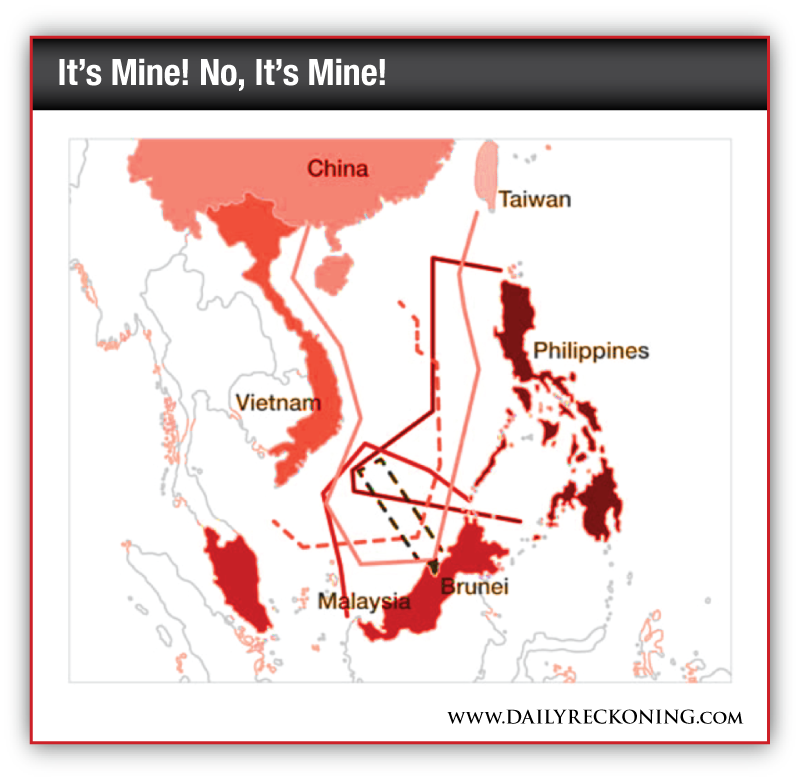
Put it another way: Washington is bound and determined to intervene in a messy dispute over islands in the South China Sea. The spaghetti-looking lines on the map nearby represent the competing territorial claims of not only China and the Philippines, but three more nations as well. The long U-shaped line is China's claimed domain.
 Click to enlarge. Click to enlarge.
It's as if the United States were arguing with Mexico, Cuba, Jamaica and the Bahamas over some islands in the Gulf of Mexico… and China asserted a "vital national interest" in the dispute, backing up that assertion with the presence of warships.
As we said, the empire has a logic all its own. "America," writes Independent Institute foreign policy scholar Ivan Eland, "is now borrowing money from China to subsidize the defense of rich East Asian allies in their quest to militarily counter… well… China."
There's nothing you or I can do to stop the madness. So we seek to follow the money and help you channel some of it to your own pocket, reclaiming your lost tax dollars.
Regards,
Addison Wiggin
for The Daily Reckoning | | | | | | | | |  Addison Wiggin is a three-time New York Times bestselling author and the cofounder of the Daily Reckoning. Addison Wiggin is a three-time New York Times bestselling author and the cofounder of the Daily Reckoning. | | | | | | | | | BE SURE TO ADD dr@dailyreckoning.com to your address book.
| | | | | | | Additional Articles & Commentary:
Join the conversation! Follow us on social media:
| | | | | | | | | |




 © 2013 Agora Financial, LLC. 808 Saint Paul Street, Baltimore MD 21202. Although our employees may answer your general customer service questions, they are not licensed under securities laws to address your particular investment situation. No communication by our employees to you should be deemed as personalized investment advice.


No comments:
Post a Comment
Keep a civil tongue.