| Here are the FeedBlitz blog updates for ignoble.experiment@arconati.us
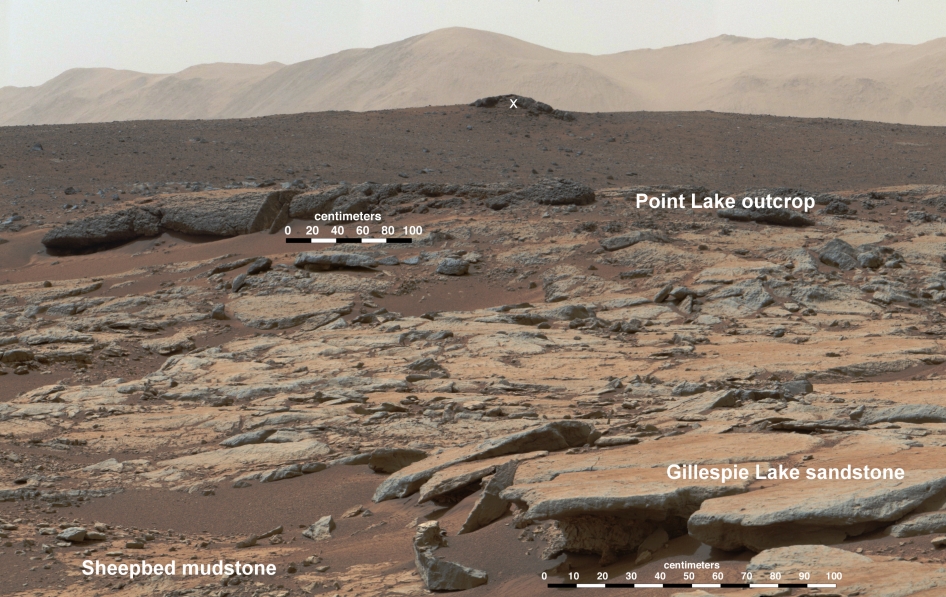
 Outcrops in Yellowknife Bay are being exposed by wind driven erosion. These rocks record superimposed ancient lake and stream deposits that offered past environmental conditions favorable for microbial life. This image mosaic from the Mast Camera instrument on NASA’s Curiosity Mars rover shows a series of sedimentary deposits in the Glenelg area of Gale Crater, from a perspective in Yellowknife Bay looking toward west-northwest. The “Cumberland” rock that the rover drilled for a sample of the Sheepbed mudstone deposit (at lower left in this scene) has been exposed at the surface for only about 80 million years. Credit: NASA/JPL-Caltech/MSSS NASA's Curiosity rover has discovered evidence that an ancient Martian lake had the right chemical ingredients that could have sustained microbial life forms for long periods of time – and that these habitable conditions persisted until a more recent epoch than previously thought. Furthermore researchers have developed a novel technique allowing Curiosity to accurately date Martian rocks for the first time ever – rather than having to rely on educated guesses based on counting craters. All that and more stems from science results just announced by members of the rover science team.(...)
Read the rest of Curiosity Discovers Ancient Mars Lake Could Support Life (673 words)
© Ken Kremer for Universe Today, 2013. | Permalink | One comment |
Post tags: Curiosity Rover, Gale crater, Mars, Mars Rovers, Mars Science Laboratory (MSL), Mars Science Laboratory (MSL) Curiosity Rover, NASA, red planet, Search for Life, yellowknife bay
Feed enhanced by Better Feed from Ozh
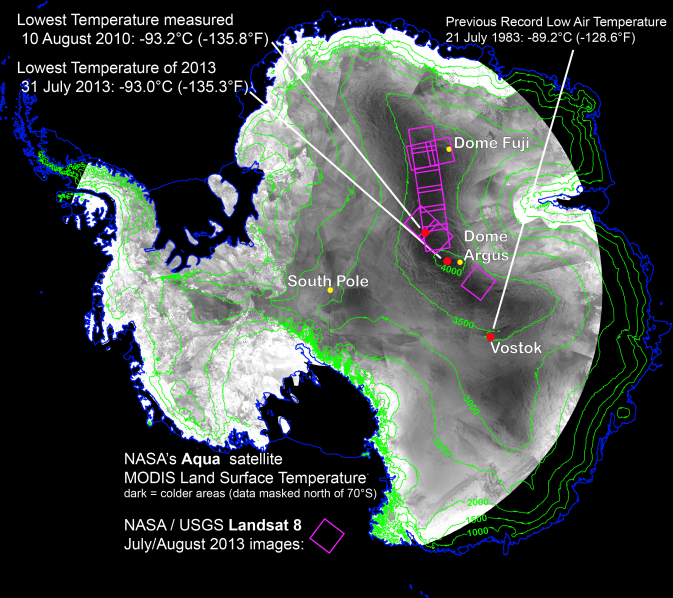
 With remote-sensing satellites, scientists have found the coldest places on Earth, just off a ridge in the East Antarctic Plateau. The coldest of the cold temperatures dropped to minus 135.8 F (minus 93.2 C) — several degrees colder than the previous record.
Image Credit: Ted Scambos, National Snow and Ice Data Center. What is the coldest place on Earth? Scientists say it's a place so cold that ordinary mercury or alcohol thermometers won't work there. If you were there, every breath would be painful, your clothing would crackle every time you moved, and if you threw hot water into the air, it would fall to the ground as tiny shards of ice. At this place, the new record of minus 136 F (minus 93.2 C) was set on Aug. 10, 2010. Researchers analyzed data from several satellite instruments and found the coldest place on Earth in the past 32 years is … (...)
Read the rest of And the Coldest Place on Earth Is … (545 words)
© nancy for Universe Today, 2013. | Permalink | One comment |
Post tags: Earth, Earth Observation, Landsat, landsat 8, MODIS
Feed enhanced by Better Feed from Ozh

Here’s how the Moon will look to us on Earth during the entire year of 2014. Using data from the Lunar Reconnaissance Orbiter, the Goddard Space Flight Center Scientific Visualization Studio can project how the Moon will appear, and compresses one month into 24 seconds and a year to about 5 minutes. Above is the video where Celestial north is up, corresponding to the view from the northern hemisphere, and below is how the Moon will look from the southern hemisphere.
(...)
Read the rest of See What the Moon Will Look Like in All of 2014 in Just 5 Minutes (171 words)
© nancy for Universe Today, 2013. | Permalink | One comment |
Post tags: Moon, phases of the moon
Feed enhanced by Better Feed from Ozh
 The morning zodiacal as seen from near Rodeo, New Mexico, looking east at 5:00 am December 6, 2013. Credit and copyright: Alan Dyer/Amazing Sky Photography. Sometimes, if you are lucky, dawn comes before the dawn. The zodiacal light – or false dawn, as it is sometimes called – is an ethereal light extending up from the horizon, sometimes seen about an hour before sunrise or an hour after sunset. At one time, it was thought this was an atmospheric phenomenon, but it’s more cosmic than that! Zodiacal light is sunlight reflecting off dust grains in space. These dust grains are likely left over from the same process that created Earth and the other planets of our solar system 4.5 billion years ago. Alan Dyer captured this beautiful view of the zodiacal light on a recent trip to New Mexico. If you look closely you can see some other cosmic phenomena as well: “Mars is above centre and Saturn is just rising over the mountain ridge,” Alan wrote on Flickr. “Comet Lovejoy C/2013 R1 is at far left. The image includes the position (left of centre, above the mountains left of the Zodiacal Light) where Comet ISON (C/2012 S2) would have been had it survived passage around the Sun.”
(...)
Read the rest of Astrophoto: Zodiacal Light at Dawn (60 words)
© nancy for Universe Today, 2013. | Permalink | No comment |
Post tags: Astrophotos, zodiacal light
Feed enhanced by Better Feed from Ozh

The Universe is filled with hot fusion, in the cores of stars. And scientists have even been able to replicate this stellar process in expensive experiments. But wouldn’t it be amazing if you could produce energy from fusion without all that equipment, and high temperatures and pressures? Pons and Fleischmann announced exactly that back in 1989, but things didn’t quite turn out as planned… (...)
Read the rest of Astronomy Cast Ep. 325: Cold Fusion (46 words)
© Fraser for Universe Today, 2013. | Permalink | No comment |
Post tags: cold fusion, fusion, sun
Feed enhanced by Better Feed from Ozh
 Here is another giveaway just in time for the holidays: The Constellation Observing Atlas by Grant Privett and Kevin Jones. Springer and Universe Today are giving away free copies to two lucky Universe Today readers. Here is another giveaway just in time for the holidays: The Constellation Observing Atlas by Grant Privett and Kevin Jones. Springer and Universe Today are giving away free copies to two lucky Universe Today readers.
Review by: Evan Gough The night sky is vast and full of wonders, and binoculars or a telescope can bring these wonders into view. The planets and the moon are easy to find, but after that, the rest of the objects in the night sky can be challenging to locate. "The Constellation Observing Atlas," by Grant Privett and Kevin Jones, will guide you around the night sky, and help you find the most interesting objects. This atlas uses the patterns of the constellations to cut the sky up into bite-sized pieces, giving the amateur observer an easy to use method for exploring the night sky. "The Constellation Observing Atlas" has a section for each one of the eighty-eight constellations recognized by the International Astronomical Union, from Andromeda to Vulpecula. (...)
Read the rest of Book Review and Giveaway: The Constellation Observing Atlas (389 words)
© Evan Gough for Universe Today, 2013. | Permalink | One comment |
Post tags:
Feed enhanced by Better Feed from Ozh
 Composite image of Circinus X-1, which is about 24,000 light-years from Earth in the constellation Circinus. Credit: X-ray: NASA/CXC/Univ. of Wisconsin-Madison/S. Heinz et al; Optical: DSS; Radio: CSIRO/ATNF/ATCA Circinus X-1 may look like a serene place from a distance, but in reality this gassy nebula is quite a busy spot. Embedded in the nebula is the neutron star that is also a leftover of the supernova that produced the gas. Not only that, but the neutron star is still locked on to a companion and is in fact “cannibalizing” it, astronomers said. The “glowing wreck of a star”, as the team called it, is exciting because it demonstrates what systems look like in the first stages after an explosion. The nebula is an infant in cosmic terms, with an upper limit to its age of just 4,500 years. To put that in human terms, that’s around the time of the first civilizations (such as in Mesopotamia). “The fact that we have this remnant along with the neutron star and its companion means we can test all kinds of things,” stated Sebastian Heinz, an astronomy professor at the University of Wisconsin-Madison who led the research. (...)
Read the rest of ‘Glowing Wreck Of A Star’ Reveals Cosmic Cannibalism (350 words)
© Elizabeth Howell for Universe Today, 2013. | Permalink | No comment |
Post tags: circinus x-1, nebula, x-ray binary
Feed enhanced by Better Feed from Ozh
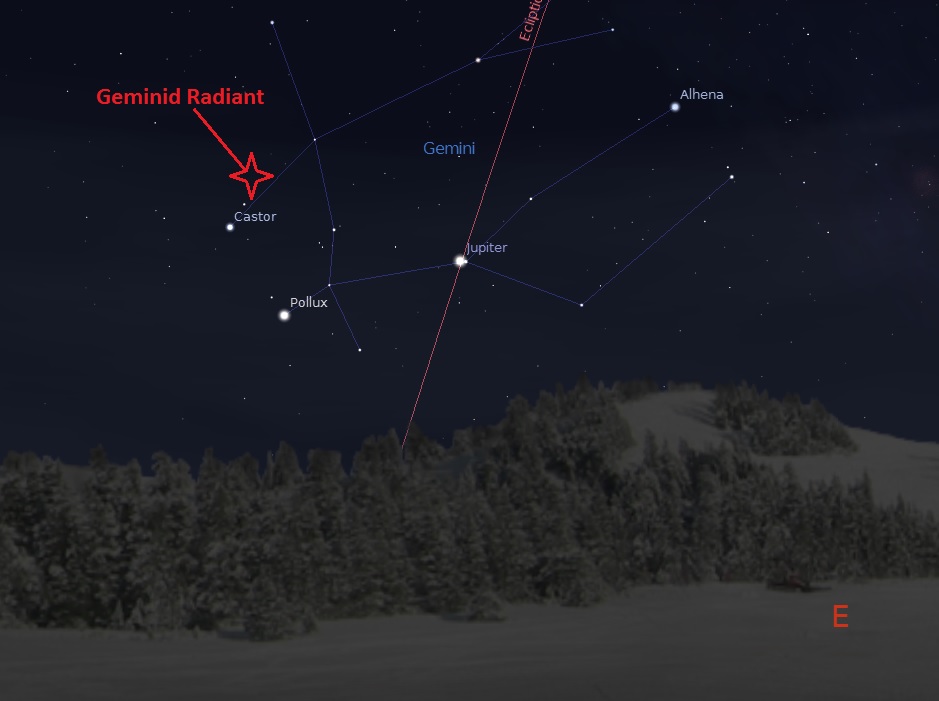
 The rising radiant of the Geminids-Looking east at 9PM local from latitude 30 degrees north. (Credit-Stellarium). One of the best annual meteor showers occurs this coming weekend. The 2013 Geminid meteors peak this coming Saturday on December 14th. This shower has a broad maximum, assuring that observers worldwide get a good look. In 2013, the maximum for the Geminids is forecast to span from 13:00 Universal Time (UT) on Friday, December 13th to 10:00UT/5:00AM EST on Saturday, December 14th, with a projected maximum centered a few hours earlier at 2:00 UT Saturday morning.(...)
Read the rest of Get Ready for the 2013 Geminid Meteor Shower (957 words)
© David Dickinson for Universe Today, 2013. | Permalink | One comment |
Post tags: 3200 phaethon, Andromedid meteor shower, december meteors, geminds, geminid meteors, meteor observing, ursids
Feed enhanced by Better Feed from Ozh
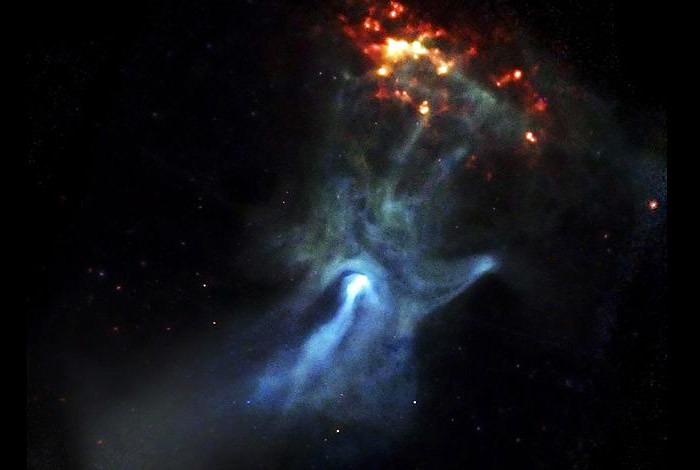
 This X-ray nebula appears to look like a human hand. The ghostly shape comes courtesy of a pulsar star called PSR B1509-58 (B1509 for short) that is just 12 miles or 19 kilometers in diameter. The nebula itself is 150 light-years across. Image taken by NASA’s Chandra X-ray Observatory. Credit: NASA/CXC/CfA/P. Slane et al. That spooky hand in the image above is producing questions for scientists. While the shape only coincidentally looks like a human hand, scientists are still trying to figure out how a small star produced such a large shape visible in X-rays. Pulsar star PSR B1509-58 (or B1509 for short) is a 12-mile (19-kilometer) remnant of a much larger star that exploded and left behind a quickly spinning neutron star. Energy leaves mostly via neutrino (or neutral particle) emission, with a bit more coming out via beta decay, or a radioactive process where charged particles leave from atoms. Using a new model, scientists found that so much energy comes out from neutrino emission that there shouldn’t be enough left for the beta decay to set off the X-rays you see here in this image, or in other situations. Yet it’s still happening. And that’s why they’re hoping to take a closer look at the situation. (...)
Read the rest of This Spooky X-Ray ‘Hand’ Demonstrates A Pulsar Star Mystery (272 words)
© Elizabeth Howell for Universe Today, 2013. | Permalink | No comment |
Post tags: Neutron Star, pulsar star
Feed enhanced by Better Feed from Ozh
| 










No comments:
Post a Comment
Keep a civil tongue.