| Here are the FeedBlitz blog updates for ignoble.experiment@arconati.us
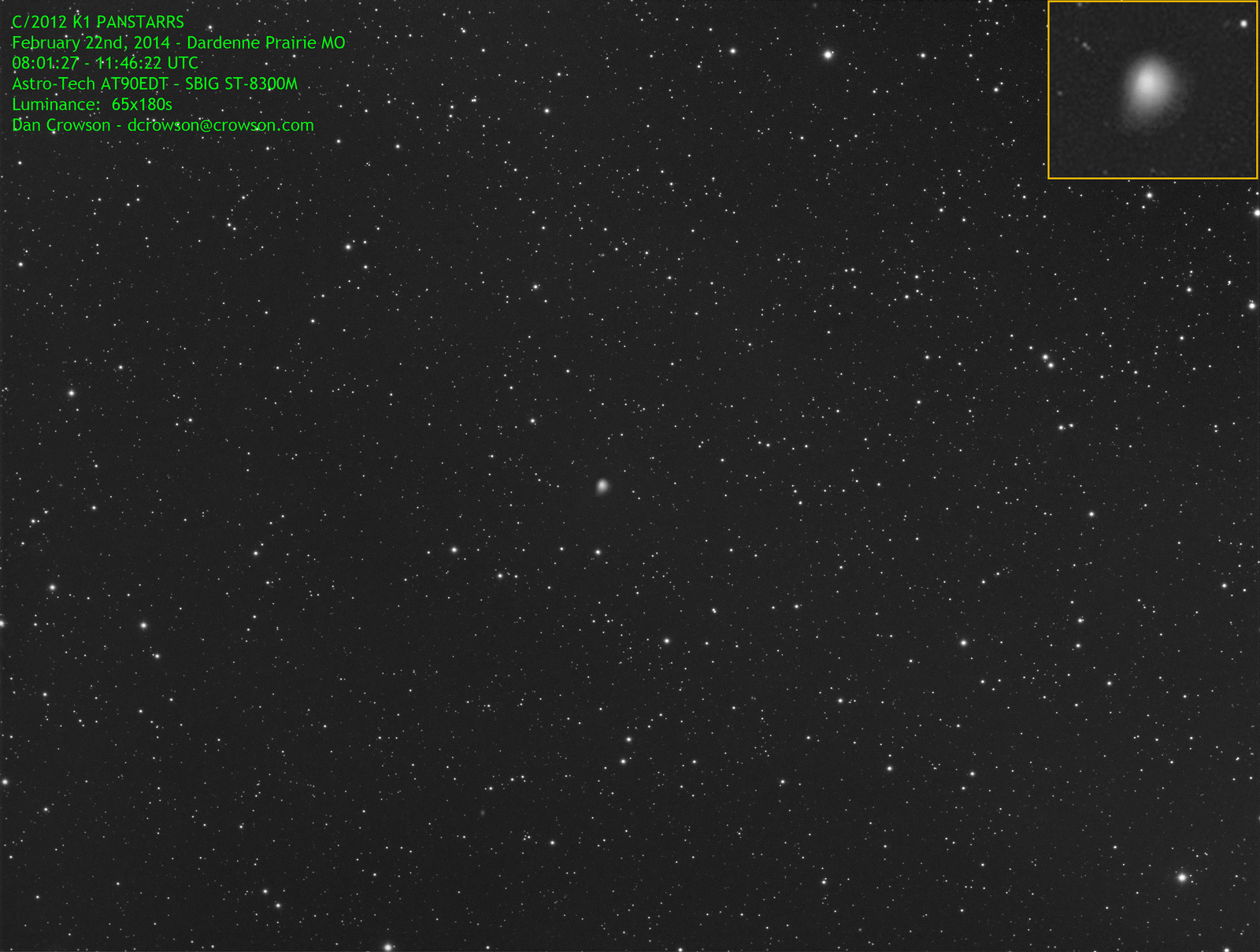
 Comet c/2012 K1 PanSTARRS as imaged by Dan Crowson on February 22nd, 2014. Image credit: Dan Crowson, used with permission. Get those binoculars ready: an icy interloper from the Oort cloud is about to grace the night sky. The comet is C/2012 K1 PanSTARRS, and it's currently just passed from the constellation Hercules into Corona Borealis and presents a good target for observers high in the sky in the hours before dawn. In fact, from our Tampa based latitude, K1 PanSTARRS is nearly at the zenith at around 6 AM local.(...)
Read the rest of Get Set For Comet K1 PanSTARRS: A Guide to its Spring Appearance (1,150 words)
© David Dickinson for Universe Today, 2014. | Permalink | One comment |
Post tags: 2014 astronomy, 2014 comets, binocular comets, comet e2 Jacques, comet K1 Panstarrs, comet observing
Feed enhanced by Better Feed from Ozh

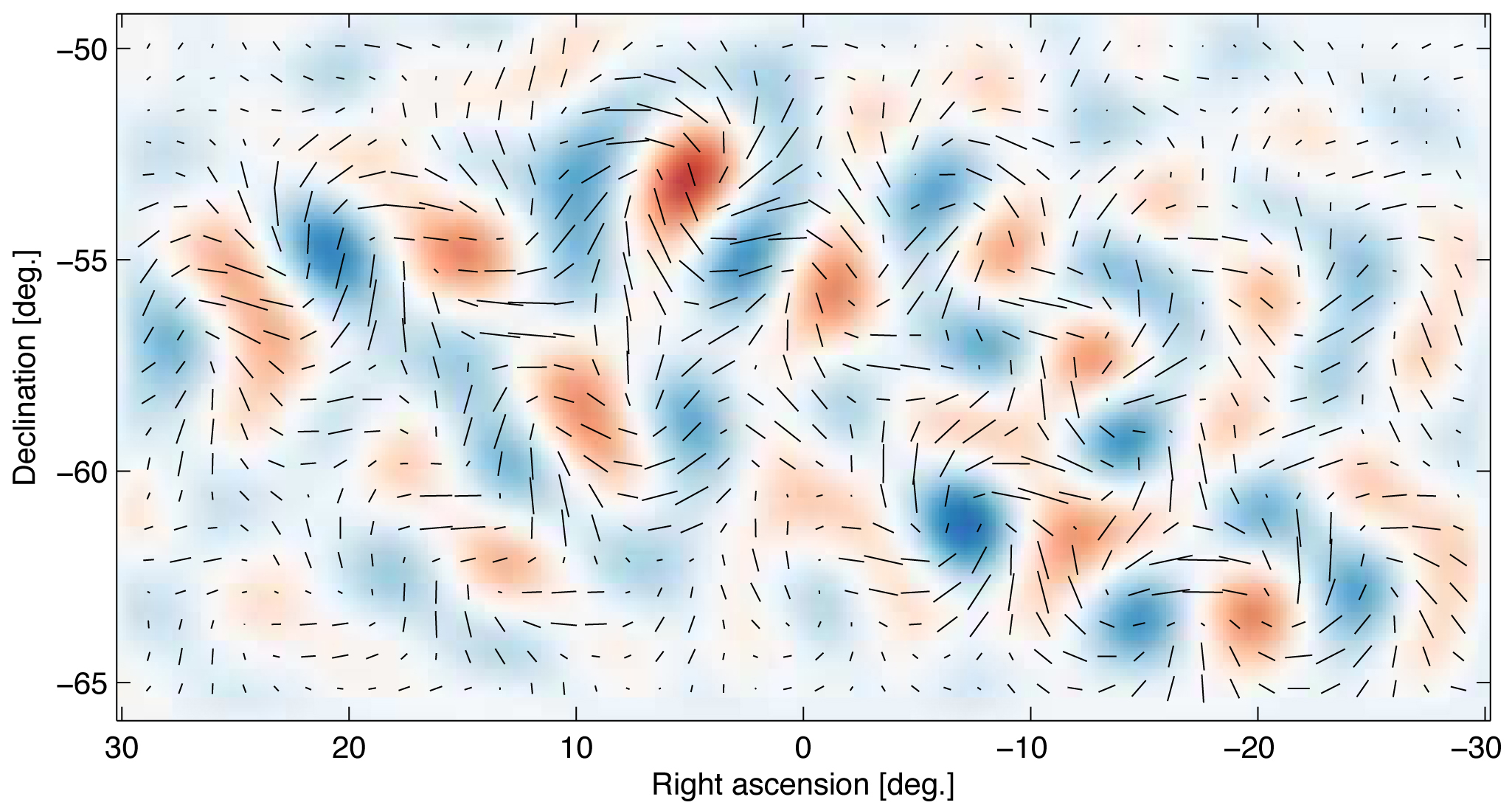
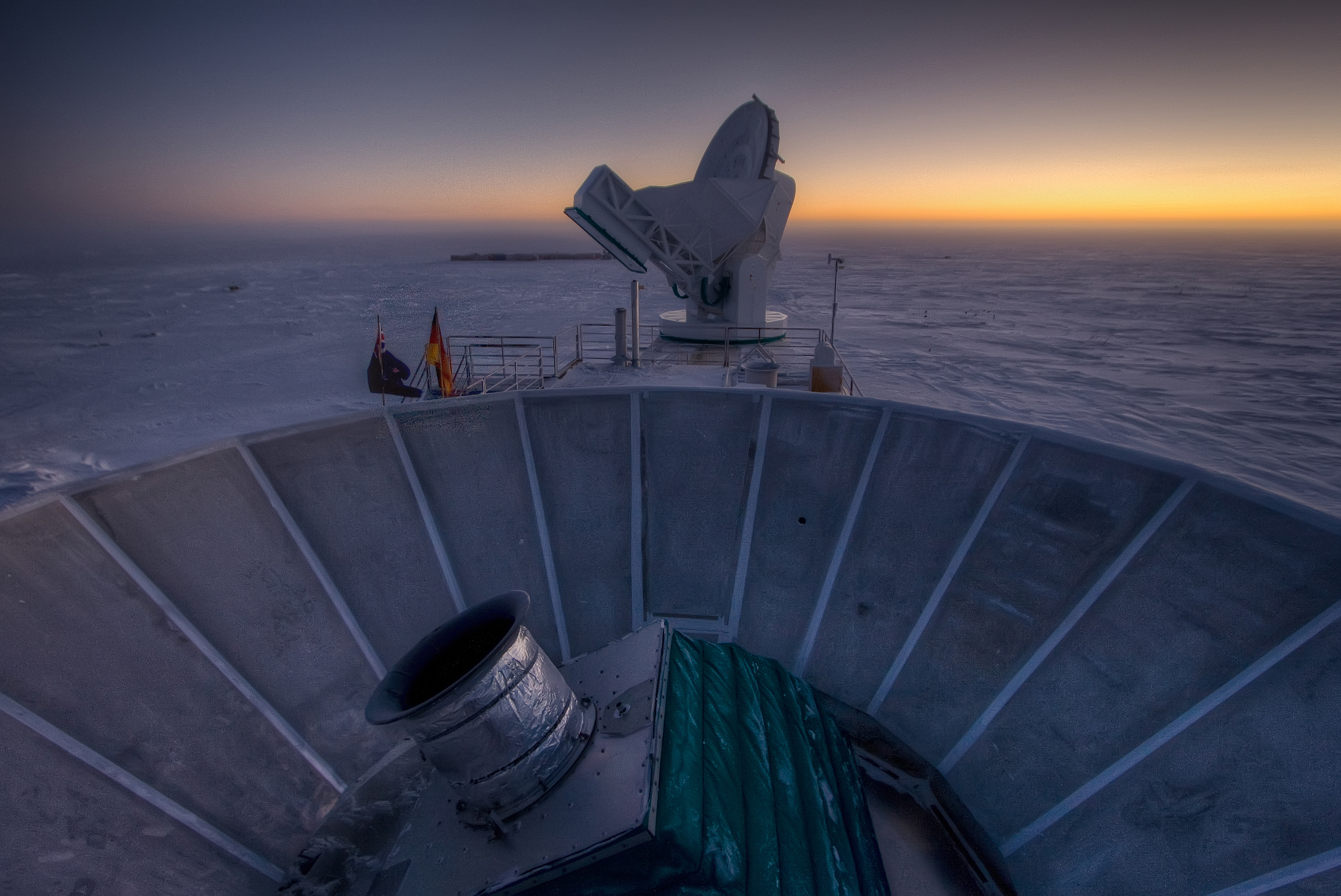
Andrei Linde, a professor in the Department of Physics at Stanford University, is one of the main authors of the inflationary universe theory, that the universe underwent a brief but remarkably accelerated expansion immediately following the Big Bang. Today, scientists announced that they've found direct evidence of primordial gravitational waves, which would provide a "smoking gun" for inflation, and also tell us when inflation took place and how powerful the process was. Above is a scientifically heartwarming video of Linde being told of the gravitational wave discovery by Chao-Lin Kuo, also from Stanford University, the designer of the BICEP2 detector that made the discovery. Read our full article about the discovery here.
(...)
Read the rest of That Moment When the “Father of Inflation” Learns of the Detection of Gravitational Waves (13 words)
© nancy for Universe Today, 2014. | Permalink | One comment |
Post tags: Andrei Linde, Cosmology, Gravitational Waves, Inflation Theory, Physics
Feed enhanced by Better Feed from Ozh
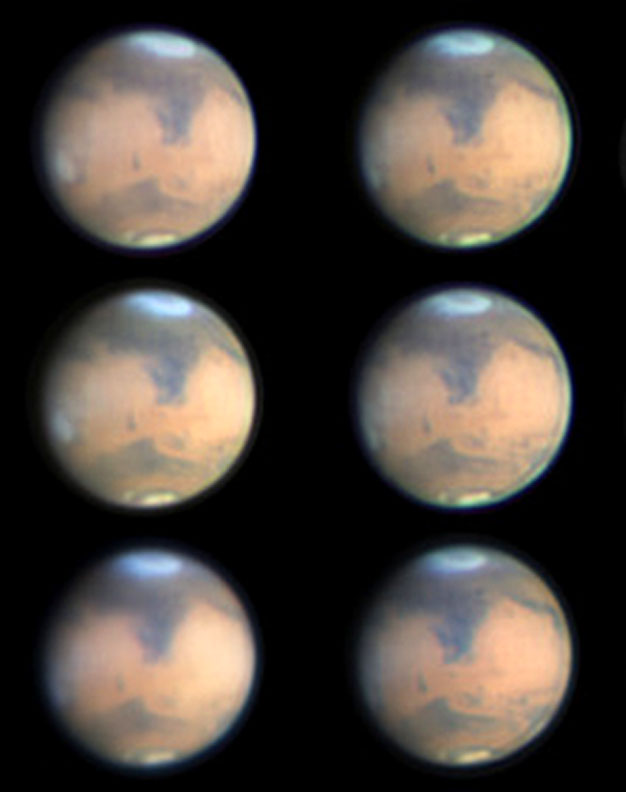
 Mars photographed during part of its rotation from Melbourne, Australia on March 8. The bright “cap” at top is Hellas, now covered in wintertime frost and clouds. The smaller oval at bottom is the north polar cap. Syrtis Major is the dark Africa-shaped feature jutting toward center. Credit: Maurice Valimberti Earth’s changing weather always makes life interesting. Seeing weather on other planets through a telescope we sense a kinship between our own volatile world and the fluttering image in the eyepiece. With the April 8 opposition of Mars rapidly approaching, you won’t want to miss a striking meteorological happening right now on the Red Planet. (...)
Read the rest of Till Hellas Freezes Over – See Frost and Clouds in Mars’ Largest Crater (772 words)
© Bob King for Universe Today, 2014. | Permalink | No comment |
Post tags: Hellas, impact basin, Mars, Syrtis Major
Feed enhanced by Better Feed from Ozh
 A 2014 image of NGC 2174 by the Hubble Space Telescope. Credit: NASA/ESA and the Hubble Heritage Team (STScI/AURA) Billowing gas clouds and young stars feature in this February Hubble Space Telescope image, released as the telescope approaches its 24th birthday this coming April. The telescope has seen a lot of drama over the years, but in this case, thankfully the excitement is taking place 6,400 light-years away. Here you can see starbirth in action in the nebula NGC 2174, which is sometimes called the Monkey Head Nebula. “This region is filled with young stars embedded within bright wisps of cosmic gas and dust. Dark dust clouds billow outwards, framed against a background of bright blue gas. These striking hues were formed by combining several Hubble images taken through different coloured filters, revealing a broad range of colours not normally visible to our eyes,” the European Space Agency wrote. (...)
Read the rest of Hubble Captures Starbirth In A Monkey’s Head As Telescope Approaches 24 Years In Space (132 words)
© Elizabeth Howell for Universe Today, 2014. | Permalink | No comment |
Post tags: monkey's head nebula, nebula, NGC 2174
Feed enhanced by Better Feed from Ozh
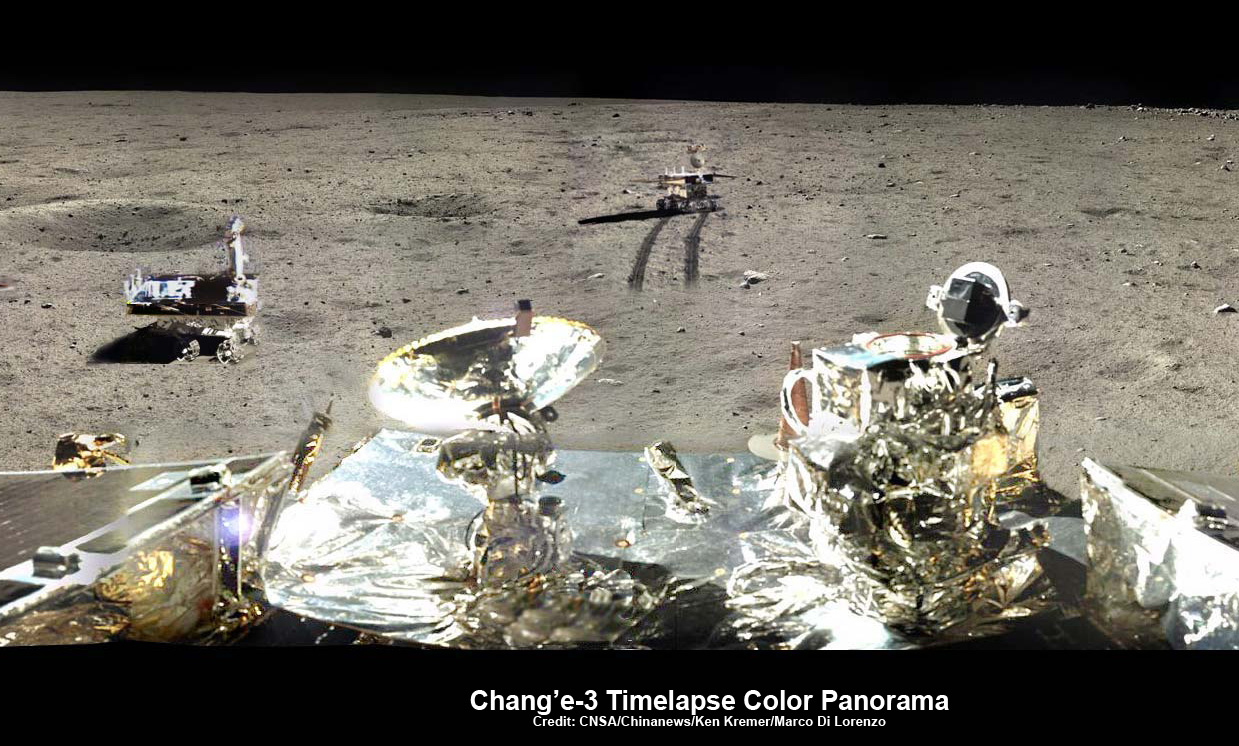
 Chang'e-3/Yutu Timelapse Color Panorama
This newly expanded timelapse composite view shows China's Yutu moon rover at two positions passing by crater and heading south and away from the Chang'e-3 lunar landing site forever about a week after the Dec. 14, 2013 touchdown at Mare Imbrium. This cropped view was taken from the 360-degree timelapse panorama. See complete 360 degree landing site timelapse panorama herein and APOD Feb. 3, 2014. Chang'e-3 landers extreme ultraviolet (EUV) camera is at right, antenna at left. Credit: CNSA/Chinanews/Ken Kremer/Marco Di Lorenzo – kenkremer.com.
See our complete Yutu timelapse pano at NASA APOD Feb. 3, 2014: http://apod.nasa.gov/apod/ap140203.htm KENNEDY SPACE CENTER, FL – China's maiden moon rover Yutu awoke from her regular two week long slumber on Friday, March 14, to begin the 4th Lunar Day since the probes history making touchdown on the surface of Earth's nearest neighbor in mid December 2013. But the endearing robot is still ailing and suffering from mechanical control issues that popped up in late January 2014 according to Chinese space officials. The Chang'e-3 mothership lander that deposited Yutu onto the pockmarked lunar surface also(...)
Read the rest of China's Yutu Moon rover starts Lunar Day 4 Awake but Ailing (725 words)
© Ken Kremer for Universe Today, 2014. | Permalink | No comment |
Post tags: Chang'E-3, China, china space program, Mare Imbrium, Moon, Yutu rover
Feed enhanced by Better Feed from Ozh

Host: Fraser Cain & Scott Lewis
Astronomers: David Dickinson, Gary Gonella, Mark Behrendt, Roy Salisbury, Stuart Forman
(...)
Read the rest of Virtual Star Party – March 16, 2014 (127 words)
© susie for Universe Today, 2014. | Permalink | No comment |
Post tags: Flame Nebula, horsehead nebula, Jellyfish Nebula, Jupiter, M81, M82, Mars, Moon, NGC 891, Orion, Rosette Nebula, Saturn, Tadpole Nebula
Feed enhanced by Better Feed from Ozh
 Image of Mercury from MESSENGER’s third flyby (NASA/Johns Hopkins University Applied Physics Laboratory/Carnegie Institution of Washington) Whatever Mercury’s did to trim down its waistline has worked better than anyone thought — the innermost planet in our Solar System has reduced its radius* by about 7 kilometers (4.4 miles), over double the amount once estimated by scientists. Of course you wouldn’t want to rush to begin the Mercury diet — its planetary contraction has taken place over the course of 3.8 billion years, since the end of the Late Heavy Bombardment. Still — lookin’ good, Mercury! These findings come thanks to the MESSENGER spacecraft, in orbit around Mercury since 2011. Now that MESSENGER has successfully mapped literally all of Mercury’s surface, detailed measurements of more than 5,900 landforms created by cooling and contraction of the planet’s crust have allowed researchers to more precisely determine its geologic history and answer some decades-old questions raised by Mariner 10 images. “This discrepancy between theory and observation, a major puzzle for four decades, has finally been resolved,” said MESSENGER Principal Investigator Sean Solomon. ”It is wonderfully affirming to see that our theoretical understanding is at last matched by geological evidence.” (...)
Read the rest of Mercury Shrinking: the First Rock from the Sun Contracted More than Once Thought (252 words)
© Jason Major for Universe Today, 2014. | Permalink | No comment |
Post tags: contraction, Mercury, MESSENGER, planet, scarps, shrinking, Solar System, tectonics
Feed enhanced by Better Feed from Ozh
| 












No comments:
Post a Comment
Keep a civil tongue.