| Here are the FeedBlitz blog updates for ignoble.experiment@arconati.us
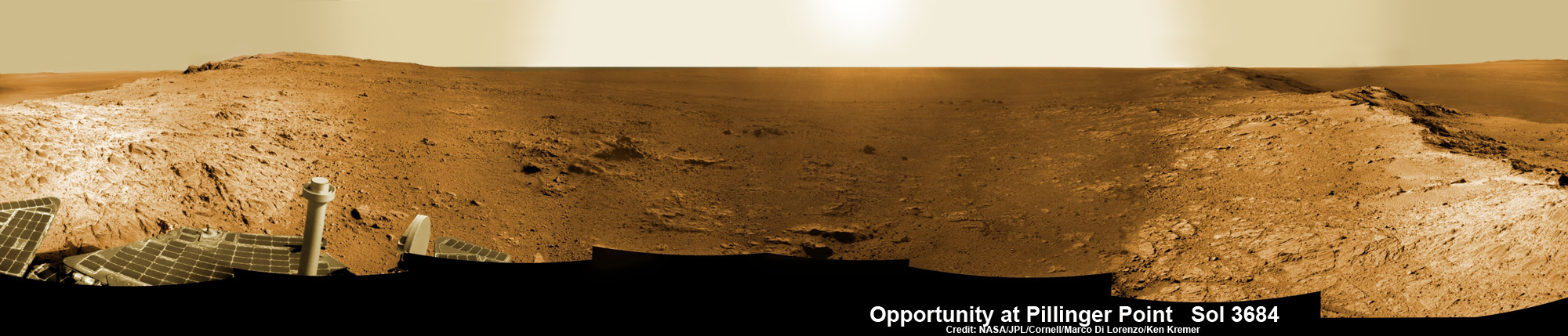
 Opportunity Mars rover peers into vast Endeavour Crater from Pillinger Point mountain ridge named in honor of Colin Pillinger, the Principal Investigator for the British Beagle 2 lander built to search for life on Mars. Pillinger passed away from a brain hemorrhage on May 7, 2014. This navcam camera photo mosaic was assembled from images taken on June 5, 2014 (Sol 3684) and colorized. Credit: NASA/JPL/Cornell/Marco Di Lorenzo/Ken Kremer-kenkremer.com NASA's decade old Opportunity rover has reached a long sought after region of aluminum-rich clay mineral outcrops at a new Endeavour crater ridge now "named 'Pillinger Point' after Colin Pillinger the Principal Investigator for the [British] Beagle 2 Mars lander", Prof. Ray Arvidson, Deputy Principal Investigator for the rover, told Universe Today exclusively. See above the spectacular panoramic view from ‘Pillinger Point’ – where ancient water once flowed billions of year ago. The Beagle 2 lander was built to search for signs of life on Mars.(...)
Read the rest of Opportunity Peers Out from ‘Pillinger Point’ – Honoring British Beagle 2 Mars Scientist Where Ancient Water Flowed (650 words)
© Ken Kremer for Universe Today, 2014. | Permalink | No comment |
Post tags: Beagle 2, Colin Pillinger, Endeavour crater, esa, Mars, Mars Express, Mars Rovers, NASA, Opportunity Rover, Pillinger Point, Solander Point, Spirit Rover
Feed enhanced by Better Feed from Ozh

Before the Apollo Program, there was the Gemini Program, and before Gemini came the Mercury Program. 7 elite astronauts chosen from a pool of military test pilots. How did NASA choose these original 7 men? Visit the Astronomy Cast Page to subscribe to the audio podcast! We record Astronomy Cast as a live Google+ Hangout on Air every Monday at 12:00 pm Pacific / 3:00 pm Eastern. You can watch here on Universe Today or from the Astronomy Cast Google+ page.
© susie for Universe Today, 2014. | Permalink | No comment |
Post tags:
Feed enhanced by Better Feed from Ozh
 A solar prominence imaged on May 27, 2014. Earth and Moon are shown to scale at the bottom. (Credit: NASA/SDO. Edited by J. Major.) Caught on camera by NASA’s Solar Dynamics Observatory, a prominence blazes hundreds of thousands of miles out from the Sun’s surface (i.e., photosphere) on May 27, 2014. The image above, seen in extreme ultraviolet wavelengths, shows a brief snapshot of the event with the column of solar plasma stretching nearly as far as the distance between Earth and the Moon. Watch a video of the event below: (...)
Read the rest of Watch the Rise and Fall of a Towering Inferno on the Sun (72 words)
© Jason Major for Universe Today, 2014. | Permalink | No comment |
Post tags: Earth, plasma, prominence, scale, SDO, Star, sun, video
Feed enhanced by Better Feed from Ozh
 Artist’s conception of the Gaia telescope backdropped by a photograph of the Milky Way taken at the European Southern Observatory. Credit: ESA/ATG medialab; background: ESO/S. Brunier Europe’s powerful Milky Way mapper is facing some problems as controllers ready the Gaia telescope for operations. It turns out that there is “stray light” bleeding into the telescope, which will affect how well it can see the stars around it. Also, the telescope optics are also not transmitting as efficiently as the design predicted. Controllers emphasize the light problem would only affect the faintest visible stars, and that tests are ongoing to minimize the impact on the mission. Still, there will be some effect on how well Gaia can map the stars around it due to this issue. (...)
Read the rest of Gaia Space Telescope Team Battles ‘Stray Light’ Problems At Start Of Mission (727 words)
© Elizabeth Howell for Universe Today, 2014. | Permalink | No comment |
Post tags: Gaia
Feed enhanced by Better Feed from Ozh
 A fish-eye view of Titan’s surface from the European Space Agency’s Huygens lander in January 2005. Credit: ESA/NASA/JPL/University of Arizona What’s in all that browny orangey stuff in the atmosphere around Titan? It’s a question that scientists have been trying to answer concerning Saturn’s moon for decades (Carl Sagan was among them). That’s because it’s hard to reverse-engineer the recipe. There are hundreds of thousands of hydrocarbons (hydrogen and carbon molecules) that could form the compounds in the atmosphere along with nitriles (nitrogen-abundant chemicals). But scientists are hoping that their new recipe gets a bit closer to understanding how the atmosphere works. (...)
Read the rest of New Recipe For Saturn’s Orangey Moon Titan Is ‘Aromatic’ And Hazy (190 words)
© Elizabeth Howell for Universe Today, 2014. | Permalink | 2 comments |
Post tags: hydrocarbon
Feed enhanced by Better Feed from Ozh
 A picture of NGC 7538 from data taken by the Herschel Space Observatory. Credit: ESA/NASA/JPL-Caltech/Whitman College Long after telescopes cease operating, their bounty of scientific data continues to amaze. Here’s an example of that: this Herschel Space Telescope image of this dust and gas cloud about 8,000 light-years away. The examination of NGC 7358 revealed a “weird” dusty ring in the cloud — nobody quite knows how it got there — as well as a baker’s dozen of huge dust clumps that could one day form gigantic stars. (...)
Read the rest of ‘Weird’ Dust Ring Baffles In Cloud That Will Give Birth To Giant Stars (340 words)
© Elizabeth Howell for Universe Today, 2014. | Permalink | No comment |
Post tags: ngc 7358
Feed enhanced by Better Feed from Ozh
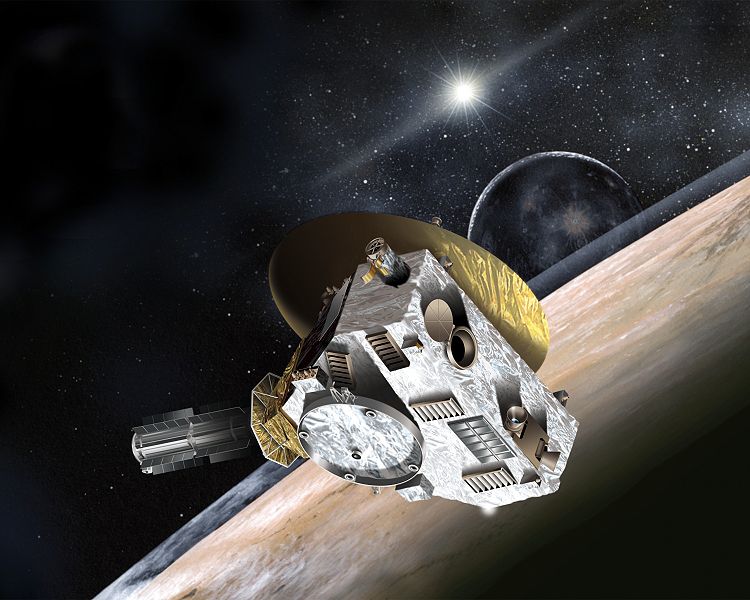
 Illustration of the New Horizons spacecraft passing by Pluto and Charon in July 2015. (NASA) While many kids in the U.S. are starting their school summer vacations, New Horizons is about to get back to work! Speeding along on its way to Pluto the spacecraft has just woken up from hibernation, a nap it began five months (and 100 million miles) ago. The next time New Horizons awakens from hibernation in December, it will be beginning its actual and long-awaited encounter with Pluto! But first the spacecraft and its team have a busy and exciting summer ahead. (...)
Read the rest of New Horizons Wakes Up for the Summer (339 words)
© Jason Major for Universe Today, 2014. | Permalink | 3 comments |
Post tags: Alan Stern, Charon, hibernation, New Horizons, Pluto, Solar System, space, spacecraft
Feed enhanced by Better Feed from Ozh
 Hubble Space Telescope picture of galaxy NGC 3081. Credit: ESA/Hubble & NASA; acknowledgement: R. Buta (University of Alabama) Let’s just casually look at this image of a galaxy 86 million light-years away from us. In the center of this incredible image is a bright loop that you can see surrounding the heart of the galaxy. That is where stars are being born, say the scientists behind this new Hubble Space Telescope image. (...)
Read the rest of Hubble Hubba: Stars Are Being Born Around A Black Hole In Galaxy’s Center (156 words)
© Elizabeth Howell for Universe Today, 2014. | Permalink | No comment |
Post tags: Hydra, ngc 3081
Feed enhanced by Better Feed from Ozh
| 










No comments:
Post a Comment
Keep a civil tongue.