

Neatorama |
- Embroidery with Bees
- Enhanced Interrogation Techniques
- Will Data Be The One To End Us?
- Celebrating a Diceiversary
- This Kid Loves To Fall
- Rebooting a Squirrel
- Pooping Corn Kernels Are Not Unique To Humans
- The 300 Cats Wanted to Act at the Manhattan Opera House
- 10,000 Ducks Cleaning Rice Paddies in Thailand
- She Tested Intel’s New Processor. This Is What She Found Out
- How to Enjoy Fall Foliage in 2020
- The Real Picture Behind The Webcam
- The 2020 Ig Nobel Prizes
| Posted: 20 Sep 2020 04:18 AM PDT Ava Roth, a paint and embroidery artist in Toronto, collaborates with bees in her recent projects. She weaves into her embroidery hoops fabrics that are bee-friendly and then inserts them into beehives so that her co-workers can contribute. Colossal reports: She receives help from master beekeeper Mylee Nordin, and together, they vertically stack hive boxes, which are known as supers, and insert large, custom-made structures. The artist also has developed a more detailed practice in recent months. "Because this project has required so much trial and error, I was still experimenting with materials last season, trying to find substances that the bees would consistently respond to positively," she writes. "I was trying to find organic substances that would not harm the bees but also that the bees would not eat or otherwise destroy." You can see more examples of embroidery by Roth and her apiarian collaborators on her Instagram page.  |
| Enhanced Interrogation Techniques Posted: 20 Sep 2020 04:18 AM PDT
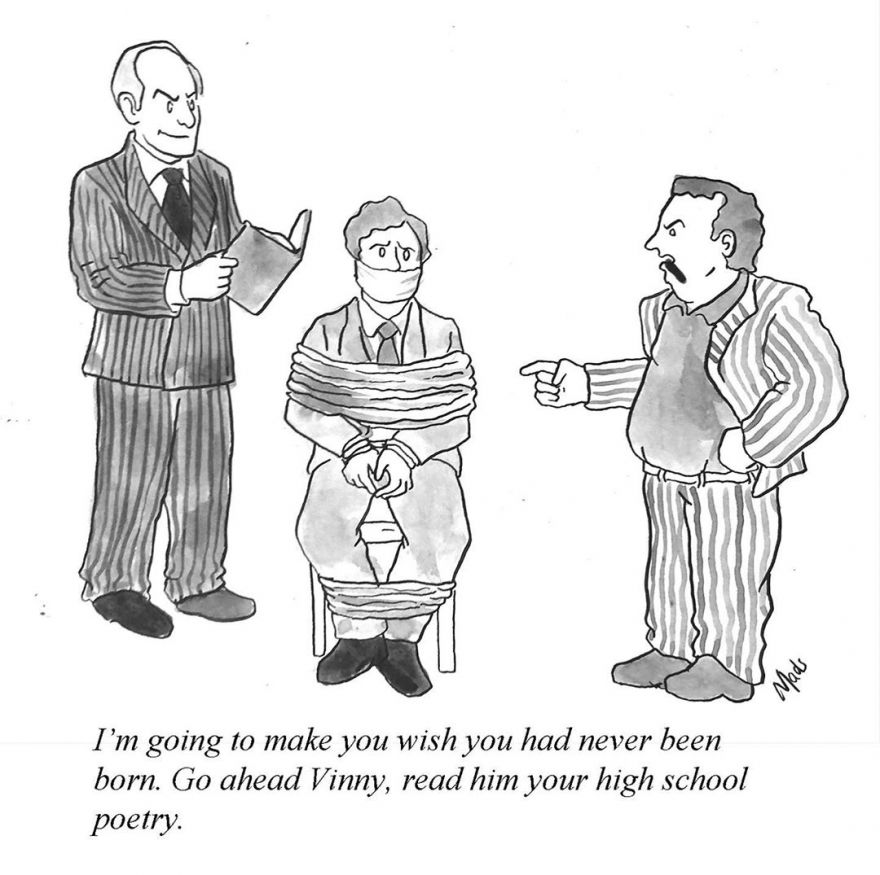
Never mind Vogon poetry. If you want to read some really awful lines, I can dig out the insipid, self-absorbed free verse that I wrote in college. But using it like this, as cartoonist Madeline Horwarth suggests, would probably be a crime. |
| Will Data Be The One To End Us? Posted: 19 Sep 2020 07:19 PM PDT
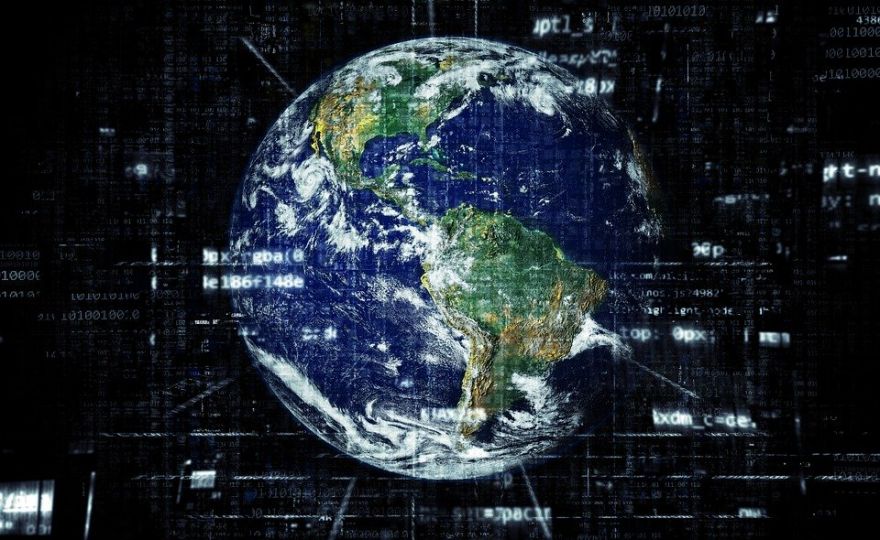
It might sound unlikely, but data does have a potential to end the human race. To be specific, it's not data itself, but data storage. As societies increasingly rely on digital information and there's more and more of it, we'll one day reach a point where the number of bits being stored will outnumber the atoms that make up our planet. That's according to theoretical physicist and Senior Lecturer Melvin Vopson at the University of Portsmouth in the UK. A peer‐reviewed paper on his theory, called "The Information Catastrophe," was recently published in the journal AIP Advances. According to the Jefferson Lab, there are about 1.33 x 10^50 atoms in our planet. That's a lot. "Currently, we produce ∼1021 digital bits of information annually on Earth," Vopson begins. This is based on an IBM estimate that humans produce 2.5 quintillion digital data bytes daily. With an assumed 20 percent growth rate, the number of bits we produce will outnumber the entirety of atoms on the planet in around 350 years. In a press release, Vopson said, "We are literally changing the planet bit by bit, and it is an invisible crisis." There are a lot of variables to consider. For instance, the number of bits produced each year, data storage capacity, energy production and the size of the bit compared to the atom (mass distribution). There are human‐centered factors too, such as population growth and the rate of access to information technology in developing countries. "If we assume a more realistic growth rates of 5%, 20%, and 50%," the paper states, "the total number of bits created will equal the total number of atoms on Earth after ∼1,200 years, ∼340 years, and ∼150 years, respectively." That's scarier than the sun exploding. And to make matters worse, we also have to deal with climate change. More details about this over at Big Think. What are your thoughts about this one? (Image Credit: TheDigitalArtist/ Pixabay) |
| Posted: 19 Sep 2020 07:19 PM PDT
When a couple reaches their d4, d6, d8, d12, d20 anniversary, it's time to celebrate it! Live long enough and you may need to mount percentile dice or one of those cumbersome 100-sided dice. Emma Vieceli's husband has the right idea. -via Super Punch |
| Posted: 19 Sep 2020 06:41 PM PDT
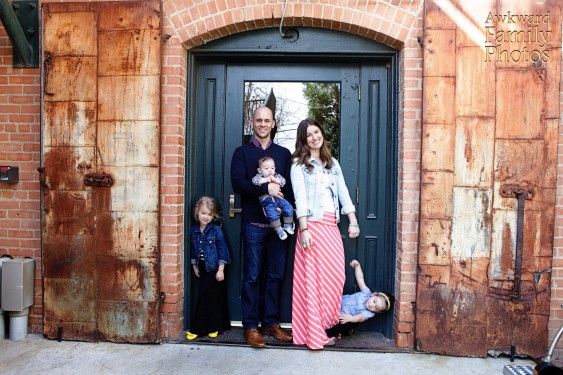
In this photo, Ashley's 2-year-old daughter can be seen falling into the pavement after letting go of her mother's hand when she leaned away from her. But this wasn't the only time she fell on this day, as the same happened to her again later that day. Images via Awkward Family Photos
|
| Posted: 19 Sep 2020 06:41 PM PDT
|
| Pooping Corn Kernels Are Not Unique To Humans Posted: 19 Sep 2020 06:41 PM PDT
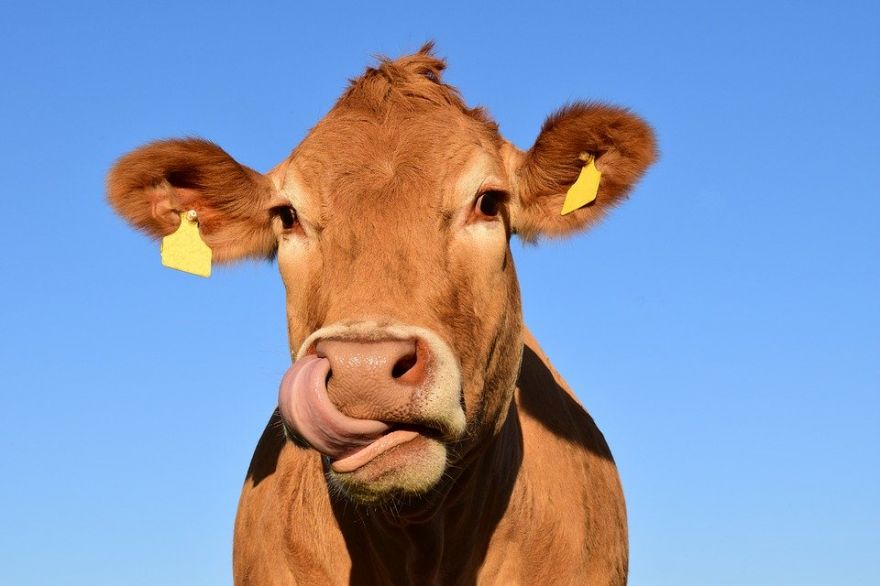
Cows are known to have four stomachs. With that in mind, we expect them to chew food really well. But it turns out, when they eat corn, cows also poop corn kernels — the same experience that we humans have. This is somewhat surprising, since cows are ruminant animals whose digestive systems can break down tough materials better than ours can. When cows swallow their food, it softens in a special digestive chamber called a rumen and then gets sent back up for another round of mastication. (This also explains why it seems like cows are always munching on something.) But scientists have discovered that corn sometimes manages to emerge partially unscathed from this process of "chewing the cud." Not entirely unscathed, though. As University of Nebraska-Lincoln ruminant nutritionist Andrea Watson told Live Science, it's only the thin yellow exterior of each kernel that escapes digestion. This is made of cellulose, a durable fiber that helps shield corn from bad weather, pests, and other potential damage. Humans can't break down cellulose, but cows usually do a pretty good job—a testament to corn's resilience. What are your thoughts about this one? (Image Credit: ulleo/ Pixabay) |
| The 300 Cats Wanted to Act at the Manhattan Opera House Posted: 19 Sep 2020 06:41 PM PDT
The ad above appeared in 1910 seeking cats for a scene in Oscar Hammerstein's comedic opera Hans the Flute Player. (Hammerstein was the grandfather of the lyricist you are familiar with.) The scene was one in which the titular flute player would lure all the town's cats away, which required a herd of cats. The ad went on to say that no acting experience was required, and that cats should be brought to the stage door of the Manhattan Opera House the next morning. What could possibly go wrong? A followup article on the eve of the opera's premiere gave more details.
Read what happened to Hammerstein's grand plan at The Hatching Cat. -via Strange Company |
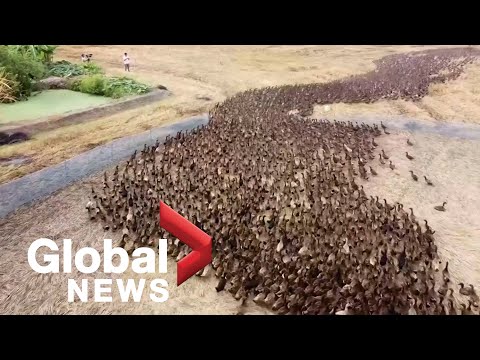
| 10,000 Ducks Cleaning Rice Paddies in Thailand Posted: 19 Sep 2020 06:41 PM PDT
|
| She Tested Intel’s New Processor. This Is What She Found Out Posted: 19 Sep 2020 06:41 PM PDT
When tech company Intel launched their 11th gen core processor, they claimed that it was the "best processor in the market." One of the many things that Intel boasts about their processor is their new Xe integrated graphics. It is known that the previous integrated graphics of the said company is good for general purpose, but not for gaming. But is it different this time? Monica Chin from The Verge was able to get her hands on a Tiger Lake reference design that Intel sent to her. Here's what she found out. Good news for Intel: Xe graphics are the real deal. Overwatch was playable at 1080p on Ultra (averaging 89fps) and Epic (averaging 59fps). Let that sink in — a system with integrated graphics is running Overwatch, on its highest possible settings, at almost 60fps. That system beat the 4800U, which only managed 46fps on Ultra, and the 1065G7, which didn't even pass 65fps on low settings in Engadget's testing. Incidentally, this is also bad news for Nvidia — with integrated graphics like this available, there's no reason anyone needs to pay for an entry-level GPU like the MX350. She also pits Intel's processor against AMD's to see which outperforms which. More details about this over at the site. (Image Credit: Monica Chin/ The Verge) |
| How to Enjoy Fall Foliage in 2020 Posted: 19 Sep 2020 05:46 PM PDT Every year, the Great Smoky Mountains National Park posts their interactive fall foliage map, so that you can plan a road trip to catch the most breathtaking views of trees turning into their blazing natural colors after they lose their chlorophyll. However, you might not want to take to the road this year. But like college classes, awards shows, and annual festivals, you can do it online! Many parks and local governments are setting up webcams that will allow you to check the fall colors as they change in Pennsylvania, Maryland, Georgia, Vermont, New Hampshire, Colorado, and other places. Find a list of these webcams at Mental Floss. |
| The Real Picture Behind The Webcam Posted: 19 Sep 2020 05:46 PM PDT
Whether it's a video call conference with our friends or co-workers, we always want to look good in front of the webcam. We figure out the right angle, and we remove the things that we don't want to be seen in the camera. In other words, we don't show what's really going on in our homes. But scientist Gretchen Goldman was brave enough to post her real setup. The caption stated: "Just so I'm being honest," and the tweet amassed 282.5k likes and 30.6k retweets. Many people followed Goldman's example, and they, too, showed the things that cannot be seen by the people on the other side of the screen. Check out the pictures over at Bored Panda. (Image Credit: Gretchen Goldman, PhD/ Twitter) |
| Posted: 19 Sep 2020 05:46 PM PDT
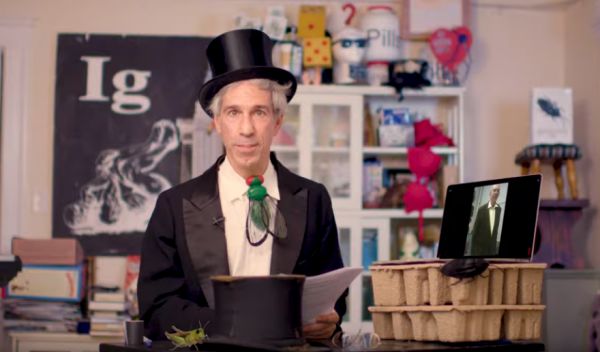
The magazine Annals of Improbable Research has bestowed the annual Ig Nobel Prizes for scientific research "that makes you laugh, then makes you think." The award ceremony was held virtually this year, which you can see here.
See current and past Ig Nobel Prize recipients at the winners page. The Annals of Improbable |





| You are subscribed to email updates from Neatorama. To stop receiving these emails, you may unsubscribe now. | Email delivery powered by Google |
| Google, 1600 Amphitheatre Parkway, Mountain View, CA 94043, United States | |


No comments:
Post a Comment
Keep a civil tongue.