

Neatorama |
- You Should Drink Coffee After Breakfast, Not Before
- The Serum Run of 1925
- Musical Nonsense For You To Vibe To
- Hey, Why Is Everyone Horny For Hades On Main?
- What’s It Like To Live On The International Space Station?
- Training AI For The International Math Olympiad
- Iron Man Cat Helmet
- How Long Would It Take If We Drove To The Sun?
- What Causes Our Elastic Sense of Time?
- Is DNA-Based Diet The Best Diet?
- First Custom Dungeon for Zelda Breath of the Wild on Nintendo Switch
- Do Students Need Calculus Anymore?
- What Operating Systems Are Running On Machines In Space?
- The Worst Reviewed Movies Of 2020
- Limitless Power From Graphene
| You Should Drink Coffee After Breakfast, Not Before Posted: 05 Oct 2020 10:09 AM PDT
If you're the type of person who drinks coffee first thing in the morning, then you better change that habit and instead drink coffee after eating breakfast. Through this study, researchers from the University of Bath found out that "a strong coffee first thing in the morning can impair the body's glucose response." Thus, the researchers recommend that coffee should be drunk after eating breakfast, not before. "We know that nearly half of us will wake in the morning and, before doing anything else, drink coffee – intuitively the more tired we feel, the stronger the coffee," says James Betts, corresponding author on the new study. "This study is important and has far-reaching health implications as up until now we have had limited knowledge about what this is doing to our bodies, in particular for our metabolic and blood sugar control." Head over at New Atlas to know more about this study. (Image Credit: freephotocc/ Pixabay)  |
| Posted: 05 Oct 2020 10:09 AM PDT
December 1924. Dr. Curtis Welch thought that a number of children, in the small Alaskan town of Nome, were suffering from tonsillitis. But as the number of cases began to grow, and as children began to drop dead, Dr. Welch knew that it wasn't tonsillitis. It was something worse. Diphtheria is a highly contagious disease caused by the bacterium Corynebacterium diphtheriae. The bacteria attacks the respiratory system, destroying healthy tissues there. The dead tissues build up in the throat and nose to form a thick leathery coating that makes breathing difficult. If not treated, a patient can die of asphyxiation. Diphtheria is usually fatal among children. During the 1920s, between one hundred to two hundred thousand people were infected each year in the United States, with fifteen thousand deaths, most of which were children. By mid-January 1925, Nome, a town home to some 1,400 people, found itself amidst an imminent epidemic. Dr. Welch, the only physician in that town, knew that not only his town was in danger, but also the other communities. If the disease spread, it could potentially affect some 10,000 people. He had to do something. The race against time was on. After this would be the chain of events which would be known as the 1925 Serum Run to Nome. Know more about this historic event over at Amusing Planet. (Image Credit: U.S. Bureau of Land Management/ Wikimedia Commons) |
| Musical Nonsense For You To Vibe To Posted: 05 Oct 2020 10:08 AM PDT
One of the great things about music is that you don't need to understand the language in order to tell if it is good or not. It doesn't even have to have words, or even meaning. Music can be great, even if it's just nonsense. Daniel Thrasher treats us to some musical nonsense that we can listen and vibe to. Hear them on this video. (Image Credit: Daniel Thrasher/ YouTube)
|
| Hey, Why Is Everyone Horny For Hades On Main? Posted: 05 Oct 2020 10:08 AM PDT
Hades (the game by Supergiant studios, not the actual god from Greek mythology … wait) is one of the games with the loudest reception this year. Sure, it's an excellent roguelite, but one of the main reasons everyone is talking about this game is because, well, the characters are hot. If you've seen that tweet of someone lowkey joking that the official Nintendo Indie World account is being horny on main, or if you've seen YouTubers go crazy over how gorgeous the characters are, well, they're right: the art for these characters is insane. Game designer Greg Kasavin told Kotaku the reason why everyone is so damned hot: Everyone, from Megaera to Thanatos (call me, zaddy), down to even Asterius and Dusa owe their attractiveness to the vision of Supergiant's art team. "There's a really simple answer to your question," he said via email. "Because Jen Zee." "Our portrayals of the gods owe greatly to classical tradition," Kasavin continued. "Something Jen cares a lot about as an artist. For instance, there's this idea of heroic nudity that dates back to ancient Greek art, and culture, and it's something we explored as part of developing the look of the game. So, I guess this is me telling you with a straight face that the gods in Hades are 'friggin' hot' as part of our commitment to honoring the source material, expressed visually through Jen's instincts as an artist." Beyond being an utterly gorgeous disaster bisexual, Zagreus' most attractive feature is how disarmingly tender he is. He has all the hallmarks of your typical cantankerous bad-boy. He is the prince of the Underworld, who resents his father, struggles with abandonment issues, and whose only talent it seems is killing monsters. I would have expected him to be some grimdark, I'm-not-here-to-play-nice kind of guy. But in his conversations with people, even people that annoy him, he is unfailingly gentle and jovial. Image via Kotaku |
| What’s It Like To Live On The International Space Station? Posted: 05 Oct 2020 10:08 AM PDT
To live on the International Space Station, which, according to Russian cosmonaut Andre Borisenko, is the "most expensive object in the history of humanity", is nothing short of a privilege. However, one doesn't live there for months to chill and sightsee. Rather, he lives there to work. And of all the types of jobs that exist in this world, the astronaut's work might just be the most specialized of them all. "... we understand our responsibility to humanity," says Borisenko. "It's impossible and incorrect to forget that." But what is it like to live in the International Space Station for a period of time? Staff from Air & Space Magazine asked some of the astronauts this question. Head over at the site to know about their interesting stories. (Image Credit: NASA/ Wikimedia Commons) |
| Training AI For The International Math Olympiad Posted: 05 Oct 2020 10:08 AM PDT
The 61st International Mathematical Olympiad (IMO) began on September 21, 2020. But, unlike the previous IMOs, this one stands out for two reasons. The first reason is that this year's IMO was held remotely because of current circumstances. The second reason is more interesting than the previous one: this year's IMO might be the last one that would only have human contestants. Artificial intelligence systems might also participate in future Math Olympiads. Indeed, researchers view the IMO as the ideal proving ground for machines designed to think like humans. If an AI system can excel here, it will have matched an important dimension of human cognition. "The IMO, to me, represents the hardest class of problems that smart people can be taught to solve somewhat reliably," said Daniel Selsam of Microsoft Research. Selsam is a founder of the IMO Grand Challenge, whose goal is to train an AI system to win a gold medal at the world's premier math competition. But why do scientists think that the IMO is the perfect place to test an AI system's abilities? Answers over at Nautilus. (Image Credit: Seanbatty/ Pixabay) |
| Posted: 05 Oct 2020 10:07 AM PDT Iron Cat is here to save the world. He's ready, now that he has a 3D printed helmet that even pops open to reveal the (very patient) cat's face on demand. Cathode the cat of Besançon, France models the latest superhero costume. -via Dave Barry |
| How Long Would It Take If We Drove To The Sun? Posted: 05 Oct 2020 10:07 AM PDT
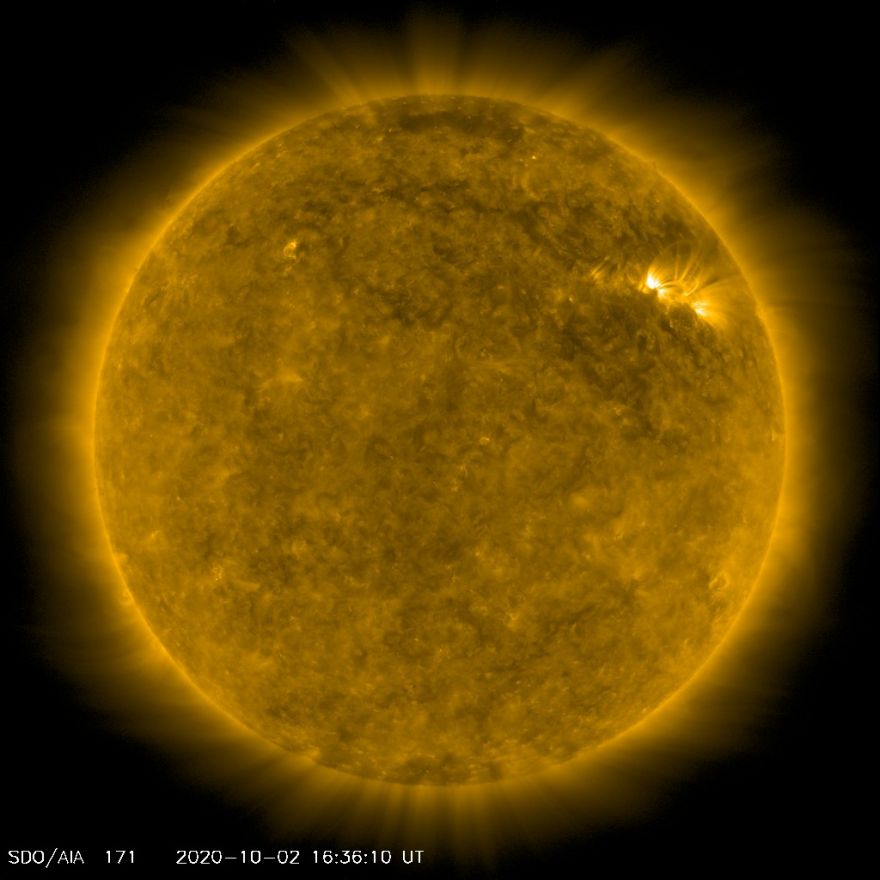
Short answer: A very long time. The distance from the Sun to the Earth is around 93 million miles. Theoretically, If a person drove a car (with an unlimited amount of fuel) at a speed of 93 miles an hour (about 150 km/hr), then it would take 1,000,000 hours, or over 114 years before he arrives at the Sun. (Image Credit: Solar Dynamics Observatory/ NASA) |
| What Causes Our Elastic Sense of Time? Posted: 05 Oct 2020 10:07 AM PDT
We've heard the phrase "time flies fast when you're having fun." But have you ever wondered why that is the case? Why does time seem to slow down at times, and why does it seem to speed up on others? What causes our elastic sense of time? The answer might be found in dopamine. … decades of research suggest that the neurotransmitter dopamine plays a critical role in how we perceive time. Dopamine has myriad effects on how much time we think has elapsed in a given period, and these effects may conflict confusingly. Some studies have found that increasing dopamine speeds up an animal's internal clock, leading it to overestimate the passage of time; others have found that dopamine compresses events and makes them seem more fleeting; still others have uncovered both effects, depending on context. Head over at Quanta Magazine to know more about this topic. (Image Credit: Pavlofox/ Pixabay) |
| Is DNA-Based Diet The Best Diet? Posted: 05 Oct 2020 10:07 AM PDT
We all have unique DNA. The different variations in a person's genes affects the way his body metabolizes nutrients. To put it simply, it can be said that our genes have a hand in the way we handle food. With this in mind, it is only reasonable to think that we all should have a personalized diet, and this personalized diet could be made possible because of nutrigenomics, the science that deals with the relationship between the human genome and nutrition. Some critics, however, believe that this idea of a personalized diet is oversold. This begs the question: is diet based on our DNA the best way? Know more about this over at Discover Magazine. (Image Credit: Mahmoud-Ahmed/ Pixabay) |
| First Custom Dungeon for Zelda Breath of the Wild on Nintendo Switch Posted: 05 Oct 2020 10:07 AM PDT
One of the gripes against the well-loved The Legend Of Zelda: Breath Of The Wild Game was its lack of the traditional temple-like dungeons we saw in previous iterations of the Zelda franchise. Waikuteru showcases their mod of the Skyview Temple implemented in the game. Watch the forty-minute walkthrough of the temple. Honestly, the amount of detail in the mod shows how much time and effort they spent finishing the custom dungeon! |
| Do Students Need Calculus Anymore? Posted: 05 Oct 2020 10:06 AM PDT
Ask students this question and you'll get a few responses of affirmation. Most would probably say no. Who wants to suffer through extremely detailed computations and formulas? I sure don't. Mathematician Daniel Rockmore asks the provocative question: "Is it time to kill calculus?" and what kind of mathematics do we need people to learn, as Popular Mechanics details: What math are people really using, and how can we prepare them to do it better, faster, and with more confidence? With arithmetic, that means ideas like rapidly making change or doing other transactional or household math in your head. And with Levitt's new committee for reforming math curricula, it means more focus on statistics over calculus. There's another key point here. As more and more students study computing and programming, there's incentive to give them access to discrete mathematics, which is the counterpoint to calculus's continuous mathematics: think counting numbers versus decimals that stretch into infinity. And what Levitt wants to include—data science—is an interesting middle ground between the two, with rays that extend into programming, data entry and management, and even proofreading, a multidisciplinary field that teaches key ideas from many areas of study. Levitt most directly advocates for turning the current model of high school math, the "algebra-geometry-algebra sandwich," into something where students have more options for the second algebra. If that means more kids who opt away from precalculus because of their interests elsewhere, honestly, Sir Isaac Newton probably approves. Image via Popular Mechanics |
| What Operating Systems Are Running On Machines In Space? Posted: 05 Oct 2020 10:06 AM PDT
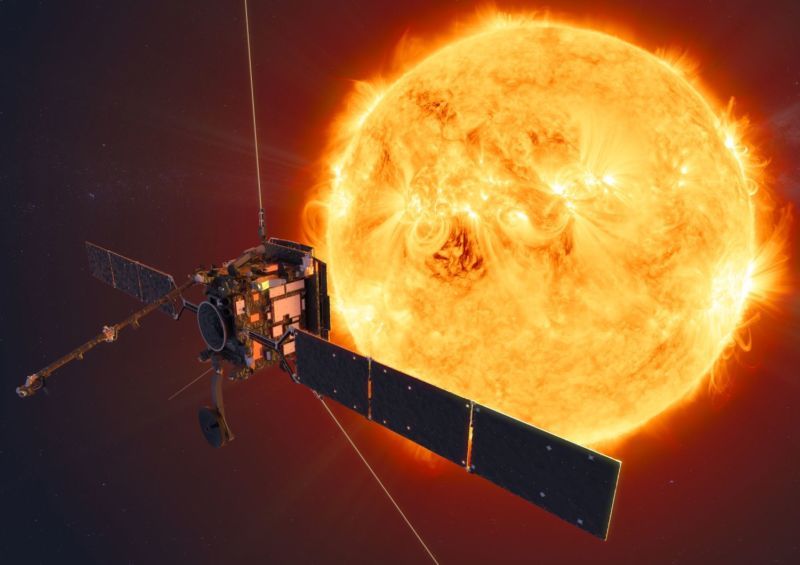
It's not the operating systems we are working with, that's for sure. Take for example the European Space Agency (ESA)'s recently-launched Solar Orbiter. Since the spacecraft will get close to the Sun, it will have to withstand harsh solar conditions. The Solar Orbiter then needs an operating system that can operate under specific conditions. The ESA developed a real-time operating system (RTOS) for Solar Orbiter that can react to dangerous situations in 50 seconds: "We've got extremely demanding requirements for this mission," says Maria Hernek, head of flight software systems section at ESA. "Typically, rebooting the platform such as this takes roughly 40 seconds. Here, we've had 50 seconds total to find the issue, have it isolated, have the system operational again, and take recovery action." To reiterate: this operating system, located far away in space, needs to remotely reboot and recover in 50 seconds. Otherwise, the Solar Orbiter is getting fried. The criteria by which we judge Windows or macOS are fairly simple. They perform a computation, and if the result of this computation is correct, then a task is considered to be done correctly. Operating systems used in space add at least one more central criterion: a computation needs to be done correctly within a strictly specified deadline. When a deadline is not met, the task is considered failed and terminated. And in spaceflight, a missed deadline quite often means your spacecraft has already turned into a fireball or strayed into an incorrect orbit. There's no point in processing such tasks any further; things must adhere to a very precise clock. The time, as measured by the clock, is divided into singular ticks. To simplify it, space operating systems are typically designed in such a way that each task is performed within a set number of allocated ticks. It can take three ticks to upload data from sensors; four further ticks are devoted to fire up engines and so on. Each possible task is assigned a specific priority, so a higher-priority task can take precedence over the lower-priority task. And this way, a software designer knows exactly which task is going to be performed in any given scenario and how much time it is going to take to get it done. Image via Ars Technica |
| The Worst Reviewed Movies Of 2020 Posted: 05 Oct 2020 09:04 AM PDT
With the pandemic forcing us to stay in our houses for our safety, most of us have probably spent their newly-found free time watching movies. Do you have a whole list of movies you like and don't like? Or are you trying to avoid bad movies so you don't end up wasting your time? Check out IGN's worst reviewed movies of 2020. Before you do, read their disclaimer for the list: IGN's worst-reviewed movies of 2020 (so far) is an unfortunate list, because nobody sets out to make a bad movie (as far as we know), but sometimes a project just doesn't come together. So let's have a look at the films released (both theatrically and streaming) so far this year that were scored the worst of the worst by IGN's critics. But first, a few notes: IGN rates its movies on a scale of 0-10. All the films cited in this article were or will be released (theatrically or streaming) between January 1st and May 1st. The "worst reviewed" movies listed here all scored 5.0 or below. The IGN review scale labels any film scored 5.0 as "mediocre," 4.0 as "bad," 3.0 as "awful" and 2.0 as "painful." Image via IGN |
| Posted: 05 Oct 2020 09:03 AM PDT
Graphene is a monolayer of carbon atoms. A team of physicists have successfully created a circuit that generates an electrical current from graphene. The electricity harvested from it can provide clean, limitless, low-voltage power for small devices or sensors, as Phys Org details: The findings, published in the journal Physical Review E, are proof of a theory the physicists developed at the U of A three years ago that freestanding graphene—a single layer of carbon atoms—ripples and buckles in a way that holds promise for energy harvesting. The idea of harvesting energy from graphene is controversial because it refutes physicist Richard Feynman's well-known assertion that the thermal motion of atoms, known as Brownian motion, cannot do work. Thibado's team found that at room temperature the thermal motion of graphene does in fact induce an alternating current (AC) in a circuit, an achievement thought to be impossible. In the 1950s, physicist Léon Brillouin published a landmark paper refuting the idea that adding a single diode, a one-way electrical gate, to a circuit is the solution to harvesting energy from Brownian motion. Knowing this, Thibado's group built their circuit with two diodes for converting AC into a direct current (DC). With the diodes in opposition allowing the current to flow both ways, they provide separate paths through the circuit, producing a pulsing DC current that performs work on a load resistor. Image via Phys Org |













| You are subscribed to email updates from Neatorama. To stop receiving these emails, you may unsubscribe now. | Email delivery powered by Google |
| Google, 1600 Amphitheatre Parkway, Mountain View, CA 94043, United States | |


No comments:
Post a Comment
Keep a civil tongue.