| Yes, These Amazing Photographs Were Taken With Smartphones Posted: 29 Jul 2021 09:31 PM PDT 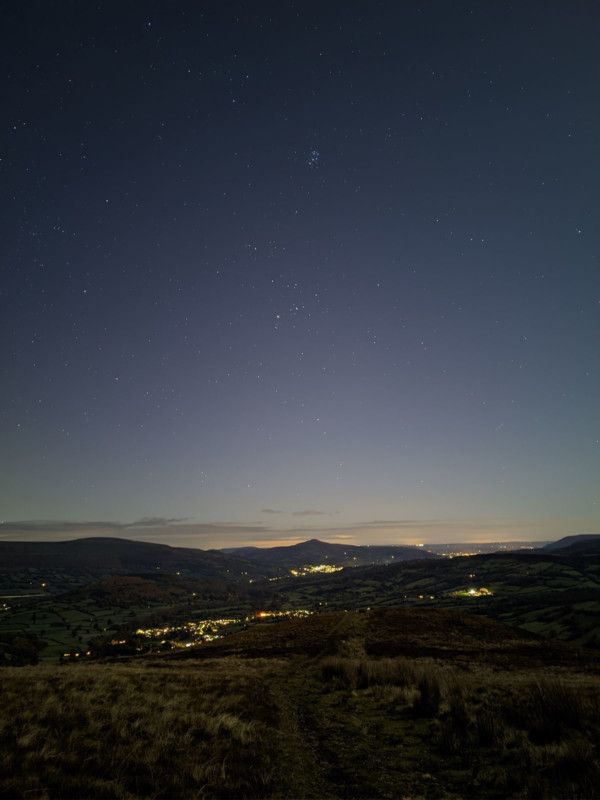
Well, we can achieve professional-looking images without equipment or experience! Thanks to new features continuously added and upgraded to our handy smartphones and different applications that help us edit and enhance our photographs, we can make our photos magazine-worthy. Hell, we can now capture a decent image of different celestial bodies in our night sky, from the Milky Way to further galaxies and constellations without expensive equipment. PetaPixel lists the available applications and techniques to produce good images using our smartphones; check the full piece here! Image credit: Alyn Wallace |
| Kinetic Chairs Posted: 29 Jul 2021 09:30 PM PDT Rocking chairs are nice, but what if you want to move in different directions? That's an option, thanks to Nicholas Gardner and Saša Štucin, artists who operate a furniture design studio called Soft Baroque. Their collection includes elegantly crafted pieces that move as you do, such as the chair pictured above. Do you fidget in your chair while working? Perhaps these chairs are optimal for those of us who need to stay in motion. And there could be a substantial market for a self-rocking crib that doesn't look like it's motorized. -via Core77 |
| The Deadly Portuguese Man O' War Posted: 29 Jul 2021 12:40 PM PDT 
While enjoying the gorgeous photography of this clip from the BBC series Blue Planet, I kept thinking of the camera operator swimming through the jellies. The Portuguese man o' war is not technically a jellyfish, but it acts in much the same way -only scarier. -via Laughing Squid
|
| 14 Plaques That Will Make You Smile Posted: 29 Jul 2021 12:40 PM PDT
There are various rules and regulations for placing historical markers in places where historic things happened, but anyone can put up a commemorative plaque, as long as it's okay with the landowner. It doesn't even have to be a true story. That why you can see where the first cheeseburger was served, in Pasadena, California.
According to local legend, a teenage cook at Rite Spot by the apt name of Lionel Sternberger was the first person to put cheese on a burger. Some claim it wasn't an invention so much as a cover-up, as Lionel had burned one side of the patty one fateful day in 1924. To hide his mistake, he slapped a new ingredient on top. Regardless of the circumstances, the cheeseburger was a hit. It later appeared on the menu as "The Aristocratic Burger: The Original Hamburger With Cheese."
A list at Atlas Obscura shows you where you can see plaques for the the site of the first kiss between Barack and Michelle Obama, the 7-11 store where the Ouija board was named, and a fight between Jack Kerouac and William S. Burroughs over the Oxford comma, among others. |
| The Difference Two Inches Makes Posted: 29 Jul 2021 12:40 PM PDT 
At the 2000 Olympics in Sydney, the women's all around gymnastics event began with a disaster. The world's greatest gymnasts were falling and crashing at the vault. It was the 19th competitor who insisted that the vault height be checked, and it was two inches (5cm) lower than regulation height! No one had adjusted it after the men's competition the night before. The upshot was that the athletes had the floor come at them much faster than in their years of training. When the error was discovered, competitors were offered a chance to re-do their vault, but it was too late for some. Several were injured, and many were so shaken that it affected their performances in other events. -via reddit
|
| The Architecture of Honeycombs Posted: 29 Jul 2021 12:39 PM PDT 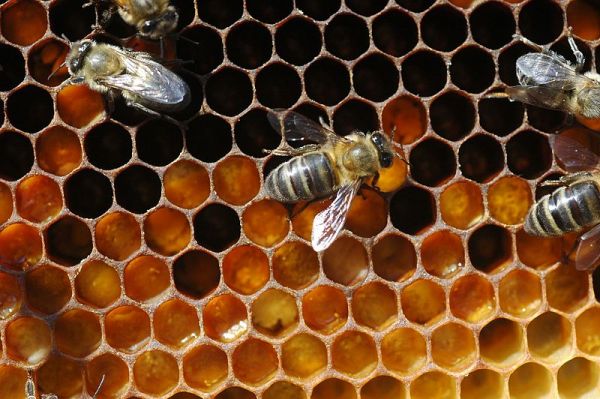
We've seen enough "you had one job" pictures too know what happens when workers start a project on both ends and try to meet in the middle. Honeybees do this all the time when they build hives, and manage to come together, knitting their little hexagon cells quite nicely, even with the difficulty of having to work around corners and curves. This happens despite a number of major challenges. To begin with, multiple workers contribute to the constructions of each honeycomb, so the regularity can't just be explained by having a single worker engage in a series of instinctual movements. In addition, nests need two different-sized honeycombs, as they use distinct sizes for workers (most of the nest) and drones (males used for reproduction). Finally, honeycombs are often built as multiple units, starting from different areas of the hive and ultimately meeting in the middle somewhere.
To find out how all these issues are managed, an animal behavior specialist (Auburn's Michael Smith) got together with two computer scientists from Cornell: Nils Napp and Kirstin Petersen, who work on insect-like robots. Combined, they put together image-analysis software that could identify the boundaries of each cell, and they figured out the cells' basic statistics—number of sides, length of each side, etc. These could then be classified based on whether they were the right size for workers or drones or whether there was something unusual about the cell.
What they found out was that bees start diverging from their own plans ahead of time in order to mesh with the workers coming from the other direction. This implies brain power that goes beyond instinct. Read what honeybees do to make it all come together at Ars Technica. -via Damn Interesting
(Image credit: Piscisgate) |
| How Bad Photography Has Changed Our Definition of Good Pictures Posted: 29 Jul 2021 12:19 PM PDT 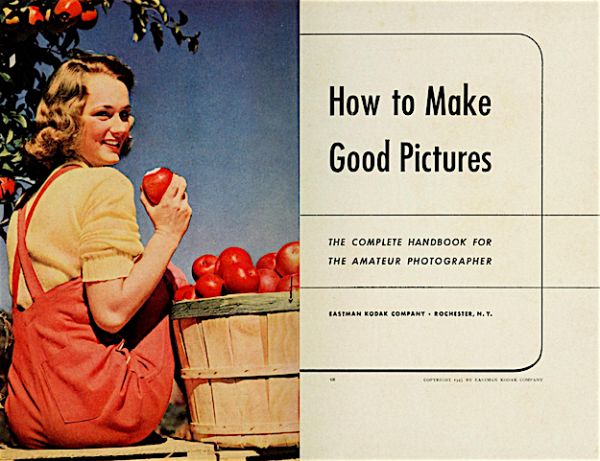
The history of photography goes back almost 200 years now. The earliest photographic images look pretty primitive to us now, but they were surely miracles in their time. As technology advanced, what was considered a "good" picture had a lot to do with the equipment. Eventually, cameras became affordable enough for lots of people to own one. But to get a "good" picture, you needed to take lessons, or learn from your mistakes, which was expensive when film had to be purchased and then processed. Photography, and photo critique, is quite different now that almost everyone has a state-of-the-art digital camera in their pocket. Kim Beil, author of the book Good Pictures: A History of Popular Photography, explains how our view of "good" pictures has changed. A second type of failure concerns effects that largely began as mistakes produced by legions of amateur photographers shooting pictures with their new, boxy, Kodak cameras, which made their debut in 1888. Foremost among these failures were motion blur and lens flare. Once upon a time, both were frowned upon by the authors of the "How to Make Good Pictures" books. Thus, a blurry background while trying to capture a moving object, or a blurry object moving across an in-focus background, were considered mistakes that a few simple techniques could help you correct.
Shooting into a light source and thus drenching precious photographic real estate in overexposed rays of light was also considered a no-no. But just as sports photographers would eventually have a ball with motion blur, fashion and advertising photographers would eventually go crazy for lens flare. Intention created context.
"Intention is central to the way I think about art, and maybe even how we define it," Beil agrees. "Take lens flare: I think the power of lens flare comes from its initial unintentional use by people who were just taking casual pictures without any premeditation, without much intention." In these sorts of photographs, Beil says, lens flare was an amateur mistake that conferred "a kind of authenticity to an image." That's why advertisers find lens flare so appealing. "Because we still associate it with authenticity," Beil says, "it makes an advertising photo seem more real, maybe even spontaneous."
Today, lens flare is so widely used, so intentional, that billions of smartphone cameras offer multiple variations of this former failing in the form of filters, which can be activated with a click or a swipe. "Everything can be achieved and there are no more accidents," Beil says of photography in the 2020s, "so photographers look to things that happened before to reinsert some kind of authenticity into their pictures." Thanks to technology, photographers can now pretend to take pictures as if they lacked the tools to make their pictures, well, good.
Beil also explains how we judge the photos of the past without understanding the limitations of the art. Read a history of "good" vs. "bad" photography at Collectors Weekly. |


No comments:
Post a Comment
Keep a civil tongue.