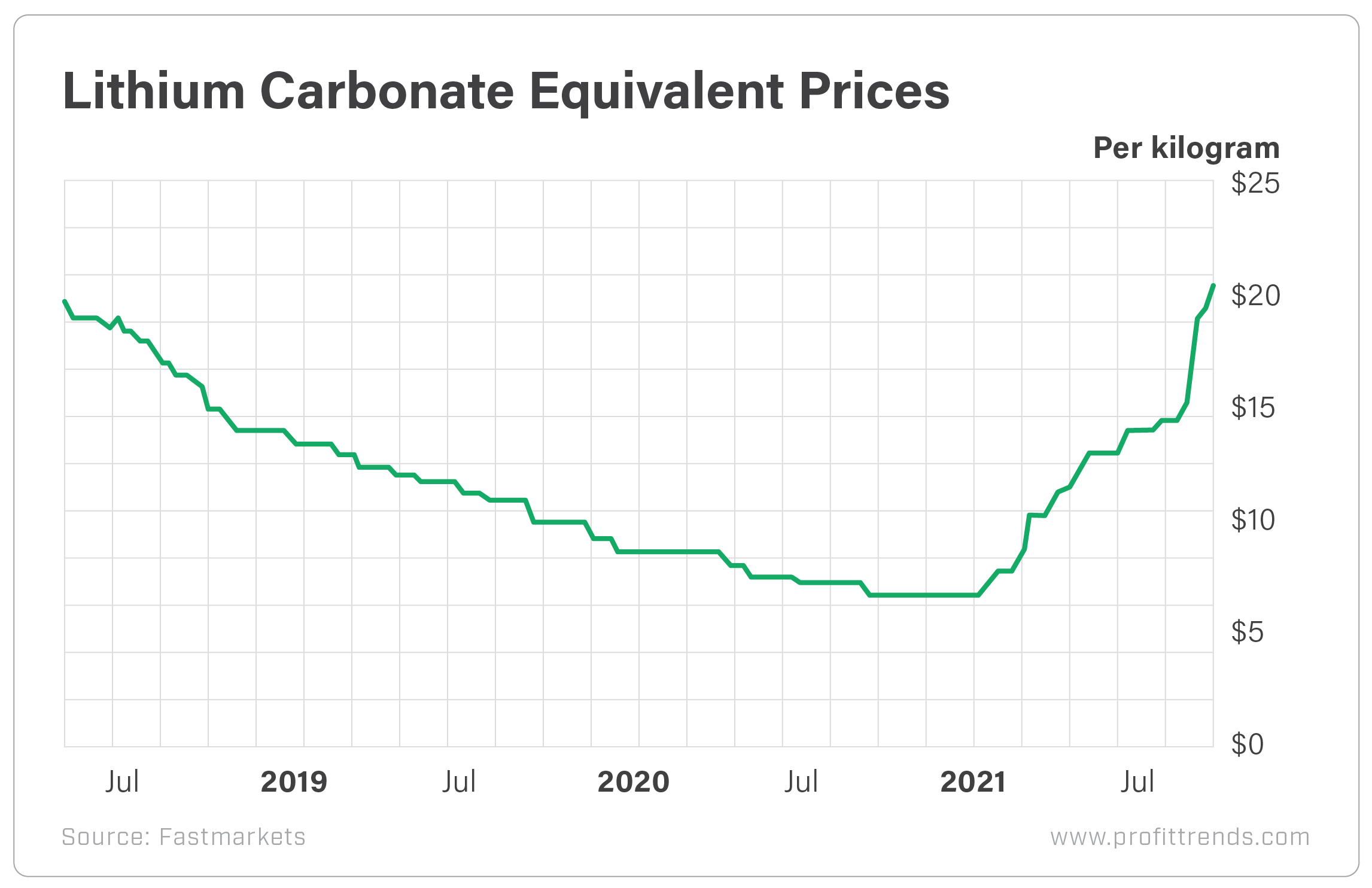
Close your eyes. Imagine you're 7,500 feet above sea level in Chile. And you're standing on the edge of the largest salt flat in the country, Salar de Atacama. It's the third-largest salt flat in the world with an area of about 1,200 square miles. But there's more here than the stark, jagged beauty of the snow-covered mountain peaks. The flat holds untold mineral riches. They're part of a salty slurry beneath the crust that covers a large part of the flat. The slurry contains boron and iodine. But another mineral is the reason mining companies are setting up operations on salt flats all over South America... The lake under the Salar de Atacama holds one of the world's largest reserves of lithium. And with ever-increasing lithium demand, miners need all the supply that they can get. Demand Is Soaring Historically, lithium has been used in lubricants, medicines and flat-screen TVs. But the demand from those uses pales next to the demand coming from lithium-ion batteries. The electrification of our transportation system is just starting. And it faces decades of robust, compound growth. But electric vehicle batteries aren't the only growth driver for this metal. Utilities are installing massive battery banks to store electricity. Some form of lithium-ion chemistry is used not only in most batteries for EVs and in energy storage but also in the batteries in our smartphones, laptops and tablets. As a result, the demand for this metal is growing at a meteoric pace. In 2020, miners produced 345,000 metric tons of processed lithium. And this year, demand is expected to increase around 19%. But supply has been tightening. The industry measures the supply of lithium as lithium carbonate. That is a stable form of the metal, which is otherwise highly reactive. Last year, producers made an excess of 54,000 metric tons of lithium carbonate equivalent. However, that excess supply is expected to decrease to just 3,000 metric tons of lithium carbonate equivalent this year. By 2030, demand is expected to grow to more than 2 million metric tons. That means production must quadruple from 2020 levels to meet this demand on time. And it's only going to get worse. EV sales continue to rise at a rapid rate as more car manufacturers introduce new models and EVs make up a higher percentage of all cars sold. As you can see from the chart above, it's going to be challenging for miners and producers to keep up with demand. But this isn't the metal's only problem... The increase in lithium demand has sent prices up as well. Take a look... Back in 2018, lithium sold for about $20 per kilogram. Excess supplies caused prices to tumble all the way down to about $5 per kilogram this past winter. But as I mentioned above, that excess supply is rapidly being used up. And that's going to send lithium prices even higher. | 




No comments:
Post a Comment
Keep a civil tongue.