Oldest-known fossils of mysterious human lineage uncovered in Siberian cave
Oldest-known fossils of mysterious human lineage uncovered in Siberian cave | 4-legged 'snake' fossil is actually a different ancient animal, new study claims | What if the speed of sound was as fast as the speed of light?
Created for ignoble.experiment@arconati.us | Web Version
Scientists have unearthed the oldest fossils to date of the mysterious human lineage known as the Denisovans. With these 200,000-year-old bones, researchers have also for the first time discovered stone artifacts linked to these extinct relatives of modern humans, a new study finds.
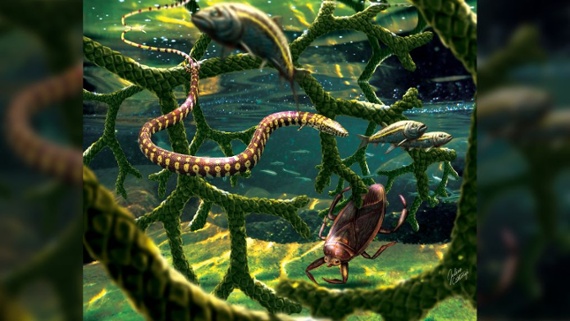
A dinosaur-age fossil heralded as the first four-legged snake known to science might actually be an entirely different beastie, a new study claims.
The tiny fossil, about the length of a pencil at 7.7 inches (19.5 centimeters) long, is likely a dolichosaur, a now-extinct marine lizard with an elongated body that lived during the Cretaceous Period (145 million to 66 million years ago), the researchers of the study found.
Win an Encalife Floating Moon lamp Click here to enter our How It Works issue 158 competition, for a chance to win 1 of 2 Encalife floating Moon lamps worth over £180.
The clouds are hanging low on the horizon; the air is sticky and sizzling with electricity. Suddenly, a silent bolt of lightning cracks open the sky. The boom follows a full four seconds later.
Compared with light, which moves at a stunning 186,000 miles per second (300,000 kilometers per second), sound waves are downright sluggish, moving through air at 0.2 miles per second (0.3 km per second). That's why you see lightning before you hear the thunder. But what would happen if the speed of sound suddenly were a million times faster — the same as the speed of light?
Octopuses are famous for their eight sucker-covered arms, whereas squids, from giant Architeuthis dux to the appetizer-size critters served at restaurants, swim with even more appendages: eight arms and two tentacles. So, what's the difference between these different types of boneless limbs?
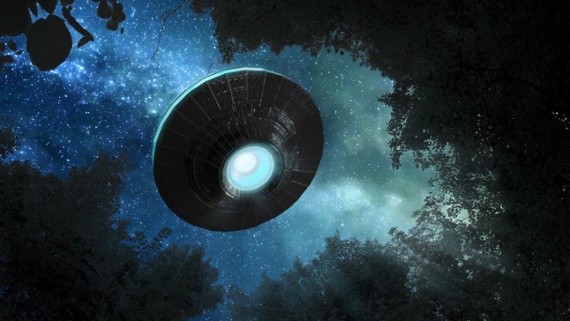
The universe is inconceivably large and mind-bogglingly old. Given all that time and space, it seems probable that somewhere, sometime, another spark of intelligence flared into existence. But if there are intelligent beings somewhere out there, how on Earth could we connect with them and, assuming we'd like to be friends, how would we give them directions to our planet?
Do you or a friend know how to build a uranium-powered nuclear reactor that can fit inside a 12-foot-long by 18-foot-wide (4 by 6 meters) rocket? Can you get the job done by the end of the decade? If so, then NASA and the U.S. Department of Energy would like to hear from you!
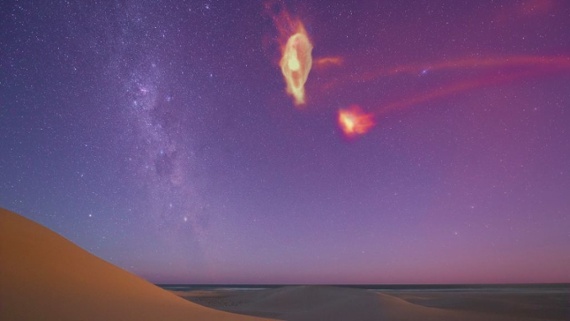
The Milky Way is playing a violent game of tug-of-war with its two toughest neighbors — the rowdy sibling dwarf galaxies known as the Large and Small Magellanic Clouds. It's hardly a fair contest. With a combined heft of about 17 billion solar masses (nearly 100 times scrawnier than the Milky Way), the two dwarf galaxies are slowly being torn apart by the gravity of our galaxy, and by each other.




















No comments:
Post a Comment
Keep a civil tongue.