Rare and fragile fossils found at a secret site in Australia's 'dead heart'
Bizarre cloud of gas is one of the longest structures in the Milky Way | Rapid tests may not detect omicron early in infection | Rare and fragile fossils found at a secret site in Australia's 'dead heart'
Created for ignoble.experiment@arconati.us | Web Version
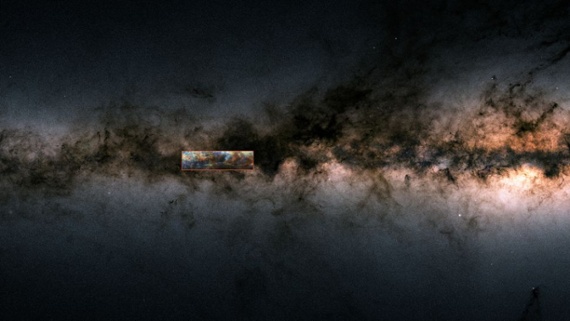
(ESA/Gaia/DPAC, CC BY-SA 3.0 IGO & T. Müller/J. Syed/MPIA)
Astronomers have discovered what may be the longest structure in the Milky Way: an unusual cloud of hydrogen.
The gigantic structure, which is more than 3,900 light-years long and around 150 light-years wide, is located roughly 55,000 light-years away from the solar system, according to a statement by researchers. (Previously, the largest known clouds of gas in the Milky Way were thought to be about 800 light-years across.) The team named the lengthy cloud "Maggie," which is short for the Magdalena River, the longest river in Colombia.
Rapid antigen tests for COVID-19 may not reliably detect the omicron variant during the first few days of infection, even when a person is shedding the virus in high enough quantities to be contagious, preliminary evidence hints.
For the new study, posted Wednesday (Jan. 5) to the preprint database medRxiv, researchers looked at 30 people from five different workplaces in New York and California, all of whom tested positive for SARS-CoV-2 in December 2021.
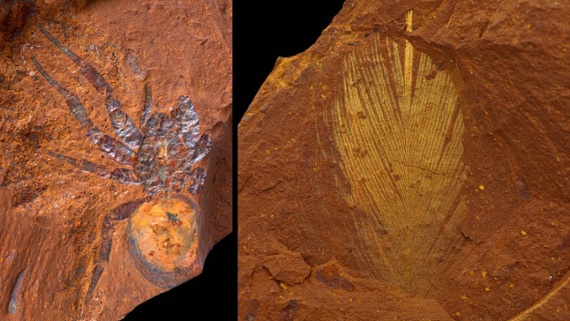
Buried in Australia's so-called dead heart, a trove of exceptional fossils, including those of trapdoor spiders, giant cicadas, tiny fish and a feather from an ancient bird, reveal a unique snapshot of a time when rainforests carpeted the now mostly-arid continent.
Paleontologists discovered the fossil treasure-trove, known as a Lagerstätte ("storage site" in German) in New South Wales, in a region so arid that British geologist John Walter Gregory famously dubbed it the "dead heart of Australia" over 100 years ago. The Lagerstätte's location on private land was kept secret to protect it from illegal fossil collectors, while scientists excavated the remains of plants and animals that lived there sometime between 16 million and 11 million years ago.
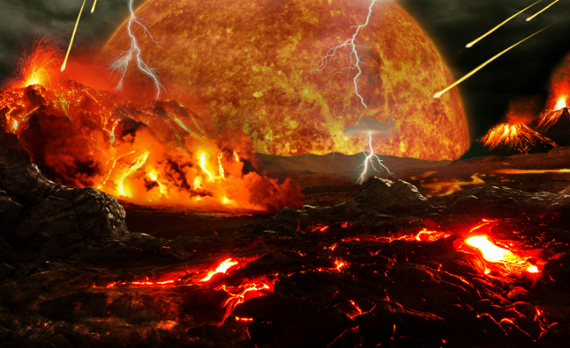
A group of mysterious, ultradense structures just outside Earth's core may be the remnants of an ancient interplanetary collision, new research suggests.
These strange structures are known as ultralow-velocity zones (ULVZs), because seismic waves generated by earthquakes travel about 50% more slowly through these zones than through the surrounding mantle. That means the ULVZs are also much denser than the rest of the mantle, and possibly made of heavier elements.
China's "artificial sun" has set a new world record after superheating a loop of plasma to temperatures five times hotter than the sun for more than 17 minutes, state media reported.
The EAST (Experimental Advanced Superconducting Tokamak) nuclear fusion reactor maintained a temperature of 158 million degrees Fahrenheit (70 million degrees Celsius) for 1,056 seconds, according to the Xinhua News Agency. The achievement brings scientists a small yet significant step closer to the creation of a source of near-unlimited clean energy.
A nuclear-powered U.S. submarine that ran aground in the South China Sea last month collided with an uncharted seamount, according to a U.S. Navy investigation.
The USS Connecticut, a Seawolf-class fast-attack submarine, collided with an unknown object in international waters on Oct. 2, causing minor to moderate injuries to 11 crewmembers, NPR reported. The damaged submarine surfaced and made it to a port in Guam unassisted. The Navy hasn't disclosed the full extent of the damage, and all the Navy said about the incident at the time was that "it was not another submarine" that had collided with the vessel, The Associated Press reported.
A 79-year-old man named Alan Gosling, who kept pet ducks at his home in Devon, England, recently became the first U.K. resident to catch the H5N1 strain of bird flu, DevonLive reported.
A flock of more than 100 ducks lived outside on Gosling's property in Buckfastleigh, and after feeding the animals for some time, Gosling brought 20 of the ducks into his home to keep as pets. In December 2021, a few of the ducks in the outdoor flock fell ill, Gosling noticed.
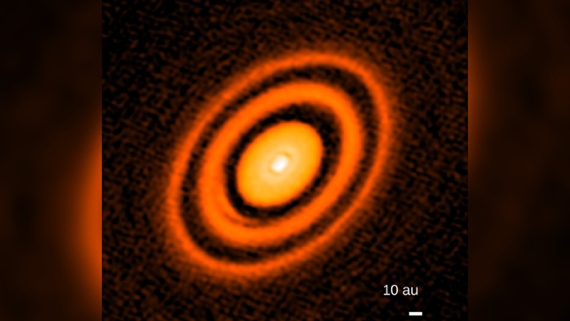
Before Earth and the other planets in our solar system existed, the sun may have been surrounded by giant rings of dust similar to Saturn's, according to a new study.
Those rings of dust may have prevented Earth from growing into a "super-Earth" — a type of planet that is about twice the size of Earth and up to 10 times its mass, according to NASA. Astronomers have discovered super-Earths orbiting about 30% of sun-like stars in our galaxy.
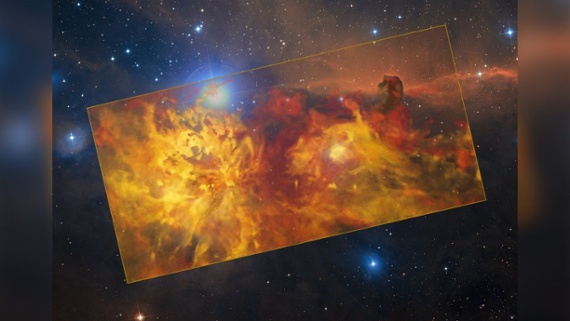
A fiery new photograph of the Flame Nebula depicts the emissions from brand-new stars, burning through space like cosmic wildfires.
These wildfires don't actually burn hot — the orange and yellow regions captured in this image are actually only a few tens of degrees warmer than absolute zero, the point at which the movement of atoms and other fundamental particles freezes, according to the European Southern Observatory (ESO). But the emissions are revealing. By pointing the SuperCam instrument aboard the Atacama Pathfinder Experiment in the Chilean desert at this region, researchers were able to discover a brand-new nebula and explore two dusty interstellar clouds, Messier 78 and NGC 2071.
(Shachar Givon, Matan Samina, Prof. Ohad Ben Shahar, Prof. Ronen Segev/BGU)
Fish may not need bicycles, but they seem to like cars.
A supremely weird new video shows a goldfish driving a water-filled, motorized "car" from one end of a room to another, bobbing and weaving to avoid obstacles along the way. Scientists performed the odd experiment to better understand how goldfish navigate terrestrial environments.















No comments:
Post a Comment
Keep a civil tongue.