Watch 'coronal streamers' streak off the sun in close-up video from Parker Solar Probe
Astronaut snaps spectacular shot of crescent moon glowing over stunning sunset | 10 fascinating findings about our human ancestors from 2021 | Why do nuclear bombs form mushroom clouds?
Created for ignoble.experiment@arconati.us | Web Version
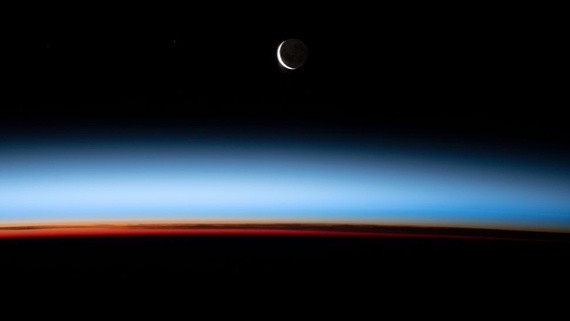
An astronaut aboard the International Space Station (ISS) has captured a stunning photo of a crescent moon above Earth as the last light of the setting sun shines through the different layers of the atmosphere.
The photo was taken Dec. 6, 2021, by an unnamed member of the Expedition 66 crew — a group of seven astronauts from NASA, the European Space Agency, the Japan Aerospace Exploration Agency and Russia's State Space Corporation, Roscosmos. The image was taken using a digital camera as the ISS passed over the Pacific Ocean east of New Zealand at an altitude of around 262 miles (422 kilometers).
Our human ancestors and relatives lived tens of thousands to millions of years ago, and we still have much to learn about their existence and abilities. In 2021, researchers investigated all kinds of clues, including ancient skulls that shed light on the evolution of Homo brains, bones from previously unknown Homo species and fossilized footprints that revealed just how early humans arrived in North America.
Here are 10 amazing discoveries about our human predecessors that scientists made in 2021.
When a bomb goes off, energy is shot out indiscriminately in all directions. So, instead of an expanding ball of fire, why do nuclear explosions result in mushroom clouds?
Although the outburst of energy does initially form a sphere of hot air, that's only the beginning of the story, according to Katie Lundquist, a researcher of computational engineering at Lawrence Livermore National Laboratory in California. Because hot air rises, the larger bulk of the sphere in the middle column — where the core of an apple would be — experiences more buoyancy than the edges do.
More and more people are tossing out the harsh chemicals from their daily cleaning routine and instead turning to natural products, such as baking soda and vinegar, to remove grime, disinfect surfaces and leave spaces shiny and clean, according to Reader's Digest. So why are these household items such effective cleaning agents? The answer is pretty basic — baking soda and vinegar lie on opposite ends of the pH scale.
Light is the fastest-moving thing in the universe. So what would happen if the speed of light were much, much slower? In a vacuum, the speed of light is about 186,000 miles per second (300,000 kilometers per second). If it were orders of magnitude slower, humans would immediately take notice.
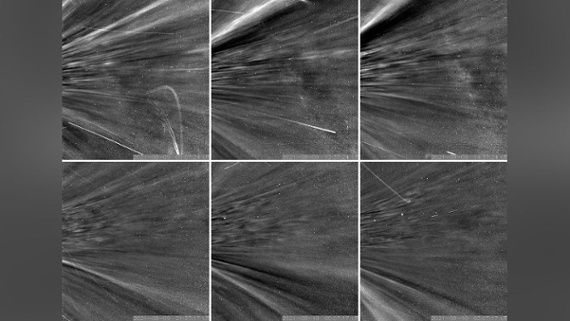
(NASA/Johns Hopkins APL/Naval Research Laboratory)
A new video of solar streamers evokes the streaking stars seen during spacecraft hyperdrives in "Star Wars."
The new NASA video from the Parker Solar Probe shows these mysterious sun structures up close for the first time, flowing past the spacecraft like interstellar fireflies. Previously, we could only catch a glimpse of streamers during solar eclipses. But with Parker specially shielded for heat-searing passes by the sun, the spacecraft has been making daring approaches closer and closer to our starry neighbor, finally reaching inside the corona during an April flyby.
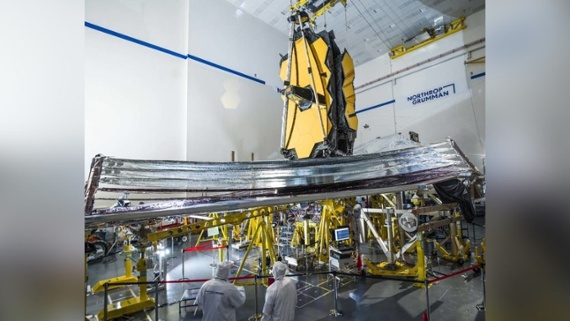
The James Webb Space Telescope has successfully deployed all five layers of its tennis-court-sized sunshield, a prerequisite for the telescope's science operations and the most nerve-wracking part of its risky deployment.
The challenging procedure, which required careful tensioning of each of the five hair-thin layers of the elaborate sunshield structure was a seamless success today (Jan. 4). Its completion brought huge relief to the thousands of engineers involved in the project over its three decades of development, as well as the countless scientists all over the world who eagerly await Webb's groundbreaking observations.















No comments:
Post a Comment
Keep a civil tongue.