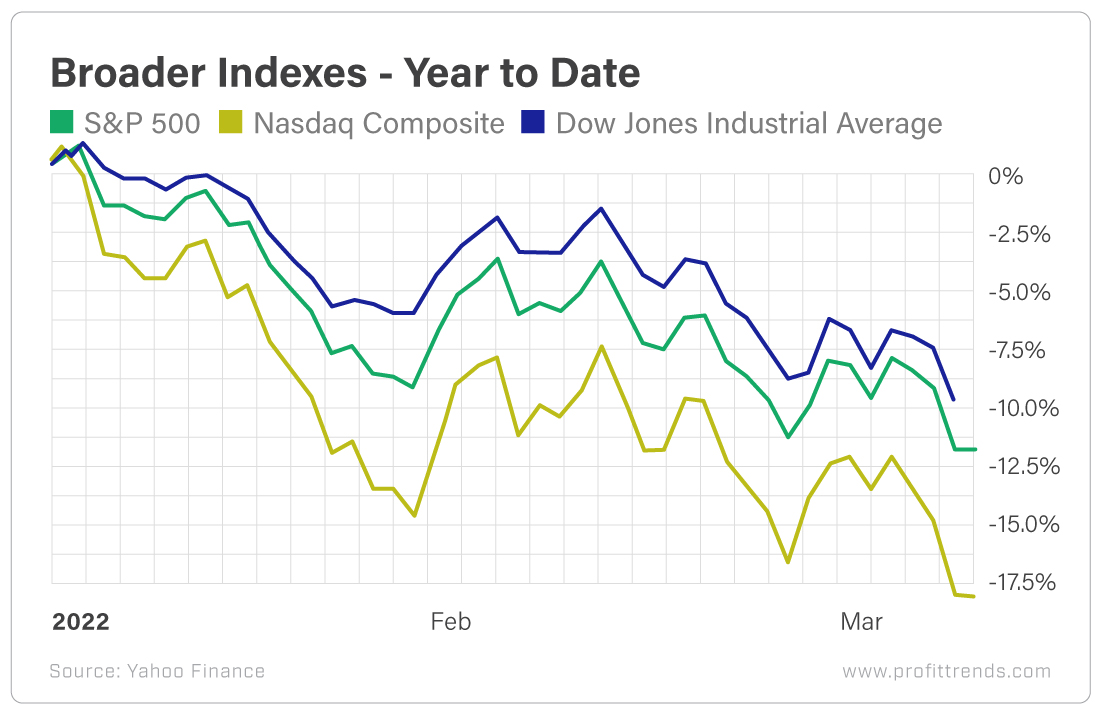
On-Time Correction Some of the most dangerous, expensive words in history are: "This time is different." Now, 2022 isn't going to be like 2020. But there are some similarities between the two. This year has been a mess for the markets... as I forecast it would be to kick off 2022. And it's images like these that highlight the widespread anxiety. The Nasdaq has fallen 20% year to date. It's now in bear market territory. And its recent declines add to the struggles tech stocks have experienced this year. The S&P 500 is in correction territory, and the Dow Jones Industrial Average is hovering right near that level. The last time the S&P was in a correction was 2020. Now, let's talk about what to expect from corrections. Historically, the markets average a 10% correction every 2.8 years. They're more common than most investors think. And during corrections, stocks suffer an average decline of 13.7% over a four-month stretch. The S&P's last high was a little more than two months ago, on January 3, and it currently sits 13% below that level. Using history as our guide, it takes roughly four months for the markets to regain all the ground they lost after a correction. That means, assuming today is the bottom of the correction, we shouldn't expect the S&P to fully recover until July. But what if the correction continues lower... Know Your Bear Breeds Not all bear markets are the same breed. There are structural bear markets, cyclical bear markets and event-driven bear markets. And each has a different average decline, duration and recovery time. A structural bear market is triggered by financial bubbles or structural imbalances. Think the dot-com crash of 2000 and the financial crisis of 2008. Cyclical bear markets are a function of rising rates, impending recessions and profit declines. And event-driven bear markets are triggered by an exogenous shock, like the 1973 oil crisis, the COVID-19 pandemic or a war - like Russia invading Ukraine. These typically don't lead to domestic recessions. Keep in mind, prior to Russia's siege on Ukraine, the markets were rallying on fourth quarter earnings. Now, structural bears are the worst. These last for an average of 42 months and see a market decline of 57%. It then takes 111 months for the markets to recover. Cyclical bear markets are part of the business cycle. Stocks fall an average of 31% over 27 months and take 50 months to recover. Event-driven bears are furious and short-lived. But they can often be the scariest. The average decline is 29% over nine months. But it takes a mere 15 months for the markets to completely recover. It is the easiest bear to tame, with a considerably shorter uphill climb than structural or cyclical downturns. So even though it may feel like the end of the world at times, it's not. Panic, anxiety and uncertainty are widespread. But I've stressed over and over that the biggest gains are made during corrections and bear markets. This is when babies are thrown out with the bathwater, so to speak, and we can buy shares of great companies for ultra-cheap. All we need to do is watch for the moment of maximum opportunity - when pessimism surges to a peak - and start adding to our positions. When our future selves look back, they'll thank us for being greedy when fear gripped everyone else. Here's to high returns, Matthew P.S. My good friend David Fessler has found the only 5G stock you need to own. Its growth potential is so large that investors who get in soon could see their profits soar. This is a moment where taking decisive action could change your life. Sitting on the fence will only lower your profit potential. Get the details here. | 







No comments:
Post a Comment
Keep a civil tongue.