| |
| |
| |
| |
| |
| Axios AM Deep Dive |
| By Mike Allen · Oct 29, 2022 |
| Good afternoon, and welcome to this latest installment of our Hard Truths Deep Dive series that explores experiments to reduce racism in policing. - Smart Brevity™ count: 1,344 words ... 5 mins.
🏡 Get Axios Local, with morning newsletters in 24 cities. |
| |
| |
| 1 big thing: Snail-paced reform |
 |
|
| Illustration: Annelise Capossela/Axios |
| |
| One proposal after another has been offered on ways to tackle systemic racism in policing. Nearly all have fallen short, and significant reforms have been slow, Axios' Keldy Ortiz and Russell Contreras report. - Protests, technology and court orders have forced some departments to face transformation. But systemic barriers continue to stall major changes.
- Since George Floyd's murder in 2020, there has been more progress on changes to police tactics — such as banning chokeholds — than on deterrence of police misconduct and accountability for the worst misconduct.
Where it stands: President Biden in May signed an executive order to create a national database of police misconduct, ban chokeholds unless deadly force is authorized, and require anti-bias training. - But the executive order doesn't have the force of legislation. Bipartisan talks on a broader bill collapsed last year.
- Jewel Hall — whose son Milton was killed by Saginaw, Mich., police officers when they unloaded 47 shots in a July 2012 standoff — said she has seen some positive change with reforms. "But those with money can still escape accountability."
Body cameras: The 2014 shooting death of 18-year-old Michael Brown by a white police officer in Ferguson, Mo., added pressure for more departments to use body cams. - Some believe body cams can deter bad policing, but research is mixed. And body cams can be turned off.
- Footage has been used as grounds to fire officers or criminally charge them — most recently after the shooting of 17-year-old Erik Cantu by a San Antonio officer — or to expose policies that allow officers to use deadly force methods that activists say are unnecessary.
Consent decrees: Federal court-ordered settlement agreements between cities and the Justice Department have compelled 40+ police departments to change practices since 1994. Reality check: A majority of police agencies that entered into consent decrees in the last 10 years saw violent crime rates skyrocket immediately, according to an Axios examination. The reasons for those increases are not known. Read the full story. |
    |
| |
| |
| 2. Cop shortages hurt diversity |
 |
|
| Illustration: Annelise Capossela/Axios |
| |
| Police officers are leaving the profession in droves, crippling recruitment — including efforts to diversify departments after George Floyd's killing, Keldy writes with Axios Local reporters from across the country. Brenda Goss Andrews, president of the National Organization of Black Law Enforcement Executives, told Axios in an interview that public mistrust is among the hurdles police face: - "We can't be warriors all the time and we can't be guardians."
In Minneapolis, the current authorized force is about 560 officers — far under the minimum of roughly 730 established by the city's charter, Axios Twin Cities' Torey Van Oot reports. - More than two-thirds of the current force is white, according to the city. 11.4% is Black. The city is 63% white and about 20% Black.
Read the full story. |
| |
| |
| |
| 3. 📱 "Siri, I'm being pulled over!" |
 |
|
| Illustration: Allie Carl/Axios |
| |
| An enterprising smartphone user set up a program for the iOS Shortcuts app that activates when you say: "Siri, I'm being pulled over." - It turns down music, alerts selected contacts and begins recording from the front-facing camera, Axios tech editor Peter Allen Clark reports.
Why it matters: Several apps and tech solutions are trying to help people de-escalate police encounters. The ACLU created an app, Mobile Justice, that allows users to quickly record and send videos to contacts or local ACLU offices. - Former police officer and police trainer Stan Campbell formed the De-Escalating Officer Patrol Encounters (DOPE) organization and developed a companion app, which allows users to record encounters and includes training videos on how to handle them.
Go deeper. |
| |
| |
| |
| A message from Axios |
| The latest political news in your inbox |
| |
 |
| |
| Stay in the know for the upcoming midterm elections with our insider's guide to the powerful people — and ideas — shaping politics. Delivered daily from Sunday to Thursday. Subscribe for Free |
| |
| |
| 4. An apology's value |
 |
|
| Illustration: Shoshana Gordon/Axios |
| |
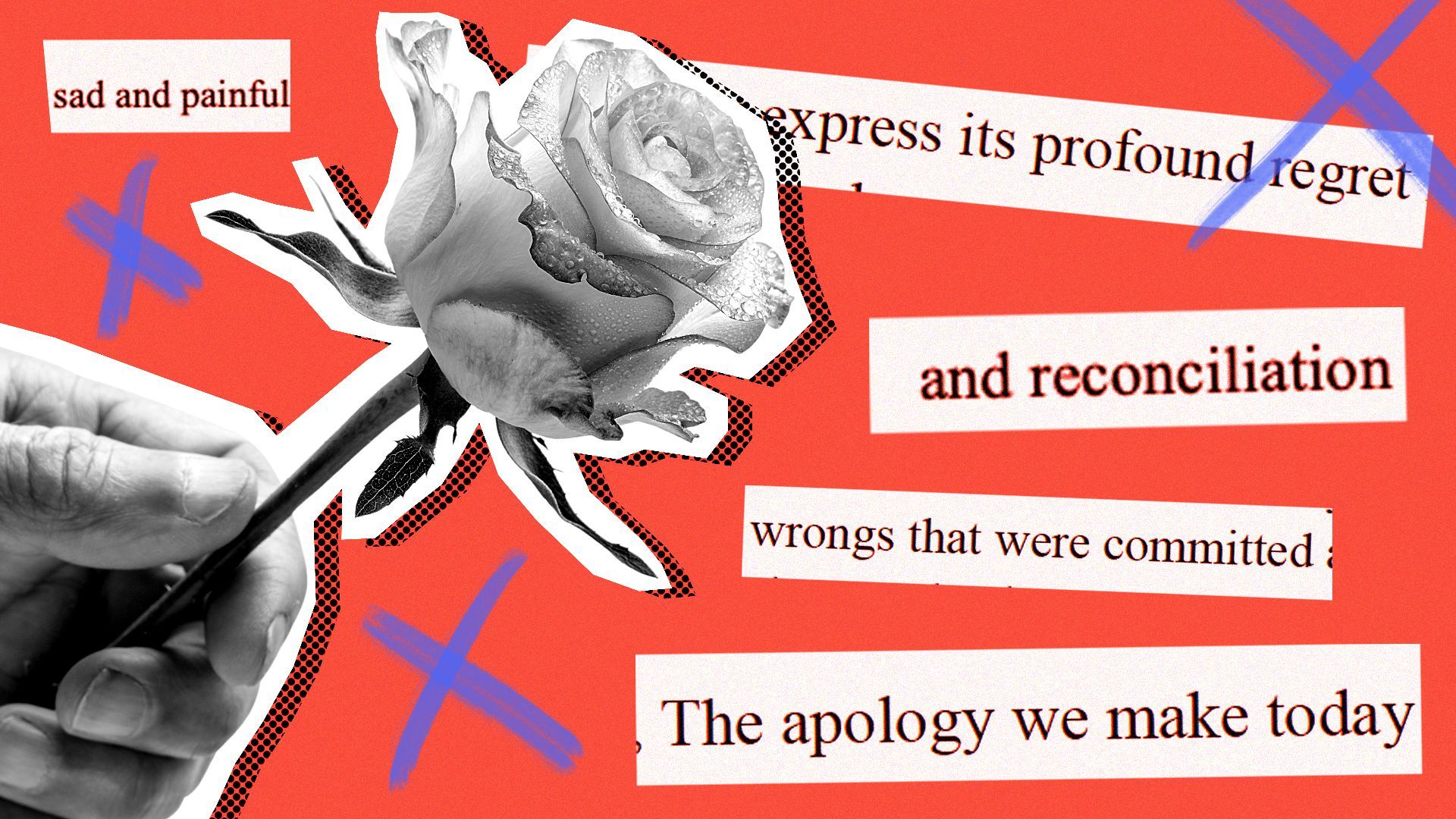
| Some cities with deep histories of police misconduct against people of color are trying to make amends, Russell and Keldy report. - Why it matters: More diverse city governments are acknowledging and trying to atone for incidents from the past. But these events are almost always decades old — not police violence in the news today.
In Houston: The mayor and police chief apologized last year to the family of a Mexican American man who was beaten to death by officers and dumped in a bayou in 1977 — a killing that sparked riots and massive reforms. - Jackson, Miss.: The mayor of Jackson apologized last year on behalf of the city for the 1970 shootings by police officers that killed two and injured 12 on the campus of a historically Black college.
Reality check: These kinds of apologies are sometimes met with skepticism from the communities. - That has been the case in Columbus, Ohio. Deputy police chief Tim Becker apologized for treatment of protesters in 2020 demonstrations over Floyd's murder, Axios Columbus' Alissa Widman Neese reports.
- Then, in August, Columbus officer Ricky Anderson shot and killed 20-year-old Donovan Lewis in his bed while serving an arrest warrant in the middle of the night.
Go deeper. |
| |
| |
| |
| 5. Legacy of Defund the Police |
 |
|
| Photo illustration: Sarah Grillo/Axios. Photo: Erik McGregor/LightRocket via Getty Images |
| |
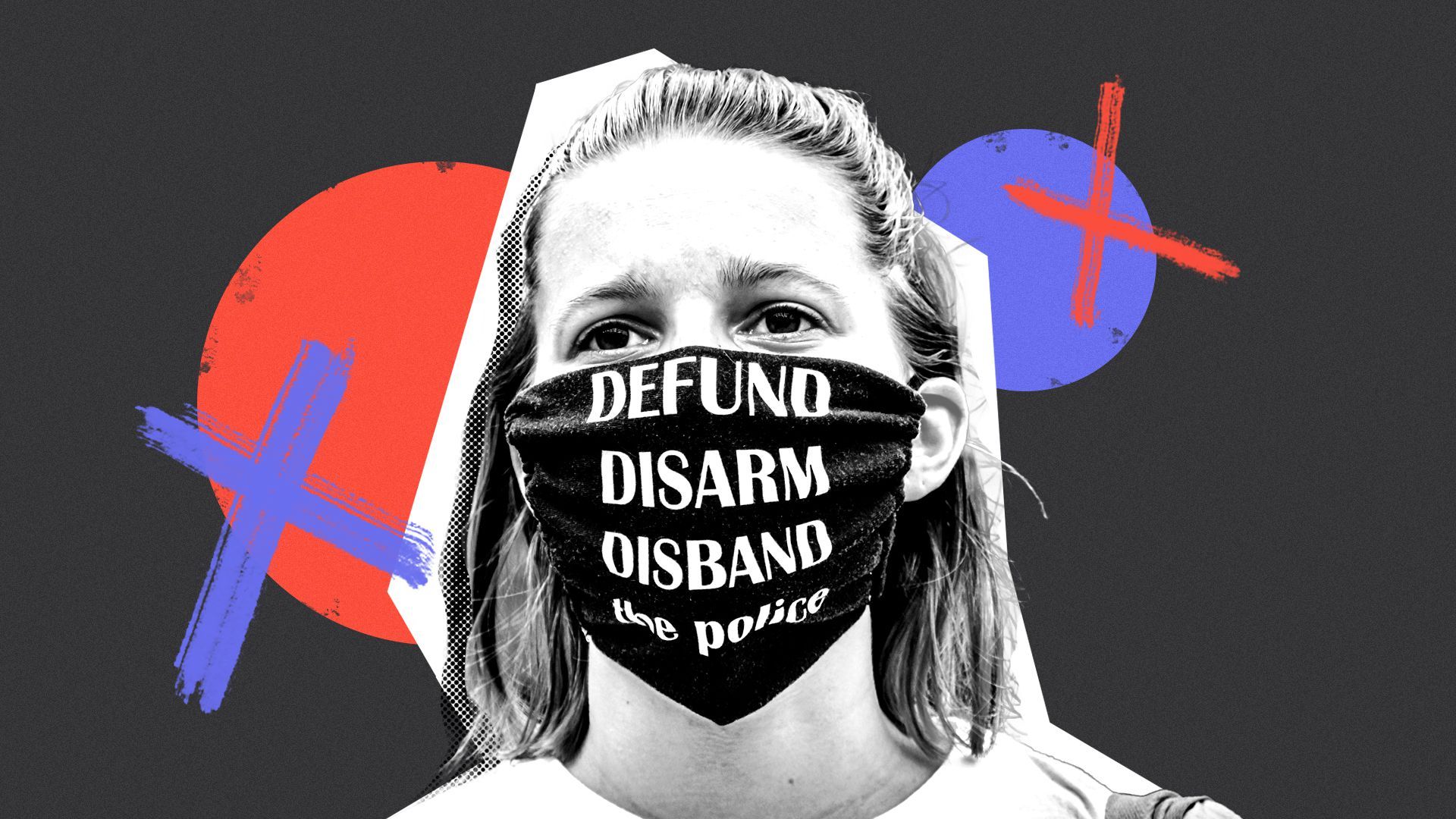
| After Floyd's death, protesters in the summer of 2020 shouted the slogan "defund the police" — a phrase rooted in a decades-old call for local governments to redirect money from police agencies to other forms of crime prevention. - The movement did force some cities to examine how to rethink police budgets, but nearly all major reforms failed, Russell reports.
- Minneapolis voters last year rejected a ballot measure to overhaul the city's police department by replacing it with a new agency.
- Jim Pasco, executive director of the Fraternal Order of Police, told Axios the Defund the Police movement died after the Minneapolis vote.
- Many Democrats, including President Biden, rejected the slogan.
Yes, but: Activists and think tanks such as the Brookings Institution said the Defund the Police movement wasn't actually about abolishing law enforcement. Instead, it was about demilitarizing police departments and reallocating funding to trained mental health workers. - In an analysis of 109 city and county budgets, ABC News found that only eight agencies cut their police budgets by more than 2%, while 91 agencies increased them by at least 2%.
Share this story. |
| |
| |
| |
| 6. Moving up mental health |
 |
|
| Illustration: Shoshana Gordon/Axios |
| |
| Many big-city departments have begun sending unarmed mental health professionals to respond to some 911 calls, Axios Twin Cities' Nick Halter writes with Axios Local reporters around the country. - Why it matters: Backers of the programs say these professionals are better equipped than police to help people going through mental health crises — and they see the programs as a way to prevent police shootings, including those involving people of color.
How it works: Minneapolis began a pilot program in December. In the first six months, mental health professionals responded to 3,300 calls — about 3% of 911 calls. - The contractor, Canopy Mental Health & Consulting, sends vans of small teams to aid people experiencing mental health crises. The person being assisted must be unarmed, nonviolent and not suffering a medical emergency.
Denver had a pilot program in the works before Floyd's killing and launched it in June 2020, a month after his death, Axios Denver's Esteban L. Hernandez reports. - Columbus' mobile response teams still include police. But the city has also embedded social workers in the 911 dispatch center, Alissa Widman Neese of Axios Columbus reports.
Go deeper. |
| |
| |
| |
| 7. Police data drought |
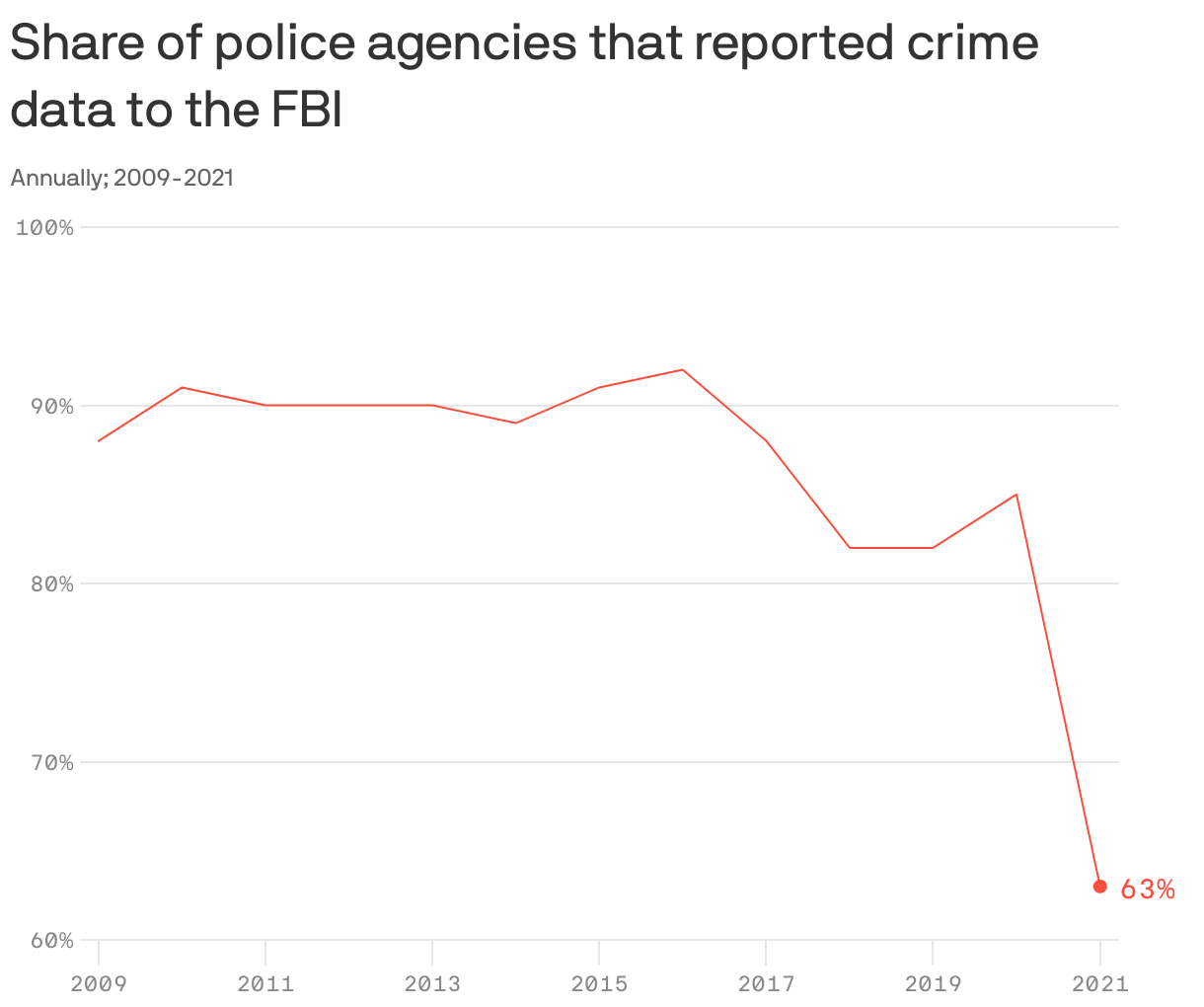 Data: FBI. Chart: Tory Lysik/Axios Visuals Police departments from Boston to Phoenix have boosted data collection to improve policing and community relations. But the impact is limited by holes in the national data and the way police departments use what they collect, Russell reports. - Why it matters: Data can improve trends in use of force and arrests. And surveillance tools can prepare police for dangerous situations — but civil liberties groups worry about ways the tech can be misused.
🧮 By the numbers: There are more than 80 Real Time Crime Centers (RTCCs) in the U.S., in 29 states — surveillance hubs that are supposed to give officers information and limit deadly encounters and mistaken suspects. - But civil liberties groups have criticized RTCCs for their use of facial recognition technologies and interpretations of suspicious activities that are law-abiding.
Another big problem: Many police departments have refused to report data to the FBI about how their officers used force and about crimes in their communities. So the data isn't useful for measuring national trends. Go deeper. |
| |
| |
| |
| A message from Axios |
| The latest political news in your inbox |
| |
| |
| |
| Stay in the know for the upcoming midterm elections with our insider's guide to the powerful people — and ideas — shaping politics. Delivered daily from Sunday to Thursday. Subscribe for Free |
| |
| This Deep Dive was edited by David Nather, Delano Massey and Hadley Malcolm, and copy edited by Amy Stern. |
 | | Are you a fan of this email format? It's called Smart Brevity®. Over 300 orgs use it — in a tool called Axios HQ — to drive productivity with clearer workplace communications. | | |


No comments:
Post a Comment
Keep a civil tongue.