Welcome to The Independent's climate newsletter, a weekly digest of climate crisis impacts around the world and the progress being made to tackle them. Thanks for reading - LB |
|
|
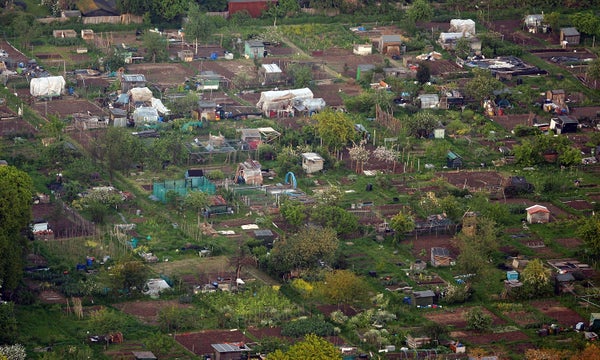
Allotments - the UK's system of community gardens - pictured in south London in 2008 (Credit: Peter Macdiarmid Getty Images) | | |
Climate crisis
Emissions gap: Despite record-breaking growth of renewables, global energy-related carbon emissions will increase through 2050, according to the latest outlook from the US Energy Information Administration (EIA). The study found that emissions cuts will be outpaced by population growth, manufacturing and more energy consumption as living standards improve around the world. However, the EIA noted that their "projections should not be interpreted as forecasts" and while current policies are not doing enough to cut emissions, more ambitious action could be taken in the future (EIA). Separately, the International Energy Agency wants the fossil fuel industry to do more to cut flaring and leaks of methane - a greenhouse gas with 80 times the warming power of carbon dioxide over 20 years. The influential group said cutting methane was "essential" to keep to 1.5C and reduce the risk of passing climate tipping points. Rapid methane cuts from fossil fuels would do more to limit temperature rise by 2050 than immediately taking all cars and trucks around the world off the road, IEA said. What's more, cutting methane would prevent nearly 1 million premature deaths in the next 30 years and 90 million tonnes of crop losses.
Exxon Mobil doubles down in Texas: As many countries strive to move faster towards clean energy, the world's largest oil company has made its position abundantly clear by buying fracking giant, Pioneer Natural Resources, for $60 billion. The move will double Exxon's oil and gas output in the Lone Star State, and signals a huge bet on a future of fossil fuels. The world's leading climate scientists have warned that to avoid deepening the climate crisis, rapid cuts are needed in fossil fuels, and no new infrastructure for oil, coal and gas. Exxon's deal is awaiting regulatory approval and may be challenged by the Biden administration.
Evacuations in Argentina: People were fleeing from their homes in Cordoba province in central Argentina on Tuesday after massive wildfires erupted during an intense heatwave. Around 1,000 firefighters and eight water-dropping planes were battling flames in hillsides around residential areas. It is unclear how many homes have been impacted. In Brazil, a drought in the Amazon is leaving communities dependent on the rainforest's waterways stranded without fuel, food or drinking water. The low water levels - which have also been linked to mass deaths of fish and river dolphins - are feared to be the worst on record in Amazonas state and are severely impacting the region's agriculture. The 40C (100F) temperatures that have impacted areas of Brazil and Argentina, along with Bolivia and Paraguay, were partly down to impacts of this year's El Nino. However scientists reported this week that the deadly winter heatwave in South America was made 100 times more likely due to the fossil-fuel driven climate crisis.
Myanmar floods: Heavy monsoon rains have displaced more than 14,000 people from townships near the country's largest city of Yangon, according to The Associated Press. No casualties have been reported so far, local officials said. In Cameroon, at least 27 people have been killed and more than 50 were injured in floods set off by heavy rains in the central African country. The rains unleashed floodwaters in the capital, Yaoundé, sweeping away buildings and reducing many to rubble. Flooding has been frequent in Cameroon in recent years, with experts often blaming the climate crisis alongside poorly-regulated construction. The latest floods were worsened after a dike in a manmade lake gave way, sweeping structures down the hill, the government said. (AP)
Invisible threat: The world is accumulating a mountain of "invisible" electronic waste each year, according to new research, worth $10bn in raw materials. While Europe recycles 55 per cent of e-waste, the numbers are woefully low globally. The average collection rate for e-waste around the world is just over 17 per cent, according to a United Nations monitor. New research from the Waste Electrical and Electronic Equipment (WEEE) Forum, a Brussels-based non-profit, found that vape pens equivalent in weight to three Brooklyn Bridges are thrown away every year. So are 7.3 billion e-toys – car racing sets, electric trains, music toys, speaking dolls, drones – an average of one for every person on the planet. And some 950million kg of cables were discarded in 2022, enough to wrap the Earth 107 times. Many of these products contain critical minerals like lithium, cobalt, nickel and copper which are in huge demand for electric cars, solar panels and large-scale battery storage. China has dominated critical mineral supply chains for decades, controlling nearly two-thirds of global production and 85 per cent of the processing industry, while the US and Europe struggle to catch up. Lithium, used in vape pens' rechargeable batteries, has been designated as a strategic raw material by the European Commission and the US government, for example.
Climate progress
'We're here, Africa': There is optimism for meaningful change at the International Monetary Fund and World Bank in order to better support Africa as it deals with some of the worst impacts of the climate crisis. The institutions held their annual meetings in Africa for the first time in 50 years this week. While concrete details are yet to emerge both institutions have promised to better recognize climate change as an economic threat and increase representation from the continent on their executive boards. "We're here, Africa," IMF Managing Director Kristalina Georgieva said on a panel with African entrepreneurs in Marrakech, Morocco. African leaders and civil society groups continue to call for increased climate funding for the continent which is suffering severe droughts, erratic flooding and deadly heat despite being responsible for only a sliver of global emissions. "But instead of receiving funds to address the climate crisis, Africa is borrowing at a cost up to eight times higher than the rich world to rebuild after climate catastrophes," wrote Kenyan President William Ruto in a NY Times op-ed on Sunday. "This is why Africa urgently needs a pause in debt repayments so that it can prepare for a world of ever greater climate extremes. The Annual Meetings of the International Monetary Fund and the World Bank in Marrakech, Morocco, that begin Monday are a good place to start."
Winds of change: Dogger Bank wind farm, the world's largest offshore facility, is up and running in the North Sea. The turbine - the first of 227 to be installed - generated its first power this week and is now connected to the UK national grid. A single turbine rotation can supply a home with two days of power, and when the wind farm is complete, it will provide 5 per cent of the UK's electricity demand. (Euro News)
Not so NIMBY: New polling from the Washington Post and University of Maryland has found that Americans are largely fine with living close to solar and wind farms. The survey found that the majority of people are comfortable with solar panels and wind turbines being built in their communities, whether they are urbanites or rural dwellers. And perhaps most surprisingly, this view cuts across party lines. Some 66 percent of Republicans weren't bothered by a field of solar panels nearby, and 59 per cent were okay with wind turbines. Among Democrats, 87 percent are comfortable with solar farms and 79 per cent with wind farms. On the flip-side, fewer than half of all US voters would want a nuclear power plant to be built. (Washington Post)
Digging it: There are nearly 175,000 applications stuck on waiting lists in the UK for allotments - the centuries-old British system of community gardens. An investigation by Greenpeace of lists in England, Scotland and Wales discovered that people are waiting on average three years to get a parcel of land to grow fruit and vegetables, with some on hold for up to 15 years.
The city with the longest list was Bristol, with 7,630 applications, followed by Sunderland, Portsmouth, Southampton, Edinburgh and Manchester. In many cases, the number of applications exceeded the total number of plots available. Greenpeace say this shows people want to grow their own food as a way to improve their health, save costs on shopping and reduce their carbon footprint. "Allotment waiting lists demonstrate a huge desire from people to be part of the solution to our broken food system but without access to land, the many benefits of community food growing to people, nature and the climate are being stifled," said Daniela Montalto, from Greenpeace UK.
| |
|
"Our position as a global leader on climate has come under renewed scrutiny following the Prime Minister's speech. We urge the Government to restate strong British leadership on climate change in the crucial period before the next climate summit, Cop28 in Dubai." |
|
|
Life in the climate crisis |
|
|
Join the conversation or follow us |
| |
Download the free Independent app |
|
|
Please do not reply directly to this email You are currently registered to receive The Independent's climate newsletter. To unsubscribe from The Independent's climate newsletter, or to manage your email preferences please click here. This e-mail was sent by Independent Digital News and Media Ltd, 14-18 Finsbury Square, London EC2A 1AH. Registered in England and Wales with company number 07320345
Read our privacy notice and cookie policy
|
|
|
|









No comments:
Post a Comment
Keep a civil tongue.