The Independent's Climate Newsletter
Welcome to The Independent's climate newsletter, a weekly digest of climate crisis impacts around the world and the progress being made to tackle them. Thanks for reading - LB |
|
|
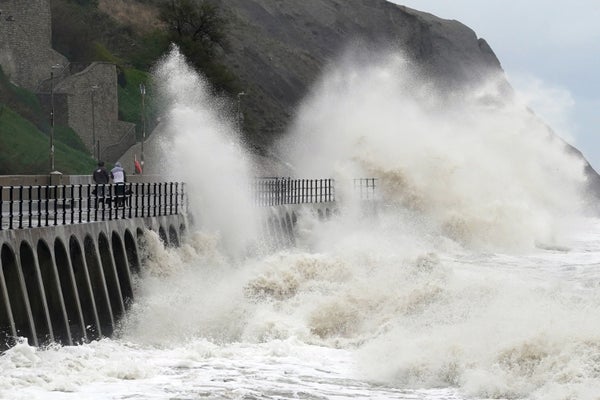
Waves crash over the promenade in Folkestone, England, on Thursday as Storm Ciarán brings 100mph winds and heavy downpours to western Europe (Credit: Gareth Fuller/PA Wire) | |
|
At least five people are dead after Storm Ciarán battered western Europe with record-breaking winds and torrential downpours. Thousands have lost power, and homes and infrastructure sustained severe damage. Air and rail travel was suspended or suffered long delays in parts of the UK, France, Belgium and beyond as authorities urged people to stay home. Winds of more than 100mph howled across northern France's Atlantic coast while 30ft waves slammed into Spain. In the UK, a tornado warning was issued from South Wales to London, and "golfball-sized hailstones" were reported.
Five fatalities were confirmed in Belgium, France, Spain, Germany and the Netherlands due to falling trees. The Channel Islands were badly hit with Ciarán thought to be the worst storm to impact the small island of Jersey since 1987. "The authorities sent out plenty of warnings to islanders to prepare, however, I don't think anyone was quite ready for the strength of the winds we experienced last night and this morning," Carl Walker, the Jersey Consumer Council chairman, told The Independent. "It's like nothing anyone can ever recall."
Hundreds of flooding warnings and alerts have been issued across the UK as
heavy rains deluged parts of the south on Thursday. More downpours are expected across northern England and Scotland by Friday morning.
The UK Met Office said the mean sea level pressure reading for England and Wales in November is the lowest ever - breaking a record which had stood since 1916. Dr Rihab Khalid, Isaac Newton Trust Research Fellow at the University of Cambridge, noted that Storm Ciarán arrived shortly after Storm Babet delivered the third wettest, three-day period in England and Wales since records began. And it's only November.
2023 is on track to be the hottest year that humans have ever experienced, largely because of the fossil-fuel-driven climate crisis. Record amounts of heat in the atmosphere and ocean are turbocharging weather events to greater, and greater, extremes.
"As records tumble, the increasing frequency and severity of extreme events is a stark reminder that the impacts of climate change are not a future probability, but a present threat affecting us in all parts of the world," Dr Khalid said.
More climate news this week from The Independent
Pope Francis will attend the Cop28 summit next month, the first time that a pontiff has done so. The Catholic leader has been outspoken on climate issues, criticizing the developed world for not doing enough to protect vulnerable countries. King Charles is also expected to attend the Dubai conference. The Israel-Hamas war could impact the number of world leaders travelling to the gathering - the largest event of the year focused on the climate crisis. On Wednesday, Reuters reported that President Joe Biden is unlikely to attend.
The carbon budget for stopping the Earth heating 1.5C above pre-industrial levels could run out in the next six years. Scientists said the window is "rapidly closing" and at the current rate of emissions, it is now more likely than not this key target of the Paris Agreement will be breached. Around 250 gigatonnes of carbon dioxide is left to emit before warming of at least 1.5C is locked in - which would take about six years without any drastic reductions.
Scientists say meat should have cigarette-style warning labels. A new study this week found that adding graphic images of wildfire-charred landscapes to meat dishes reduced people's desire to choose them.
Nearly 100 people are dead or missing after Hurricane Otis struck the city of Acapulco last week, the strongest ever storm to make landfall on Mexico's west coast. The hurricane underwent explosive intensification from a Category 1 to Category 5 in just 12 hours, taking forecasters by surprise and leaving the city little time to prepare.
The introduction of London's first clean air zone 15 years ago has significantly improved air quality, according to new analysis. London launched its low emission zone (Lez) in 2008 and subsequent ultra low emission zone (Ulez) in 2019. The low emission zone helped to cut particulate matter (PM10), which lodges in the lungs and causes an array of health issues. Greater London saw PM10 decline by 13 per cent between 2008 and 2013, compared to between 2003 and 2007.
|
|
|
Climate scientists are tearing their hair out because we're not listening to their warnings. If comedians can help them scream more effectively, then I'm happy to oblige. |
|
|
Life in the climate crisis |
|
|
Join the conversation or follow us |
| |
Download the free Independent app |
|
|
Please do not reply directly to this email You are currently registered to receive The Independent's climate newsletter. To unsubscribe from The Independent's climate newsletter, or to manage your email preferences please click here. This e-mail was sent by Independent Digital News and Media Ltd, 14-18 Finsbury Square, London EC2A 1AH. Registered in England and Wales with company number 07320345
Read our privacy notice and cookie policy
|
|
|
|






No comments:
Post a Comment
Keep a civil tongue.