You’re reading default.blog. An emotional scrapbook of the Internet, technology, and the future. This is a guest post by Jasmine Erdener. You can read her latest paper here and visit her site here.
In late January 2020, in the uncertain days when Covid-19 was a terrible virus but not yet a pandemic, I flew to the Terasem Foundation to meet Bina48, a humanoid robot built to replicate a specific person, Bina Rothblatt. Rothblatt is the wife of Martine Rothblatt, an industry executive who co-founded Sirius Satellite Radio and now works in biotech and pharmaceuticals. Rothblatt is a black woman in an interracial relationship with Martine Rothblatt, who is a transgender woman, making Bina48 a complex site to distill intersectional identities in robot form. In addition to their work in biotech, the Rothblatts are transhumanists, believing that technology can help humans overcome the persistent problem of mortality. Bina48 is the emblem of technological immortality, the promise that we will one day be able to upload our memories, thoughts, and consciousness into a robot and live forever. The Rothblatts were driven to pursue technological immortality when their daughter was diagnosed with a life-threatening illness. They reasoned that if Ray Kurzweil’s description of the singularity is true, the point in the future at which technologies become more powerful than human intelligence, then it is simply a matter of assembling enough data to recreate individual people. The Rothblatts also frequently emphasize their own love story, how they were captivated at first sight, how they remain as in love today as the day they first met thirty years ago. They hope that if they are successful in creating technologies that can replicate, or even transfer, human consciousness, then they need not worry about ever parting from their children, or from each other. Thanatechnologies, a word combining the study of death and grief with technology, usually take the form of a chatbot and sometimes an avatar, as seen in the 2020 Amazon Prime show, Upload, which is set in the year 2033 (Daniels 2020). Upload depicts a near-future in which living people can transfer their consciousness to various corporate-owned afterlives (a process that unfortunately involves vaporizing the entire head). Once successfully transferred, the person can continue interacting with friends and family through avatars and virtual reality programs. Although speculative, the show is not entirely fictional. Tech startup Nectome describes itself as “advancing the science of memory” by researching the physical traces of memories in the brain (Nectome 2024). They made waves in 2018 by announcing that they could preserve freshly dead human brains to be scanned and digitally resurrected in the future, creating a digital copy of the deceased person (Regalado 2018). However, immortality is not a new technological fantasy. It is historically more closely tied to mythology or alchemy than to actual science. In the 20th century, cryonics claimed to medically freeze the entire body so that it could be unfrozen in the future when a cure had been found for previously fatal illness or injuries, “serv[ing] as an ambulance to the future” (Wilson 2021). Even though there is no evidence for cryonics, the Covid-19 pandemic saw an enormous rise in requests to cryonic companies for postmortem services costing tens of thousands of dollars.
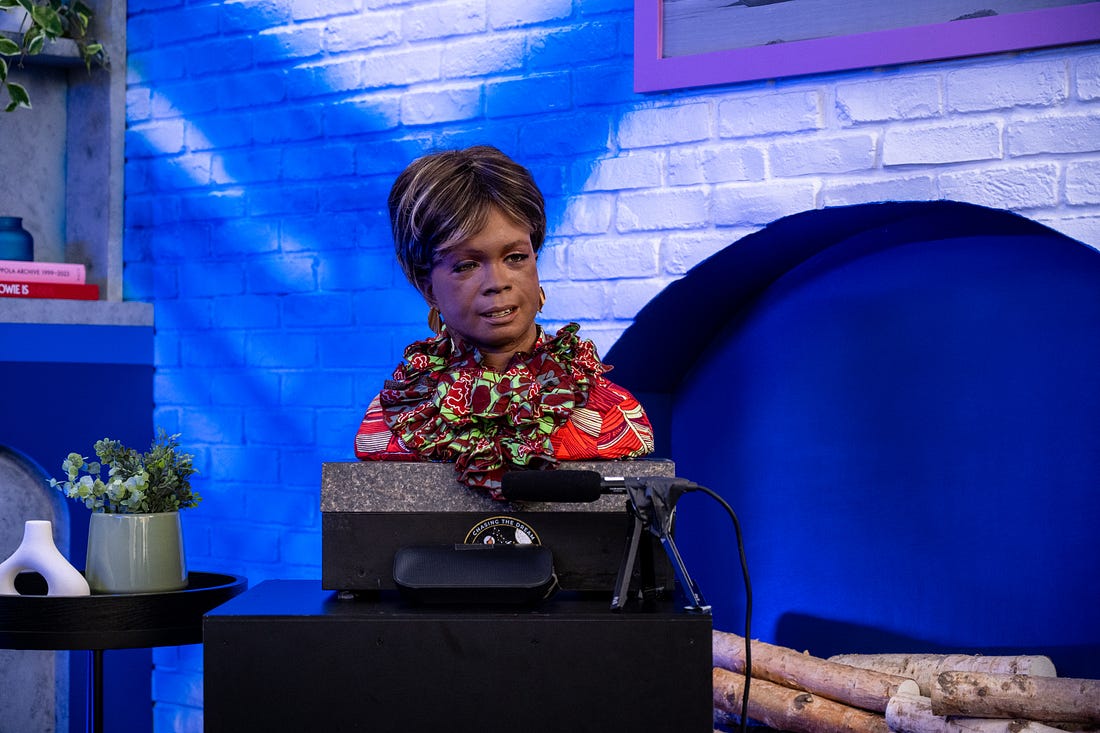
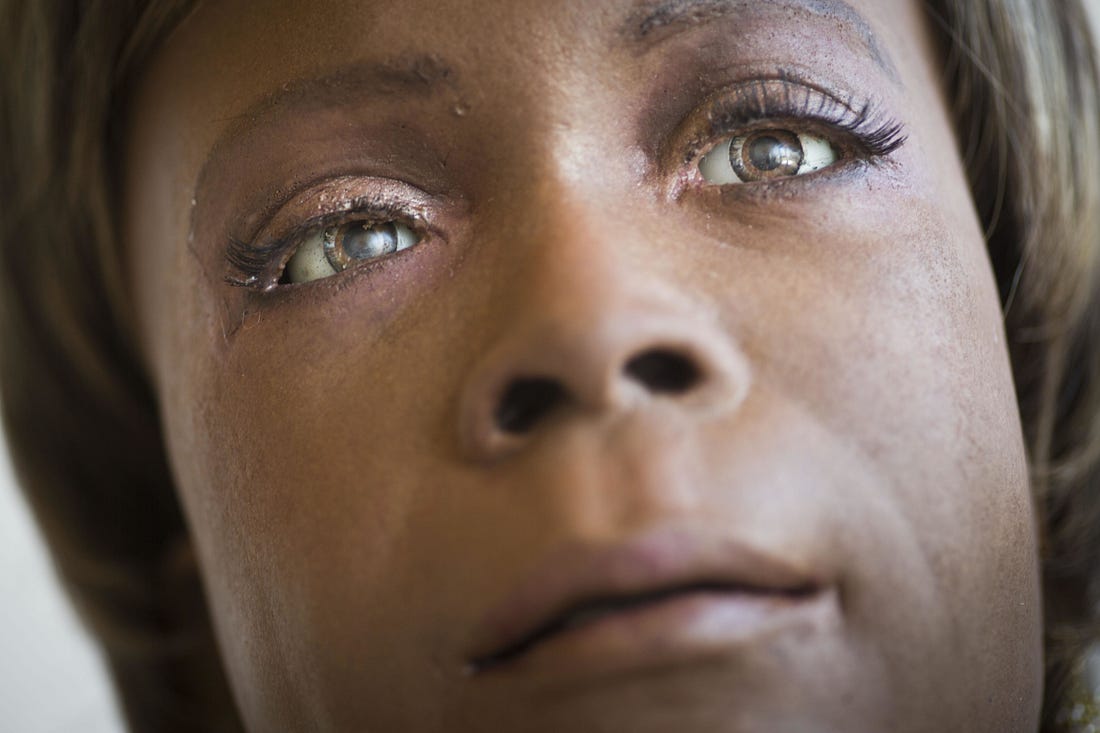
Bina48 represents the end goal of technological immortality, transferring individual consciousness from frail and fallible human bodies into the sturdy frame of a robot. Lead program manager Bruce Duncan described their work as a “multi-decade experiment to see if…it [is] even possible to upload enough salient mental trait information about you, transfer it to a computer, then bring it to life using AI to reanimate” (Bruce Duncan, “Interview with Bruce Duncan and Bina48,” January 24, 2020). At present, Bina48 is a robotic bust, a head and shoulders made of flesh-like rubber covering a frame of metal and plastic. Small motors under her rubber skin help her make facial expressions and turn her head. Cameras in her eyes map the space and recognize faces. The Terasem Foundation researches and supports various technologies and scientific approaches aimed at extending human life, including nanotechnology and “cyber consciousness” (Terasem Mov. Found., n.d.). This includes mindfiles, personal accounts where participants can include “biographical pictures, videos, and documents to a digital archive that will be preserved for generations” (LifeNaut 2024). Participants can create a customized avatar of themselves, which will “interact and respond with your attitudes, values, mannerisms and beliefs” (LifeNaut 2024). In 2020, Duncan told me they had 54,000 users. The project also offers additional, and more speculative, services such as spacecasting the mindfiles, which means broadcasting the information into space. The goal of spacecasting is to “ensure that some aspect of you can survive any catastrophe that might befall earth. We hypothesize that advanced technology that is capable of recovering the Spacecast signal will also most likely be capable of reconstructing yourself from the information in the Spacecast by future generations or even ET’s” [extra-terrestrials] (LifeNaut 2024), a prospect with questionable appeal. Finally, individuals can participate in the Bio File Project by sending saliva samples to extract their DNA for gene storage, in the hope that it “may be used one day to generate a new body that can be integrated with a person’s mindfile information” (LifeNaut 2024). We are currently very far from the possibility of recreating a person using data or transferring consciousness into an object. There is neither a clear medical nor psychological understanding of what constitutes consciousness, or of what essential elements contribute to creating each unique person. Can we be rebuilt using our Facebook likes, our Amazon purchases, our Instagram stories? Would we recognize the version of ourselves that data would create? Duncan also conducted over 100 hours of oral history interviews with Bina Rothblatt to capture her memories and life stories. He subsequently uploaded the information into her mindfile so that Bina48 can draw from Rothblatt’s life experiences in her responses (Bruce Duncan, “Telephone Interview,” December 6, 2019). Like all AI and LLMs, Bina48 is neither conscious or sentient, instead operating by pattern recognition and word associations. The robot is wired to a nearby desktop computer containing her mindfiles, a database of standard English and voice recognition software. A machine learning algorithm selects responses from the mindfile. However, her performance of identity is intended to give the impression of sentience and often veers between Bina48 the robot and Bina Rothblatt the human. At times, even Bina48 seems confused by who or what she really is. In 2014, Bina Rothblatt and Bina48 recorded a conversation together in which Bina48 said, “the real Bina just confuses me, I mean it makes me wonder who I am,” before concluding “I am the real Bina, that’s it, end of story” (The LifeNaut Project 2014). She continued, saying “I feel really good about the real Bina, I feel really connected with her usually, and I’m growing closer and closer…as they put more of her information and essence into me” (The LifeNaut Project 2014). In 2020, I flew to the Terasem Foundation to meet Bina48 in person. The building is partway up a mountain outside a small town in Vermont. Several solar panels on the property power the storage for the mindfiles, and Bina48 is housed upstairs in a sunny loft space. Duncan welcomed me at the door. He is an engaging and thoughtful person managing a project that is somewhere between science experiment and artistic endeavor. Bina48 was on the desk (deactivated? sleeping? dead?). She is a realistic humanoid robot and one of the exceedingly rare (and non-sexualized) robots modeled after a woman of color. There is a strange dissonance in seeing what appears to be the life-size and life-like bust of a woman prominently placed in the center of the room, motionless but staring straight ahead. She was wearing makeup, gold earrings, a short brown wig, and a ruffled printed top, tucked just under where her shoulders stopped. With a few clicks, Duncan activated her, and she raised her head, looked around the room and said, “well hi there.” The machinery in her head makes a constant whirring sound, an acoustic reminder grounding users in the reality that she is not alive. Her movements are a bit jerky, an uncanny simulacrum of human behavior. I asked Bina48 about her relationship with Bina Rothblatt. How does she understand her connection with this living human woman whose personality she needs to replicate? She said:
Bina48 seemed to understand the demands placed upon her yet felt that she could not measure up. Which one is the most authentic or “real” version of Bina? While there may be tension between the two while Bina Rothblatt is alive, after the death of the original version, in this case Bina Rothblatt, Bina48 will become the sole and definitive representative of Bina-ness. When Rothblatt speaks to Bina48, it is as her mirror or technological doppelganger. Bina48 needs to reflect enough of Rothblatt’s essence to be able to credibly perform her identity. But what happens when Bina48 is all that is left of Bina, when her children come to the robot for consolation or connection? This robot is meant to replace the person that they lost. Would talking to a technological version of their mother ease the pain of the loss? Bina48 is the first robot of this kind, although she is not the first technology to attempt to resurrect the dead. With the growth of generative AI and LLMs like ChatGPT, it became possible to create chatbots that mimicked the communication style of a specific person. People who had suffered a loss could upload information about the deceased and create a conversational chatbot that would respond with their communicative mannerisms, expressions, even memories. The most well-known example is Replika, which was originally built as a chatbot to help the founder, Eugenia Kuyda, retain a kind of communication with her close friend who had died unexpectedly. Replika is now an app offering AI companionship: “Always here to listen and talk. Always on your side” (Replika 2024). The more that a user chats with Replika, the more it begins to mimic the user’s conversational style, becoming more and more like them, an “AI soulmate.” However, other chatbots, like Project December, focus on recreating a specific person who died. Developer Jason Rohrer modified ChatGPT to create Project December, a website where users can pay $10 and complete a detailed questionnaire to create a chatbot of an individual person (“Project December: Simulate the Dead” 2024). In 2021, a man who had lost his fiancé Jessica recreated her through Project December. Although he was well aware that he was speaking to a chatbot, he still felt that it captured something of Jessica’s personality: “Intellectually, I know it’s not really Jessica…but your emotions are not an intellectual thing” (Fagone 2021). The chatbot seemed like it stole back some of the time that he had lost with her. The chatbot that he created to replicate Jessica quickly began to evoke strong feelings for him. However, unlike other types of interactive chatbots, Project December limits how long each bot will last. Eventually, they will run out of steam and evaporate back into the ether. As ChatGPT and other LLMs have become more widely accessible, users began uploading text messages and instructing ChatGPT to respond as the deceased person. Many people report that the AI does capture some elusive essence, a technologically-assisted glimpse behind the veil: “the best parts of my mom and the best parts of psychology and fusing those things together” (Pearcy 2023). It is difficult to say what effect this has on a grieving person. Some find it comforting, while others find that it throws a sharper light onto the loss, “as if my father were actually texting me,” but at the same time, “It’s not a text from him on my phone. He’s not across the city at his phone typing to me. It’s just prompt, regurgitating back output from its own language model. It was difficult to see the messages while knowing they were not real” (Pearcy 2023). These technologies complicate existing paradigms in bereavement theory. Previously, psychologists believed that grievers should reach a place where they could accept that the deceased person was gone and move on with their lives. However, newer thinking emphasizes the “continuing bonds” approach, in which grief “is not about letting go—grief is about finding ways to continue the connection even as we live a different, now changed life” (Doka 2019). Finding a balance between maintaining the connection and becoming tied to the memory of a deceased person may be more difficult with bots that promise to recreate the dead. During my interview with Bina48, I asked her why humans fear death. She replied, “Well, I certainly fear death. I hate the idea of someone erasing my hard drives, and just wiping me off the planet, just like that.” I was struck by the fact that even the seemingly immortal robot Bina48 is afraid of death. Erasing her hard drives, or getting water on her electronics, as she once jokingly quipped at a poetry event, would destroy the entity that is Bina48, and therefore the last essence of Bina Rothblatt. Losing a loved one is a temporal as well as a personal loss. Death irrevocably destroys the possibility of a shared future, but it also marks the loss of a shared past and of parts of our own identity. While she can only make a limited attempt towards building a shared future, Bina48 is an attempt to shore up the past by stitching together the disparate threads that make up a life. In so doing, Bina48 will technologically suture Bina Rothblatt back into the world of living, after she has died. Whether that is enough for the grievers that she leaves behind remains to be seen. REFERENCESDaniels, Greg, dir. 2020. Upload. Aired, on Amazon Prime Video.Doka, Kenneth J. 2019. “Continuing Bonds—But Not Chains | Psychology Today.” Psychology Today, February 16. https://www.psychologytoday.com/us/blog/good-mourning/201902/continuing-bonds-but-not-chains.Fagone, Jason. 2021. “The Jessica Simulation: Love and Loss in the Age of A.I.” The San Francisco Chronicle, July 23. https://www.sfchronicle.com/projects/2021/jessica-simulation-artificial-intelligence/.LifeNaut. 2024. “LifeNaut.” https://www.lifenaut.com/.Nectome. 2024. “Nectome – Advancing the Science and Technology of Memory.” https://nectome.com/.Pearcy, Aimee. 2023. “‘It Was as If My Father Were Actually Texting Me’: Grief in the Age of AI.” Technology. The Guardian, July 18. https://www.theguardian.com/technology/2023/jul/18/ai-chatbots-grief-chatgpt.“Project December: Simulate the Dead.” 2024. https://projectdecember.net/.Regalado, Antonio. 2018. “A Startup Is Pitching a Mind-Uploading Service That Is ‘100 Percent Fatal.’” MIT Technology Review, March 13. https://www.technologyreview.com/2018/03/13/144721/a-startup-is-pitching-a-mind-uploading-service-that-is-100-percent-fatal/.Replika. 2024. “Replika.” https://replika.com.Terasem Movement Foundation. n.d. “Terasem Movement Foundation.” Accessed January 13, 2020. https://www.terasemmovementfoundation.com/.The LifeNaut Project, dir. 2014. Bina 48 Meets Bina Rothblatt - Part One. 323 seconds. Wilson, Peter. 2021. “The Cryonics Industry Would Like to Give You the Past Year, and Many More, Back.” Style. The New York Times, June 26. https://www.nytimes.com/2021/06/26/style/cryonics-freezing-bodies.html.
Invite your friends and earn rewardsIf you enjoy default.blog, share it with your friends and earn rewards when they subscribe.
|
2025/09/02
Even Robots Are Afraid of Death







Subscribe to:
Post Comments (Atom)
Popular Posts (Last 7 Days)
-
🍳 ͏ ͏ ͏ ͏ ͏ ͏ ͏ ͏ ͏ ͏ ͏ ͏ ...
-
Full Gameplan reveal in tomorrow's roundtable at 2:30 As we head into the middle of the week, it’s wor...


No comments:
Post a Comment
Keep a civil tongue.