|  | Source: Greenville SC Law Firm |
| Drug trafficking has been one of the most serious issues in Latin America for more than four decades. It affects security, politics, the economy, and daily life. The region plays a key role in the global drug trade. It produces most of the world's cocaine. It also serves as a key transit zone to big consumer markets. Despite strong military and police responses, this traffic continues to adapt and expand. Understanding its roots, its functioning, and its outcomes is crucial to grasp many of the region's challenges. | Production and trade | The region is mostly involved in this traffic through drug production. Coca leaves are grown mostly in Colombia, Peru, and Bolivia. It is the base ingredient for cocaine. These areas are often remote, mountainous, or covered by jungle. It makes state control difficult. For many rural farmers, coca is one of the few crops that provides stable income. Poverty, lack of infrastructure, and weak public services push local populations to depend on illegal incomes. Drug trafficking groups take advantage of this situation. They offer protection and money where the state is absent. | | 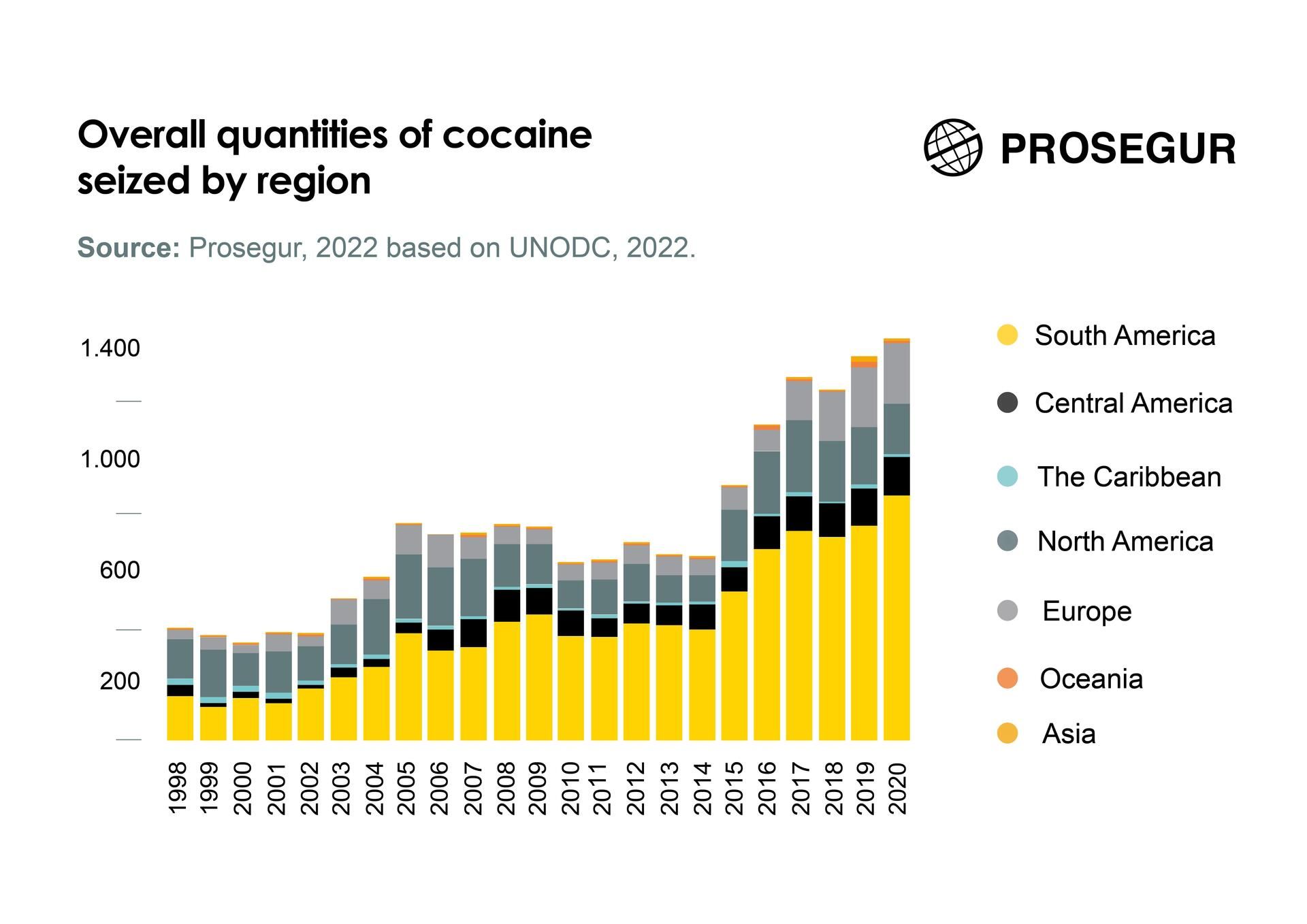 | Source: Prosegur Research |
| Once produced, drugs must reach global markets. This makes Latin America a key transit region. Mexico plays a key role as the main gateway to the U.S. The latter is the world's largest drug consumer. Central American states such as Guatemala and Honduras are used as land, air, and sea corridors. Caribbean routes are also important. They are used to send drugs to Europe. In recent years, Brazil has become a strategic hub. It is both a consumer market and a departure point for cocaine sent to the EU. | Powerful criminal groups control these flows. In Mexico, the Sinaloa and the Jalisco New Generation cartels operate like companies. They manage production, transport, security, and money laundering. In Colombia, large cartels have disappeared. But smaller armed groups and former guerrilla factions continue the traffic. In Brazil, groups in prison control both local violence and global routes. All these groups are flexible. They can adapt to police pressure. | | | Trump's Exec Order #14154 — A "Millionaire-Maker"
Donald Trump has cheated death.
He's overcome insane and criminal vote rigging.
And survived every indictment and impeachment thrown at him.
But his next move could make him a legend – and perhaps the most popular president in U.S. History.
Former Presidential Advisor, Jim Rickards says, "Trump is on the verge of accomplishing something no President has ever done before."
And if he's successful, it could kick off one of the greatest wealth booms in history.
We recently sat down with Rickards to capture all the key details on tape.
For the moment, you can watch this interview free of charge – just click here. |
|
| | Social impact | The social and security impacts of this traffic are huge. Violence is the most visible effect. States affected by drug routes often have very high homicide rates. Cities become battlegrounds between rival gangs or between cartels and the state. Journalists, judges, and politicians are often threatened or killed. It also weakens trust in institutions. Corruption spreads through police forces, courts, and local governments. In some areas, criminal groups provide services and impose their own rules, acting like a parallel state. | States' responses | States have mostly responded with militarized strategies. Mexico has used the army to fight cartels for more than fifteen years. Colombia received strong support from the U.S. through security cooperation programs. These policies sometimes reduce the power of specific groups. But they rarely solve the problem. When one cartel is destroyed, others quickly take its place. Violence often increases as groups fight to control new territories. Critics argue that focusing only on repression ignores deeper social and economic causes. | Geopolitical outcomes | This traffic has outcomes for the region and beyond. First, it shapes relations with external actors, especially the U.S. Anti-drug cooperation gives the U.S. strong influence over policies in the region. This can limit national sovereignty. It can also push states toward military solutions, even when results are poor. | Second, it turns parts of the region into strategic spaces in global criminal networks. Drug routes now link it to Europe, West Africa, and Asia. It makes the problem truly global. | Third, the instability created by drug violence w eakens states. It slows development. This affects regional integration and foreign investment. | Finally, it fuels migration. Violence pushes many people to leave their home, especially from Central America toward North America. It creates political tensions far beyond the region. | Links with other criminal activities | Drug traffic is closely linked to other forms of crime. This includes terrorist groups and gun traffic networks. These actors often work together because they share common goals. These include money, territory, and secrecy. Drugs provides a key source of funding for armed groups. It allows them to buy weapons, recruit fighters, and control local populations. In some regions, terrorist or insurgents protect drug routes or production areas in exchange for a share of the profits. Arms traffickers also supply weapons to drug cartels. It increases their firepower and makes them harder to defeat. Many of these weapons come from weakly controlled markets and cross borders illegally. This cooperation creates criminal networks that are flexible and global. | | In recent years, new trends have appeared. Synthetic drugs, such as fentanyl, are growing fast. They change traffic patterns. Environmental damage linked to coca cultivation and illegal mining is increasing. Some leaders now call for new approaches. These include focusing on financial flows rather than street-level crime. But no clear alternative model has yet replaced the current system. | Decoding geopolitics isn't a job. It's survival. | Joy |
|




No comments:
Post a Comment
Keep a civil tongue.