5 Stocks That Could Double in 2026 (From TradingTips)
What You Need to Know
- Strategic investors are shifting focus toward essential supply chain partners that enable the deployment of advanced computing architectures and massive data centers.
- Specialized firms providing critical power management and optical connectivity solutions are seeing increased demand as they solve physical limitations in server racks.
- Advanced manufacturing and thermal management technologies have become vital components enabling the semiconductor industry to meet soaring global computing demand.
NVIDIA (NASDAQ: NVDA) has achieved a level of dominance in the stock market that defies historical comparison. The chip giant's market capitalization briefly peaked above $4.76 trillion following its dominant presentation at CES 2026, which featured the debut of its new consumer-focused RTX 60-Series. This surge was temporary, however, as the value soon settled back into its current $4.5-$4.6 trillion range. NVIDIA is the undisputed king of artificial intelligence (AI). However, for investors seeking exponential returns in 2026, NVIDIA's sheer size presents a compelling problem in financial mathematics known as the Theory of Large Numbers.
To double its stock price from here, NVIDIA would need to add another $4.76 trillion in value, roughly the equivalent of creating another Apple (NASDAQ: AAPL) or Microsoft (NASDAQ: MSFT) out of thin air. While not impossible, the law of large numbers suggests the easy money has already been made, and when it has, retail investors tend to exit.
The smart money is now pivoting to climb higher up the tree in search of fruit, hunting for specialized mid-cap and small-cap suppliers tasked with building NVIDIA's upcoming Rubin architecture. While NVIDIA designs the chips, these companies solve the laws of physics for NVIDIA, managing heat, speed, and manufacturing limits, allowing the system to function as designed. Because they are smaller, new orders from NVIDIA move their stock prices significantly more than they move NVIDIA's stock price once announced.
Just like Microsoft and Adobe rode the software wave in Web 1.0, RAD Intel is riding the AI software wave in 2025. Their product helps brands instantly find the right audience and message using AI – solving the #1 waste in marketing: misfired ad spend.
Already trusted by a who's-who of Fortune 1000 brands and leading global agencies – with recurring seven-figure partnerships in place. With a Nasdaq ticker reserved, $RADI, it's early – but very real.
$0.85 Won't Last – Secure Your Shares Now.
Flex Ltd: The Grid Builder for AI
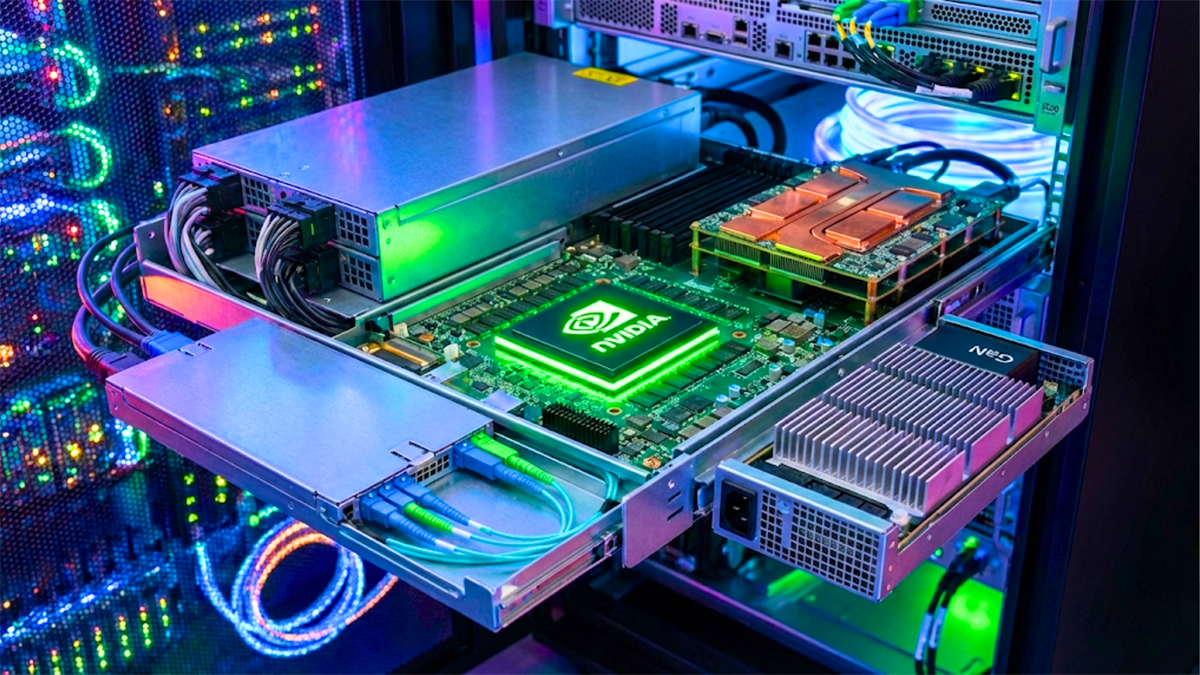
The first bottleneck in the AI supply chain isn't just making the chip; it is powering it. NVIDIA's upcoming Rubin architecture is so dense that it cannot use standard server power supplies. It requires massive, centralized units known as Power Shelves to distribute energy evenly across the rack.
Flex Ltd. (NASDAQ: FLEX) has quietly transformed itself from a generic contract manufacturer into the primary architect of this power infrastructure. While the company still builds a wide variety of electronics, its Data Center division has become its growth engine. In its latest quarterly update, Flex reported that Data Center revenue grew 35% year-over-year, driven almost entirely by demand for these complex power systems.
Wall Street has taken notice of this pivot. Early in December 2025, for instance, analysts at Goldman Sachs increased the stock's price target to $74. This new target represents a healthy appreciation of about 17% from its current trading price. The analyst raised their price target on Flex due to strong performance and growth in key areas such as AI data centers, the utility sector, and automotive tech, benefiting from increased demand and a positive industry outlook.
Coherent Corp: Solving the Speed of Light Crisis
As AI clusters grow from thousands to tens of thousands of chips, the second bottleneck is speed. Traditional copper cables are too slow and heavy to connect the massive server racks required for the Rubin architecture. To solve this, data must move via light, a technology known as photonics.
Coherent Corp (NYSE: COHR) is a leader in this transition. The industry is shifting to 1.6 Terabit (1.6T) optical transceivers, devices that convert electrical signals into light signals, to keep up with NVIDIA's processing speeds. Coherent controls the supply of Indium Phosphide, a critical material for manufacturing these lasers at scale.
Think of Coherent as a toll booth operator on the information superhighway. The more data NVIDIA chips process, the more lasers Coherent sells.
- Key Catalyst: The shift from 800G to 1.6T speed is creating a supply strain.
- Why It Matters: Shortages give suppliers pricing power. The stock is trading near 52-week highs around $185, driven by projections of 17% quarter-over-quarter revenue growth.
Bitcoin just dipped, and while most people are staring at the price, they're missing the real opportunity — this pullback could be the best setup all year for a simple, low-cost strategy that generates steady weekly income without buying crypto, opening an exchange account, or trading options. It uses a small position available in most brokerage accounts, and it's designed to deliver reliable Thursday payouts, even in volatile markets, making this moment especially important for income-focused investors.
Watch my Bitcoin Income Briefing here
Amkor Technology: The Manufacturing Release Valve
The third bottleneck is manufacturing capacity. NVIDIA's primary manufacturing partner, Taiwan Semiconductor Manufacturing Company (NYSE: TSM), cannot package every AI chip it produces. Its advanced packaging lines, known as CoWoS, are always at capacity.
Amkor Technology (NASDAQ: AMKR) has become the critical release valve for this pressure. As the only major U.S.-headquartered company with advanced packaging capabilities to handle AI chips, Amkor is absorbing the volume that TSMC cannot.
This essential role has transformed Amkor from a boring value stock into a momentum leader, with shares rallying approximately 100% since January 2025.
Navitas Semiconductor: The High-Voltage Gamble
The final bottleneck is heat. NVIDIA's upcoming Rubin architecture consumes massive amounts of electricity. Traditional silicon power supplies are struggling to handle this density without overheating or taking up too much space.
Navitas Semiconductor (NASDAQ: NVTS) offers a solution with Gallium Nitride (GaN) technology. GaN chips can handle higher-power loads more efficiently than silicon chips. At CES 2026, Navitas unveiled the world's first 8.5 kW AI Data Center Power Supply, a product offering 98% energy efficiency designed explicitly for next-generation racks. The market's reaction to the CES announcement was swift, acting as a key catalyst that drove Navitas' stock price up approximately 30% in the days that followed.
Drafting Behind the Titan: A Picks and Shovels Strategy
NVIDIA provides the roadmap for the future of artificial intelligence, but these four companies provide the vehicle to get there. For investors, looking inside the server rack offers a way to bypass the law of large numbers.
By investing in the specific bottlenecks that must be solved for AI to advance, portfolios can gain exposure to the same explosive growth trends that drove NVIDIA, while also benefiting from a fresh runway for 2026.
Read this article online ›





No comments:
Post a Comment
Keep a civil tongue.