View in browser
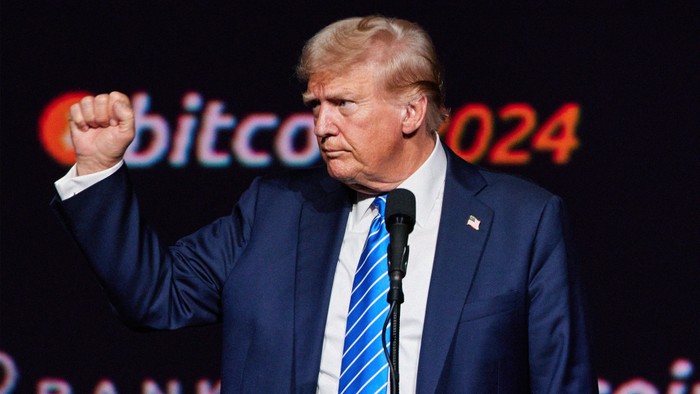
During the summer of his 2024 presidential campaign, Donald Trump made a vow to the cryptocurrency industry: Elect him, and the United States would become the "crypto capital of the planet." That winter, after crypto-industry donations helped secure Trump's place in the White House, digital assets began appreciating rapidly—and the president-elect was glad to take the credit. When bitcoin crossed the $100,000 mark, he simply posted, "YOU'RE WELCOME!!!"
For a sense of just how much money has evaporated from the crypto industry since then, look to bitcoin. On October 6, the price of a single bitcoin climbed to an all-time high north of $126,000; today, its value is closer to $69,000. The global market capitalization of all coins has shed more than $2 trillion in that time, and fewer and fewer traders are dabbling in meme coins and derivatives. Following a relatively fruitful 2025, crypto-venture-capital deals have fallen off a cliff over the past few months. Commentators have now started to wonder whether the president, who has spent the past two years positioning himself as the industry's protector and hype man, might initiate a crypto bailout.
But wasn't Trump's election already a kind of bailout? His explicit promise on the campaign trail was that America would lead the way, but his implicit promise was that prices would go up. Since taking office, Trump has established himself as the face of crypto through his flagrant promotional tactics (remember those limited-edition bitcoin-orange sneakers?), his sweeping deregulation efforts, and, of course, his family's investments in digital assets. The Trumps have now made hundreds of millions of dollars from cryptocurrencies, according to recent estimates. Despite these links, crypto's fate isn't solely tied to the Trumps. There's no single cause for the current downturn, but it demonstrates that a president's intervention—even intervention as consistent as Trump's—can only do so much to keep cryptocurrencies afloat.
Throughout its 17 years, bitcoin has been defined by cycles—booms and busts that are sometimes explicable and sometimes not. This volatility is part of why the president himself once thought of bitcoin as a "scam." It is driven both by an inbuilt technical feature called "halving" (which I will stop myself from explaining but is worth digging into if you're so inclined) and by the natural waxing and waning of global attention. The year 2021 gave us a historic bubble, fueled in part by venture-capital funding and NFTs. The bubble popped in 2022 thanks to the unraveling of two crypto kingpins, Do Kwon and Sam Bankman-Fried, and the ensuing regulatory crackdown. After that came a deep freeze of investment activity, a so-called crypto winter, and a slow but steady recovery. Trump's 2024 "crypto capital" remark arrived as the sector was starting to wake from hibernation. Morale was, if not quite as low as it is right now, nowhere near where it had been a few years prior. The crypto optimism of Trump's election probably helped boost prices, but it was not a guaranteed buffer against all future instability.
The president's public support of the industry is inextricable from his family's personal investments. The Trumps' empire encompasses the crypto firms World Liberty Financial and American Bitcoin, as well as the crypto-adjacent Trump Media & Technology Group, which at one point held about $2 billion worth of bitcoin. There are also the meme coins $TRUMP and $MELANIA, the first of which made the president a crypto billionaire just before his inauguration and has since lost about 95 percent of its value.
The administration has also made life easier for crypto more broadly, championing industry-backed regulations such as the GENIUS Act, a new framework for stablecoins that was signed into law this past summer. It has also, separately, dropped Joe Biden–era investigations into major firms. The White House is now packed with crypto devotees, including the venture capitalist David Sacks, who now serves as special adviser for AI and crypto, and Commerce Secretary Howard Lutnick, who has dubbed Trump the "crypto president." Together, this team has worked to establish a crypto-forward White House, most notably by creating a "strategic bitcoin reserve."
These moves probably accelerated the real gains that crypto was making throughout the majority of 2025. But those gains weren't entirely attributable to Trump, either. Over the past few years, cryptocurrencies have cropped up in BlackRock's exchange-traded funds and in mainstream brokerage apps. A side effect of crypto's integration with existing financial institutions is that bitcoin has started to trade like an ordinary tech stock: Bitcoin's rise last year coincided with the broader momentum of the tech industry. The fact that it's now crashing doesn't necessarily suggest a complete decoupling (parts of tech, particularly software stocks, are getting crushed right now), but the downtrend is a reminder that crypto is governed by more than just Silicon Valley earnings calls. Plus, the industry is still more international than Trump might like it to be; prices are determined by traders all over the world.
A crypto-friendly White House was never going to be a panacea, but the scale of the recent crash is remarkable. The global crypto market capitalization—that is, the approximate value of all of its tokens—has entirely erased the gains it made since Trump's inauguration, despite this supposed regulatory golden age. If Democrats return to power in 2028, they aren't likely to share this administration's permissive attitude. And those commentators musing about whether Trump would bail out crypto are likely to be disappointed. When asked in a congressional hearing last week whether the administration would direct private banks to purchase more bitcoin, Treasury Secretary Scott Bessent insisted that the government has no authority to do so.
Bitcoin was once envisioned as an alternative to a corrupt system—something entirely independent from governments and big banks. In 2026, the most powerful politicians and financiers in the world have gone all-in. An asset that was once anti-system has now effectively become the system. There's no question that this has benefited crypto in some ways. (For one, institutional adoption has made it more resilient; crypto is not beyond recovery, and it will probably bounce back.) But because no one actor has unilateral control over the sector's future, the prices of these coins remain as fickle as ever.
Trump has long embraced the notion that he has the power to solve even the most intractable problems. He famously told voters in 2016 that the system is broken and that "I alone can fix it." But volatility is inherent to crypto; not even the "crypto president" can fix that.
Related:











No comments:
Post a Comment
Keep a civil tongue.