

Below is an important message from one of our highly valued sponsors. Please read it carefully as they have some special information to share with you.
Dear Reader,
As a seasoned venture capitalist, if I can give you one piece of advice, it’s this:
Do not invest on IPO Day.
I don’t care how big the IPO is.
Elon Musk is set to take Starlink public this year in what will be the biggest IPO in history.
But instead of buying Starlink, you should look into this $30 stock - and you should do it right now, before the potential IPO today.
This company - whose name and ticker is revealed for FREE in this short video - is poised to rocket 100% or more in the next year off the back of the coming SpaceX IPO.
And you can get shares today.
Sincerely,
James Altucher
The Late-Stage Bull Market Is a Buying Opportunity for Tech
Written by Jordan Chussler. Date Posted: 2/24/2026.

Key Points
- Despite the NASDAQ falling 5% from its October high and tech currently lagging the S&P 500, analysts argue this is late-stage bull market maturity rather than the end of the cycle.
- Several major names—including Adobe, Intuit, and The Trade Desk—are trading at Relative Strength Index levels well below 30. Combined with significant year-to-date losses, these stocks are oversold.
- Improving valuations, including Meta’s forward P/E of 24.13 and Adobe’s 14.78, indicate that earnings potential is becoming cheaper.
- Special Report: [Sponsorship-Ad-6-Format3]
After years of leading the pack, the tech sector has been in retreat since the NASDAQ hit its all-time high last October. And while the ongoing sell-off has fueled speculation that the market is in the late stages of its bull run, discerning investors may see this as a buying opportunity for names that haven't been on sale for a while.
Tech stocks finished 2025 up nearly 34%, but after a 1.68% loss on Feb. 23, the sector is down about 2.15% year-to-date (YTD), the second-worst showing among the S&P 500's 11 sectors.
Elon Musk: This Could Turn $100 into $100,000 (Ad)
What if you could shrink your entire wealth journey from decades down to just 24 hours?
Sounds impossible…
But I'll show you how Elon Musk is about to make it a reality.
Much of this decline stems from the underperformance of several members of the Magnificent Seven, which has spurred an exodus into defensive sectors and equal-weight exchange-traded funds (ETFs). Investors are also worried about an AI bubble and a broad pullback in software stocks.
Rumblings of a potential bear market could mean further downside for tech. Even so, valuations are improving, and many analysts argue the growth-focused sector is beginning to offer value.
A Late-Stage Bull Market Doesn't Mark Its End
As Andrew Slimmon, head of the applied equity advisors team at Morgan Stanley (NYSE: MS), noted in the firm's 2026 market outlook report, a late-stage bull market doesn't necessarily mean the cycle is over.
Slimmon acknowledged the cycle is mature but not finished, observing that the average bull market lasts five to seven years and that "history favors the bull market in a fourth year," which is where the market sits in 2026.
Those years have historically produced positive returns. Slimmon added that "investors who take higher risk may be rewarded in the coming year, and while corrections are likely in a potentially volatile year for stocks, that could be healthy and support the broader trend upward."
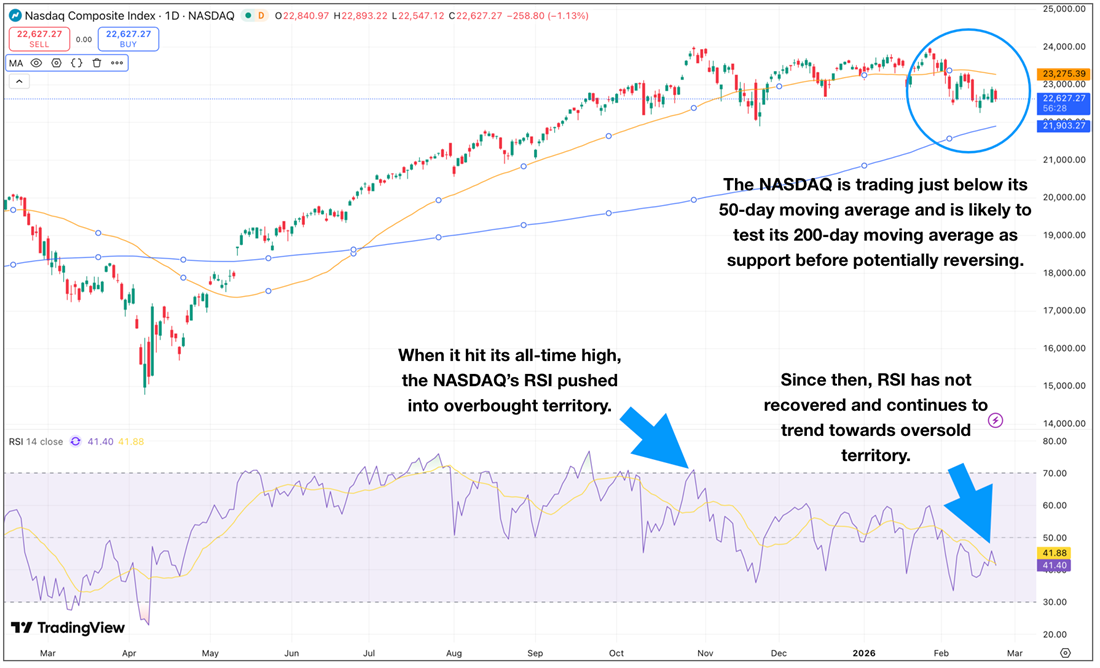
The NASDAQ is undergoing a pullback—more than 5% below its October high—and several individual tech stocks are already in correction territory, including some Magnificent Seven names.
Both Amazon (NASDAQ: AMZN) and Meta Platforms (NASDAQ: META) are down more than 19% from their respective one-year highs. For Palantir (NASDAQ: PLTR), the drop from its one-year high is nearly 37%.
AI-powered customer relationship management provider HubSpot (NYSE: HUBS) has plunged more than 43% YTD, and International Business Machines (NYSE: IBM) fell more than 13% on Feb. 23 alone.
That doesn't automatically make any of these stocks a Buy. However, the market's flight to safety has disproportionately benefited sectors like energy, materials, and industrials, leaving numerous tech stocks oversold.
Evidence of a Buying Opportunity
Both technical and fundamental indicators support the idea of a buying opportunity. The NASDAQ's current Relative Strength Index (RSI) of 41.4 is moving toward the 30 level commonly used to mark oversold conditions. The index is still trading below its 50-day moving average, however, which suggests more downside could occur before the NASDAQ finds support at its 200-day moving average and potentially reverses.
MarketBeat has identified dozens of oversold tech stocks, some with RSI readings well below 30 and analyst price targets that imply substantial upside:
- Adobe (NASDAQ: ADBE): RSI 33, down 26% YTD, 53% potential upside over the next 12 months
- Paychex (NASDAQ: PAYX): RSI 26, down 21% YTD, 40% potential upside over the next 12 months
- Accenture (NYSE: ACN): RSI 24, down 25% YTD, 49% potential upside over the next 12 months
- The Trade Desk (NASDAQ: TTD): RSI 28, down 34% YTD, 131% potential upside over the next 12 months
- Workday (NASDAQ: WDAY): RSI 19, down 39% YTD, 85% potential upside over the next 12 months
- Intuit (NASDAQ: INTU): RSI 18, down 46% YTD, 101% potential upside over the next 12 months
- Automatic Data Processing (NASDAQ: ADP): RSI 20, down 21% YTD, 42% potential upside over the next 12 months
These figures can change quickly, but the sector-wide message is clear: for investors who maintain a long-term bullish view on technology, the current pullback presents a compelling opportunity.
Fundamentally, many of these companies are also showing improvement. Take Meta Platforms: its trailing 12-month (TTM) price-to-earnings (P/E) ratio of 27.37 looked elevated, but a forward P/E of 24.13 implies a lower valuation relative to expected future earnings.
That's reflected in Meta's year-over-year (YOY) earnings per share (EPS) growth over recent years. After rising more than 73% YOY in 2023 and nearly 61% YOY in 2024, EPS growth fell to -1.55% last year, suggesting the potential for a regression back toward trend this year.
The same dynamic appears outside the Magnificent Seven. Adobe's forward P/E is 14.78, Paychex's is 17.72, and Accenture's is 15.77. Their five-year average annual EPS growth rates are 10.01%, 9.01%, and 9.20%, respectively.
Super Micro: Why the Shadow of NVIDIA Is a Profitable Place to Be
Written by Jeffrey Neal Johnson. Date Posted: 3/2/2026.
Key Points
- Super Micro Computer is outperforming competitors in current hardware delivery volume by prioritizing immediate execution over future promises in the data center market.
- Management has strategically built up significant inventory to ensure faster delivery times than peers amid global component scarcity.
- Super Micro is transitioning its business model to capture higher long-term profits by selling essential liquid-cooling infrastructure.
- Special Report: [Sponsorship-Ad-6-Format3]
For weeks, Wall Street whispered about a potential bubble in the artificial intelligence (AI) sector. Anxiety over a possible slowdown in capital spending gripped the market, producing significant volatility in major semiconductor stocks. Late February 2026 provided a clearer answer. The Super Week of earnings, led by industry titan NVIDIA (NASDAQ: NVDA), showed the global infrastructure boom is not only alive but accelerating.
While chipmakers rallied on that news, their primary hardware partner, Super Micro Computer (NASDAQ: SMCI), has seen its stock consolidate. Shares ended February having successfully held the critical $30 support level during a volatile stretch. That divergence — strong operational execution with record volume but a stalled share price — has created a notable valuation gap.
Elon Musk: This Could Turn $100 into $100,000 (Ad)
What if you could shrink your entire wealth journey from decades down to just 24 hours?
Sounds impossible…
But I'll show you how Elon Musk is about to make it a reality.
The market appears to be treating Super Micro's strategic reinvestment as a sign of weakness. While competitors emphasize backlog, Super Micro emphasizes immediate deployment. For investors seeking exposure to the next phase of the AI cycle, this consolidation offers an opportunity to evaluate a triple-digit-growth company trading at a discount.
The Engine And The Car: Understanding The Ecosystem
The investment thesis for Super Micro Computer is straightforward: NVIDIA provides the engine (the chips), and Super Micro builds the car (the servers).
In today's market, you cannot have one without the other. High-performance AI chips, such as the Blackwell series and the upcoming Vera Rubin, do not operate on their own.
They require complex, high-density server racks to function. As long as NVIDIA forecasts exponential demand, Super Micro's order book is materially supported by the industry leader.
The financial data reinforces this link. In late February, NVIDIA reported record revenue of $68.1 billion, a 73% increase year over year.
CEO Jensen Huang confirmed demand for their latest platforms is off the charts. Super Micro is capturing that volume directly: the company reported fiscal Q2 2026 revenue of $12.68 billion, a 123% increase from the same period last year.
Critics argue Super Micro is too dependent on its partner. But in a market where one company controls the most sought-after technology, being the preferred deployment partner is a competitive moat, not a weakness. As chip supply expands, Super Micro's revenue has grown in lockstep.
Trading Margin For Dominance
The primary reason Super Micro's stock price has not rallied alongside its revenue is profitability. In the most recent quarter, gross margins fell to 6.4% on a non-GAAP basis. This is well below historical norms and has understandably spooked some investors. But the competitive landscape suggests this is likely a deliberate land-grab strategy rather than an operational failure.
Super Micro is locked in a fierce battle with Dell Technologies (NYSE: DELL) to win contracts with the world's largest data center operators. On Feb. 26, Dell reported an impressive $43 billion AI backlog. That massive number highlights a key strategic difference between the two firms:
- Backlog vs. Deployment: Dell's backlog represents future promises; Super Micro's revenue reflects current execution.
- The Volume Gap: In the most recent quarter, Super Micro shipped $12.7 billion in product, outpacing Dell's $9.5 billion in AI server shipments.
Super Micro is using aggressive pricing to win installations now. That strategy consumes cash and compresses margins in the short term, but it prevents competitors from gaining a foothold in the world's most important data centers. Once a data center is designed around Super Micro's architecture, switching costs become significant, securing longer-term customer relationships.
The $10 Billion Stockpile: Preparing For The Future
To support its high-volume approach, Super Micro has deliberately swollen its inventory to $10.6 billion. In a traditional retail business, unsold inventory is a liability that can lead to write-downs. In the AI hardware market, however, the dynamics are different: scarcity rules.
Global shortages of advanced components mean lead times — the time it takes to build and deliver a server — are the primary concern for buyers. Companies racing to build AI models cannot afford to wait months for hardware. By stockpiling components, Super Micro can deliver servers faster than peers who are constrained by parts availability.
- Strategic Positioning: This inventory is not idle; it is a war chest.
- Future Proofing: It positions the company to immediately fulfill orders for NVIDIA's Vera Rubin and AMD Helios platforms later in 2026.
This inventory build explains the negative free cash flow in the recent quarter, but it is a feature of the company's growth strategy rather than a flaw in its operations.
The Razor and Blade Pivot
If the land-grab explains why margins are down today, the company's product roadmap explains how they will rise again. Super Micro is shifting toward a classic razor-and-blade model: the low-margin servers are the razor, and high-margin liquid-cooling infrastructure is the blade.
The company is moving beyond box-building to sell Data Center Building Block Solutions (DCBBS), the full ecosystem required to keep AI facilities running:
- Coolant Distribution Units (CDUs)
- Power distribution shelves
- Manifolds and management software
Management has said these DCBBS products carry gross margins estimated above 20%. This shift is driven by physics as much as finance: next-generation AI processors generate heat levels that traditional air cooling cannot handle. Liquid cooling becomes mandatory for platforms like NVIDIA's Vera Rubin.
By securing the server footprint now through aggressive pricing, Super Micro is positioning itself to upsell high-margin liquid-cooling infrastructure to the same customers later. The company expects to double profit contribution from this segment by the end of 2026, offering a clear path to margin recovery.
Why The Risk Is Worth The Reward
The gap between Super Micro's stock price and its operational performance creates a compelling valuation case. The stock is trading at a price-to-earnings ratio (P/E) of roughly 24x. For a company growing revenue at a triple-digit rate (123%), that valuation looks inexpensive compared with parts of the broader technology sector, where slower-growing software companies often trade at 30x–40x earnings.
Margin compression appears temporary and strategic, aimed at locking out competitors during a critical phase of industry expansion. The shadow of NVIDIA can be a profitable place to be. As the AI infrastructure build-out enters its next phase, Super Micro's large installed base and inventory advantage put it in position to exceed expectations. Investors seeking growth at a reasonable price may want to add Super Micro Computer to their watchlist as it consolidates above $30.
This email content is a sponsored email sent on behalf of Paradigm Press, a third-party advertiser of DividendStocks.com and MarketBeat.
If you have questions about your newsletter, feel free to contact our U.S. based support team at contact@marketbeat.com.
If you no longer wish to receive email from DividendStocks.com, you can unsubscribe.
© 2006-2026 MarketBeat Media, LLC. All rights reserved.
345 N Reid Place #620, Sioux Falls, SD 57103. USA..


No comments:
Post a Comment
Keep a civil tongue.