| Here are the FeedBlitz blog updates for ignoble.experiment@arconati.us
 Little yellow ducks, the new face of the global warming fight (Wikimedia Commons) NASA scientists have dropped 90 yellow rubber ducks into holes in Greenland's Jakobshavn glacier in an attempt to understand why glaciers speed up during summer months as they slip into the sea. The ducks, attached to a football-sized probe, have an email address and message prompting anyone who discovers the ducks to contact NASA to reveal where and when the duck was found. There is an undisclosed award for anyone who finds one of these rubber global warming crusaders. The NASA scientists, based at the Jet Propulsion Laboratory (JPL) in California, hope this campaign will shed new light on the melting mechanisms behind Greenland's fastest moving glacier… (...)
Read the rest of NASA Uses 90 Rubber Ducks to Study Global Warming (392 words)
© Ian O'Neill for Universe Today, 2008. | Permalink | No comment | Add to  del.icio.us del.icio.us  digg digg
Who's linking ?  Technorati Technorati  BlogPulse BlogPulse  Google Google
Want more on these topics ? Browse the archive of posts filed under Environment, NASA. 

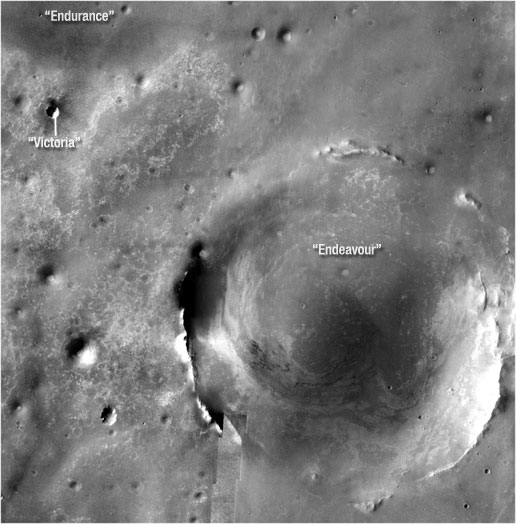
 The Big Drive to Endeavour-crater. Credit: NASA/JPL Opportunity, the intrepid Mars Exploration Rover, is going to put the pedal to the metal and head out for a crater nearly 12 kilometers (7 miles) away. That would match the distance the rover has traveled since landing in 2004. But the call of the unknown is compelling the rover science team to make the attempt. "We may not get there, but it is scientifically the right direction to go anyway," said Steve Squyres, principal investigator for the science instruments on Opportunity and its twin rover, Spirit. For an "aging" rover (what age is 4 in rover years?), this might be setting the bar pretty high. But maybe it's the journey and not the destination. "This is a bolder, more aggressive objective than we have had before," said John Callas, the project manager the rovers. "It's tremendously exciting. It's new science. It's the next great challenge for these robotic explorers."
(...)
Read the rest of Opportunity's Next Adventure: The Big Drive (391 words)
© Nancy Atkinson for Universe Today, 2008. | Permalink | 6 comments | Add to del.icio.us digg
Who's linking ? Technorati BlogPulse Google
Want more on these topics ? Browse the archive of posts filed under Mars, Missions. 


Ever wondered what might crawl out from under a rock on Mars? The Phoenix lander is going to attempt to find out today by trying to nudge a rock aside today with its robotic arm to see what might be underneath. Engineers have developed a plan to try moving a rock on the north side of the lander. This rock, roughly the size and shape of a VHS videotape, is called "Headless." Even though the Phoenix mission has been extended for a second time – the mission is now on through December, the team feels like it's time to pull out all the stops and do as much work as possible. "We're getting towards fall in the northern plains of Mars and our sun is dropping lower day by day," said mission principal investigator Peter Smith on NPR's Science Friday. "Our days are getting precious." So, even though Phoenix's robotic arm was not designed to move rocks, the team wants to give it a shot. "The appeal of studying what's underneath is so strong we have to give this a try," said Michael Mellon, a Phoenix science team member at the University of Colorado, Boulder.
(...)
Read the rest of Anything Under That Rock on Mars? Phoenix to Take a Peek (303 words)
© Nancy Atkinson for Universe Today, 2008. | Permalink | 2 comments | Add to del.icio.us digg
Who's linking ? Technorati BlogPulse Google
Want more on these topics ? Browse the archive of posts filed under Mars, Missions. 


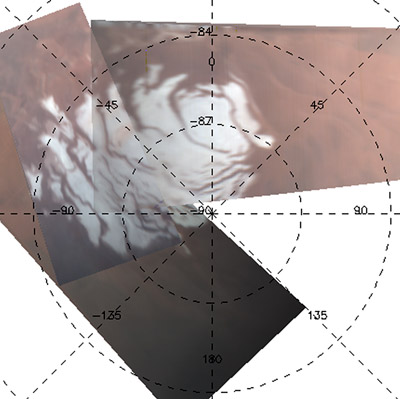
Like Earth, Mars has frozen polar caps, but unlike Earth, these caps are made of carbon dioxide ice as well as water ice. During the southern hemisphere's summer, much of the ice cap sublimates, or evaporates directly to a gas, but leaves behind what is known as the residual polar cap. The problem is that while the winter cap is symmetrical about the south pole, the residual cap is offset by some three to four degrees. Using data from ESA's Mars Express spacecraft, scientists say two things are to blame: the Martian weather system, and interestingly, so is the largest impact crater on Mars – even though it is nowhere near the south pole.
(...)
Read the rest of Why is Mars' Southern Polar Cap Crooked? (386 words)
© Nancy Atkinson for Universe Today, 2008. | Permalink | No comment | Add to del.icio.us digg
Who's linking ? Technorati BlogPulse Google
Want more on these topics ? Browse the archive of posts filed under Mars. 

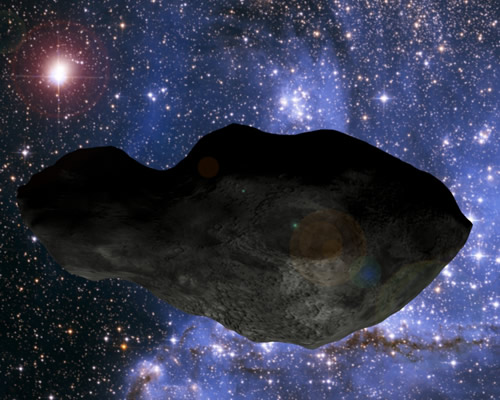
 Artist impression of the Asteroid Kleopatra. Credit: NASA Meteorites and asteroids from the inner solar system could be responsible for Earth's store of precious metals such as platinum and iridium, brought to our nascent planet during the period of Late Heavy Bombardment, about 4,000 million years ago. Dr. Gerhard Schmidt from the University of Mainz, Germany, has calculated that about 160 metallic asteroids of about 20 kilometers in diameter would be sufficient to provide the concentrations of these metals, known as Highly Siderophile Elements (HSE), found in the Earth's crust. "A key issue for understanding the origin of planets is the knowledge of the abundances of HSE in the crust and mantle of the Earth, Mars and the Moon. We have found remarkably uniform abundance distributions of HSE in our samples of the Earth's upper crust. A comparison of these HSE values with meteorites strongly suggests that they have a cosmo-chemical source," said Schmidt.
(...)
Read the rest of Earth's Precious Metals Could Be From Meteorites and Asteroids (416 words)
© Nancy Atkinson for Universe Today, 2008. | Permalink | 4 comments | Add to del.icio.us digg
Who's linking ? Technorati BlogPulse Google
Want more on these topics ? Browse the archive of posts filed under Asteroids, Meteorites. 

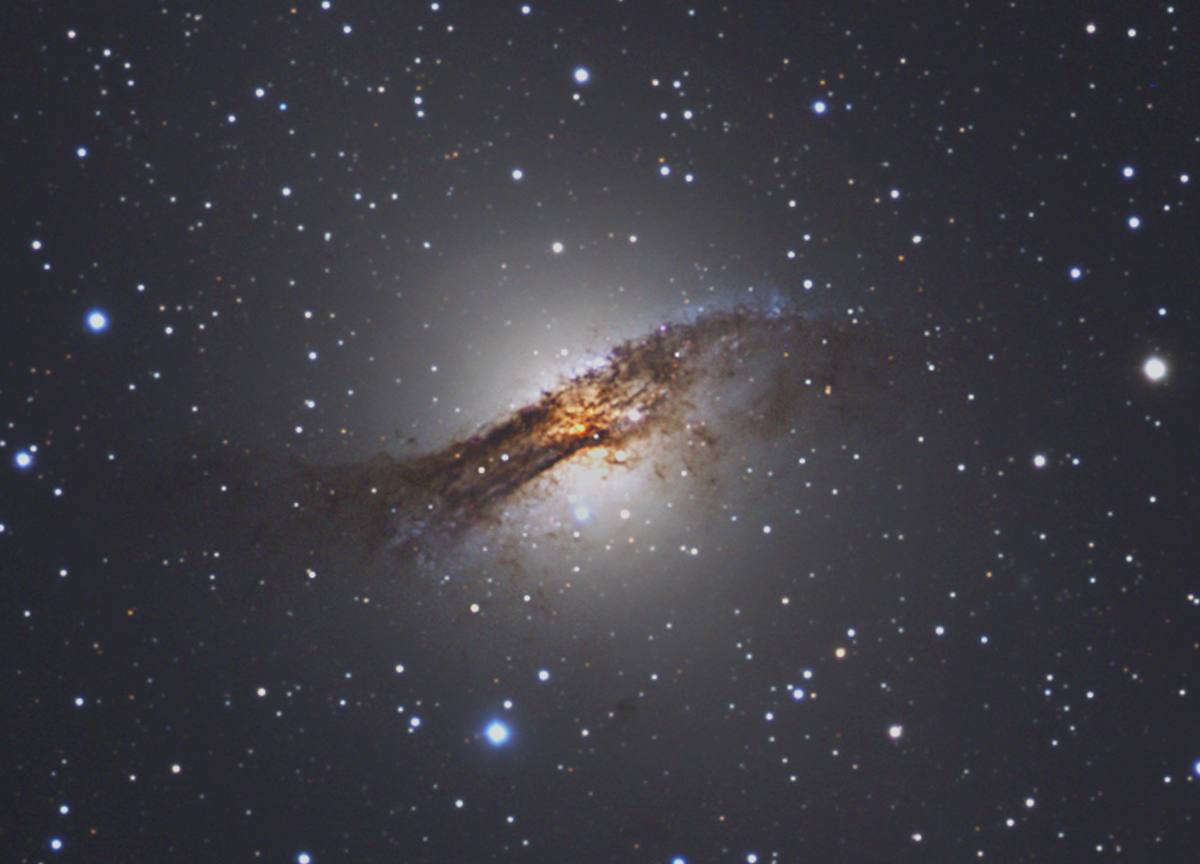
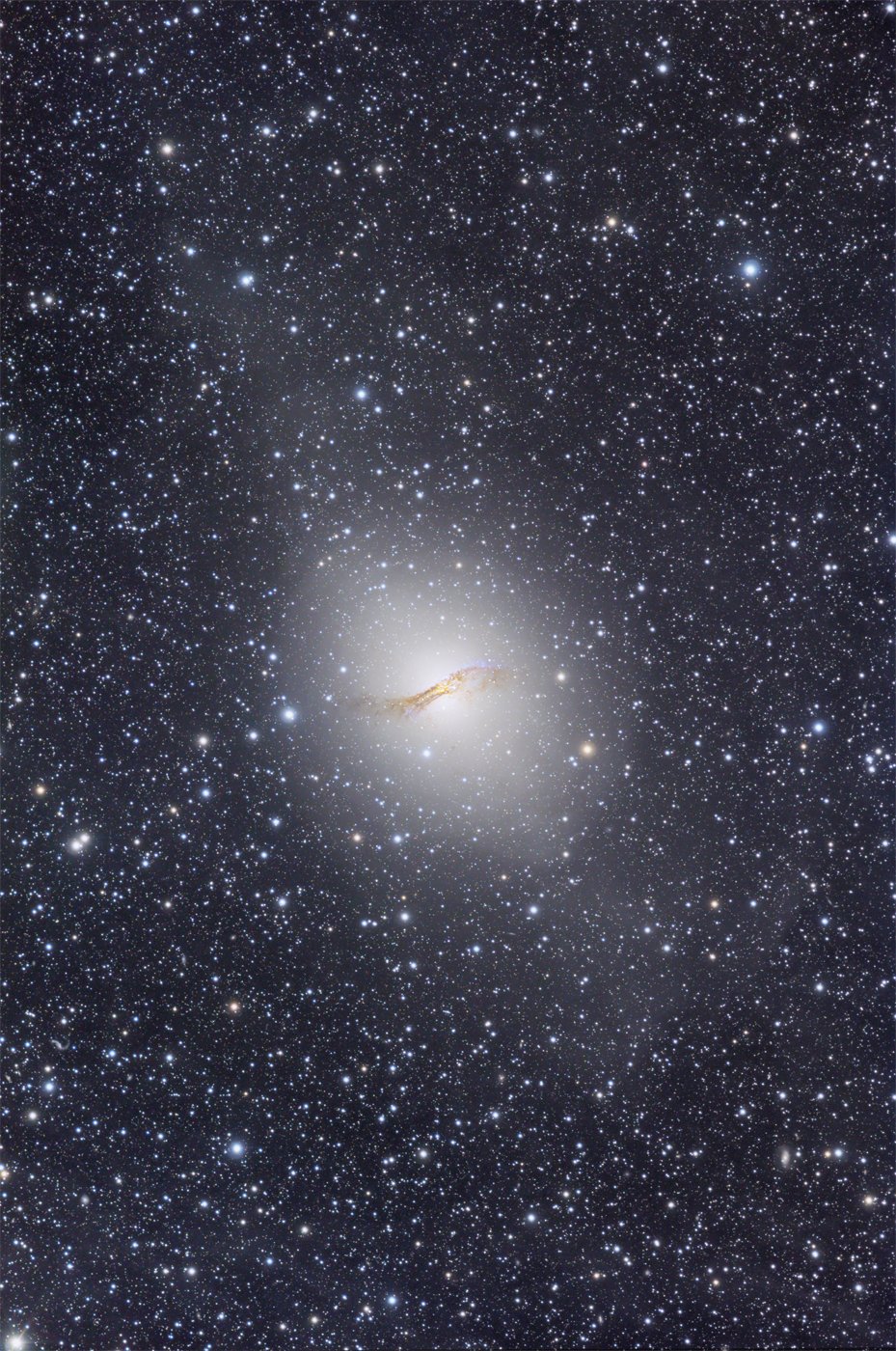
 Centaurus A - Ultra-Deep by Mike Sidonio Before you dismiss this as just another photo of Centaurus A, you better look again. It's way deeper… First discovered by James Dunlop on August 4, 1826 this incredible galaxy known as Centaurus A (NGC 5128) has been tickling the imagination of astronomers since John Herschel described it as "two semi-ovals of elliptically formed nebula appearing to be cut asunder and separated by a broad obscure band parallel to the larger axis of the nebula, in the midst of which a faint streak of light parallel to the sides of the cut appears." in 1847. What makes this incredible galaxy tick? Step inside and let's find out… (...)
Read the rest of Deep Inside a Giant - Centaurus A by Mike Sidonio (1,425 words)
© Tammy Plotner for Universe Today, 2008. | Permalink | 8 comments | Add to del.icio.us digg
Who's linking ? Technorati BlogPulse Google
Want more on these topics ? Browse the archive of posts filed under Astronomy, Astrophotos. 

 A series of problems forces LHC shutdown (CERN/LHC) It's this sort of news I really did not want to wake up to. At 0927 GMT Friday morning, a fault known as a "quench" resulted in the leakage of a tonne of helium coolant causing 100 of the LHC superconducting magnets to heat up 100°C. The fire services had to be called and it was some time before engineers could access the tunnels to assess the damage. It was worse than they were expecting. Although no one was hurt and there was no danger to the public, the once-supercooled magnets were hot enough to boil water and optimal vacuum conditions had been lost. To perform repairs, the rest of the damaged sector will need to be warmed up and then slowly cooled down again, resulting in a shutdown of LHC operations for at least two months… (...)
Read the rest of Helium Leak Forces LHC Shutdown for at Least Two Months (411 words)
© Ian O'Neill for Universe Today, 2008. | Permalink | 30 comments | Add to del.icio.us digg
Who's linking ? Technorati BlogPulse Google
Want more on these topics ? Browse the archive of posts filed under Physics. 


NASA's Swift satellite captured the most distant gamma-ray burst ever detected. The blast came from an exploding star 12.8 billion light-years away, near the edge of the visible universe. Swift saw the explosion on September 13 at 1:47 am EDT. But because light moves at finite speed, and looking farther into the universe means looking back in time, this means the burst occurred less than 825 million years after the universe began, or when the universe was less than one-seventh its present age. This star was probably from the earliest generations of stars ever formed. "This is the most amazing burst Swift has seen," said the mission's lead scientist Neil Gehrels at NASA's Goddard Space Flight Center.
(...)
Read the rest of Gamma Ray Burst From the Edge of the Universe (262 words)
© Nancy Atkinson for Universe Today, 2008. | Permalink | 22 comments | Add to del.icio.us digg
Who's linking ? Technorati BlogPulse Google
Want more on these topics ? Browse the archive of posts filed under Gamma Ray Bursts. 


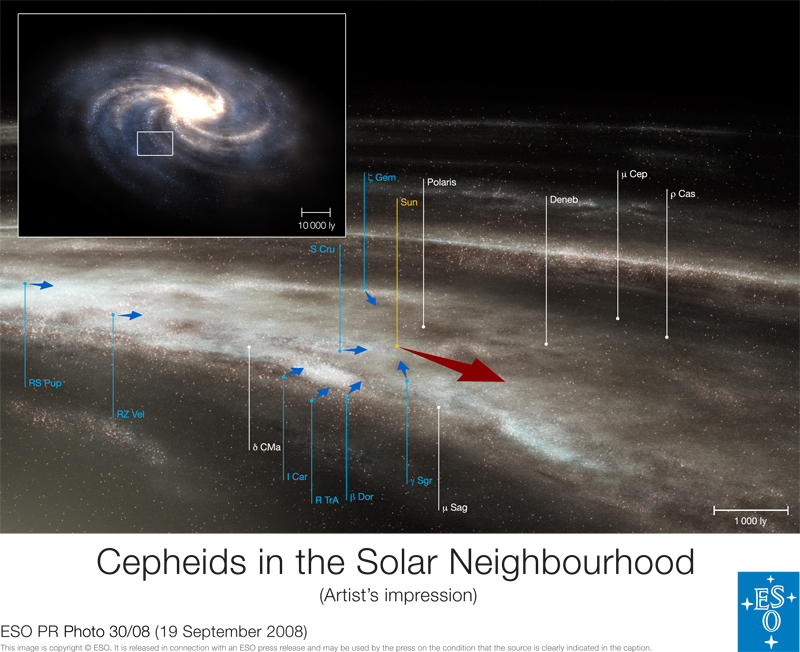
Cepheid variable stars have been used for years as a way to determine distance to other galaxies. The correlation between their period of variability and absolute luminosity provides a cosmic yardstick to measure distances out to a few tens of millions of light-years. Additionally, Cepheids closer to home are used as tools to investigate how the Milky Way spins. But the motion of the Cepheids in our galaxy has confused astronomers, as these neighborhood Cepheids appear to fall towards the sun. A debate has raged for decades as to whether this phenomenon was truly related to the actual motion of the Cepheids and, consequently, to a complicated rotating pattern of our galaxy, or if it was the result of effects within the atmospheres of the Cepheids. But new observations with the HARPS (High Accuracy Radio Velocity Planet Searcher) spectograph shows that the Cepheids aren't falling, and that the much debated, apparent 'fall' does in fact stem from properties of the atmospheres around these variable stars.
(...)
Read the rest of The Cepheids Aren't Falling (210 words)
© Nancy Atkinson for Universe Today, 2008. | Permalink | 2 comments | Add to del.icio.us digg
Who's linking ? Technorati BlogPulse Google
Want more on these topics ? Browse the archive of posts filed under Observatories, Observing. 


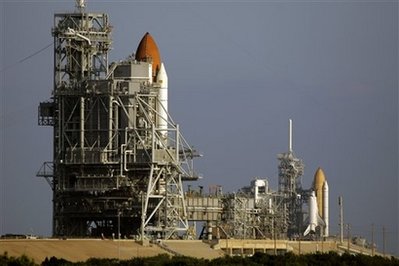
It's a rare event anyway, but this is the last time ever. Two shuttles are now sitting on NASA's two launchpads at Kennedy Space Center. Space shuttle Endeavour completed a 4.2-mile journey to Launch Pad 39B Friday morning, Sept. 19, at 6:59 a.m. EDT, and this is the first time a shuttle has stood by as a rescue vehicle. Atlantis, over at Pad 39A is preparing for its mission to the Hubble Space Telescope, currently scheduled for Oct. 10 (although there might be an problem with that date –see below). Since Atlantis won't be going to the International Space Station which would be a "safe haven" in the event of an emergency, Endeavour will stand by in the unlikely event a rescue mission is necessary. After Endeavour is cleared from its duty as a rescue vehicle, it will move to Launch Pad 39A for the upcoming STS-126 mission to the International Space Station. That flight is targeted for launch Nov. 12. This Saturday, there will be a good photo op as the Rotating Service Structures for Endeavour will be rolled back, making both the shuttles more visible. Robert Pearlman at CollectSPACE.com has a full list of the 17 times in history two shuttles sat on the launchpads, and some great pictures, too.
(...)
Read the rest of Two Shuttles on the Pad — The Last Time (213 words)
© Nancy Atkinson for Universe Today, 2008. | Permalink | 10 comments | Add to del.icio.us digg
Who's linking ? Technorati BlogPulse Google
Want more on these topics ? Browse the archive of posts filed under Space Shuttle. 

 Greetings, fellow SkyWatchers! Are you psyched up for tonight's Pleiades occultation? I am! While the Moon often passes near the ancient cluster, it's not often we get to enjoy such a great event so well placed at a comfortable time of the year. This weekend we'll be watching for ISS passes, reaching for the "Ring", visiting Andromeda, and taking on two new Herschel 400 studies. Time to get out your telescopes, spotting scopes and binoculars and head out into the night because…. Here's what's up! Greetings, fellow SkyWatchers! Are you psyched up for tonight's Pleiades occultation? I am! While the Moon often passes near the ancient cluster, it's not often we get to enjoy such a great event so well placed at a comfortable time of the year. This weekend we'll be watching for ISS passes, reaching for the "Ring", visiting Andromeda, and taking on two new Herschel 400 studies. Time to get out your telescopes, spotting scopes and binoculars and head out into the night because…. Here's what's up!
(...)
Read the rest of Weekend SkyWatcher's Forecast - September 19-21, 2008 (1,179 words)
© Tammy Plotner for Universe Today, 2008. | Permalink | 3 comments | Add to del.icio.us digg
Who's linking ? Technorati BlogPulse Google
Want more on these topics ? Browse the archive of posts filed under Astronomy, Observing. 

 Debris from particles hitting the collimator blocks were detected in the calorimeters and muon chambers (CERN/LHC/CMS) According to reports, only a day after the first successful circulation of protons in the Large Hadron Collider (LHC) last week, operations at the world's largest particle accelerator had to be stopped due to a fault with a 30 tonne transformer used to cool part of the facility. The protons were not being accelerated at the time and there was no risk to safety at the LHC. Rather than maintaining the equipment below the operational 2 Kelvin, the transformer glitch caused temperatures to rise to over 4 Kelvin (which is still cold, after all it is only 4 degrees above absolute zero - but it's not cold enough). The transformer failed after the successful anticlockwise circulation of protons on the evening of September 11th and rumours about LHC problems have only just been confirmed…
(...)
Read the rest of Transformer Glitch Halts LHC Operations (288 words)
© Ian O'Neill for Universe Today, 2008. | Permalink | 23 comments | Add to del.icio.us digg
Who's linking ? Technorati BlogPulse Google
Want more on these topics ? Browse the archive of posts filed under Physics. 

 ATV. credit: ESA The Jules Verne Automated Transfer Vehicle (ATV) has done its duty – it even went above and beyond its expected capabilities. But the end is nigh, and soon, on September 29 the ATV will become a fireball and burn up in the Earth's atmosphere, never to be seen again. But before it does, people in North America and Europe have the perfect opportunity to see it sail overhead this weekend in its low Earth orbit, and according to Spaceweather.com, the ATV will glow about a brightly as the North Star, Polaris. To find out when and where to look for the ATV in the evening or early morning skies, check out Spaceweather.com's great satellite tracking webpage. Just plug in your zip code and you'll be able to get tracking information for all the satellites that will be visible for the next few days. Also, Heavens Above is a great site to find tracking information, as well. So get out there and bid Jules Verne adieu. Here's some of the great things the ATV accomplished while on orbit at the ISS, and a movie of its undocking too… (...)
Read the rest of See Doomed Spacecraft Before Its Fiery Demise (113 words)
© Nancy Atkinson for Universe Today, 2008. | Permalink | 15 comments | Add to del.icio.us digg
Who's linking ? Technorati BlogPulse Google
Want more on these topics ? Browse the archive of posts filed under Satellites, Skywatching, Space Station. 

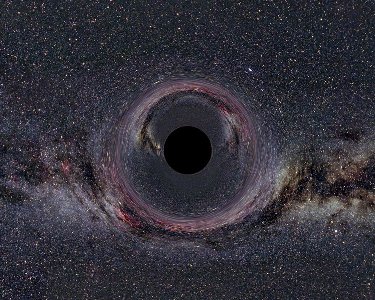
 Artist impression of a black hole. As you know, we wanted to answer listener questions regularly, but we found it was taking away from the regular weekly episodes of Astronomy Cast. So we've decided to just split it up and run the question shows separately from the regular Astronomy Cast episodes. If this works out, you might be able to enjoy twice the number of Astronomy Cast episodes. So if you've got a question on a topic we cover in a recent show, or you just have a general astronomy question, send it in to info@astronomycast.com. Either by email, or record your question and email in the audio file. Click here to download the episode. Or subscribe to: astronomycast.com/podcast.xml with your podcatching software. Black Hole Surfaces, Magnetic Field Strengths, and the Speed of Gravitons show notes.
© Astronomy Cast for Universe Today, 2008. | Permalink | One comment | Add to del.icio.us digg
Who's linking ? Technorati BlogPulse Google
Want more on these topics ? Browse the archive of posts filed under Black Holes, Podcasts. 


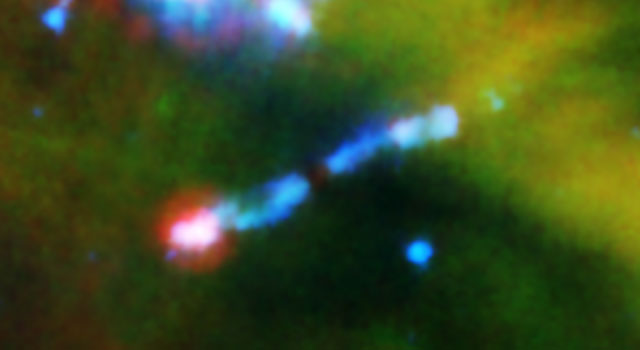
 A jet of gas firing out of a very young star can be seen ramming into a wall of material in this infrared Spitzer image. Image credit: NASA/JPL-Caltech/Harvard-Smithsonian CfA The Spitzer Space Telescope has spied water in a cloud of gas and dust around a nascent star. That's interesting in itself, but even more remarkable, the water is being blasted apart by the young star's laser-like jets. Spitzer's spectrometer was used to get a better look at these jets and analyze the jet's molecules. To the astronomers' surprise, Spitzer picked up the signature of rapidly spinning fragments of water molecules, called hydroxyl, or OH. "This is a truly unique observation that will provide important information about the chemistry occurring in planet-forming regions, and may give us insights into the chemical reactions that made water and even life possible in our own solar system," said Achim Tappe, of the Harvard-Smithsonian Center for Astrophysics, Cambridge, Mass.
(...)
Read the rest of Star Blasting Water From Its Surroundings (336 words)
© Nancy Atkinson for Universe Today, 2008. | Permalink | 8 comments | Add to del.icio.us digg
Who's linking ? Technorati BlogPulse Google
Want more on these topics ? Browse the archive of posts filed under Spitzer. 


The Cassini spacecraft recently flew through the plane of Saturn's rings and took this straight-on image of the G ring, showing a bright arc of material seen here as it rounds the ring's edge, or ansa. The spacecraft also took images of the moons Mimas and Calypso (see below). In the image here, the diffuse glow at left shows the extended nature of this faint ring. The view looks toward the sunlit side of the rings from less than a degree below the ringplane. The ring moved against the background stars during this exposure, creating the star trails seen here. Cassini scientists and engineers are preparing for an upcoming flyby of the moon Enceladus on October 9. This is the second of seven targeted Enceladus fly-bys in the Extended Mission., and the spacecraft will pass through the moon's geyser-like plumes in an attempt to measure fields and particles.
(...)
Read the rest of Saturn's Glowing Rings (120 words)
© Nancy Atkinson for Universe Today, 2008. | Permalink | 7 comments | Add to del.icio.us digg
Who's linking ? Technorati BlogPulse Google
Want more on these topics ? Browse the archive of posts filed under Saturn. 


A team of astronomers has discovered the least luminous, most dark matter-filled galaxy known to exist. The Segue 1 galaxy is one of about two dozen small satellite galaxies orbiting our own Milky Way. This is a very faint galaxy, a billion times less bright than the Milky Way. But despite its small number of visible stars, Segue 1 is nearly a thousand times more massive than it appears, meaning most of its mass must come from dark matter. "Segue 1 is the most extreme example of a galaxy that contains only a few hundred stars, yet has a relatively large mass," said Marla Geha, an assistant professor of astronomy at Yale and lead author on a paper about Segue 1.
(...)
Read the rest of Companion Dwarf Galaxy Almost Invisible (339 words)
© Nancy Atkinson for Universe Today, 2008. | Permalink | 5 comments | Add to del.icio.us digg
Who's linking ? Technorati BlogPulse Google
Want more on these topics ? Browse the archive of posts filed under Dark Matter, galaxies. 

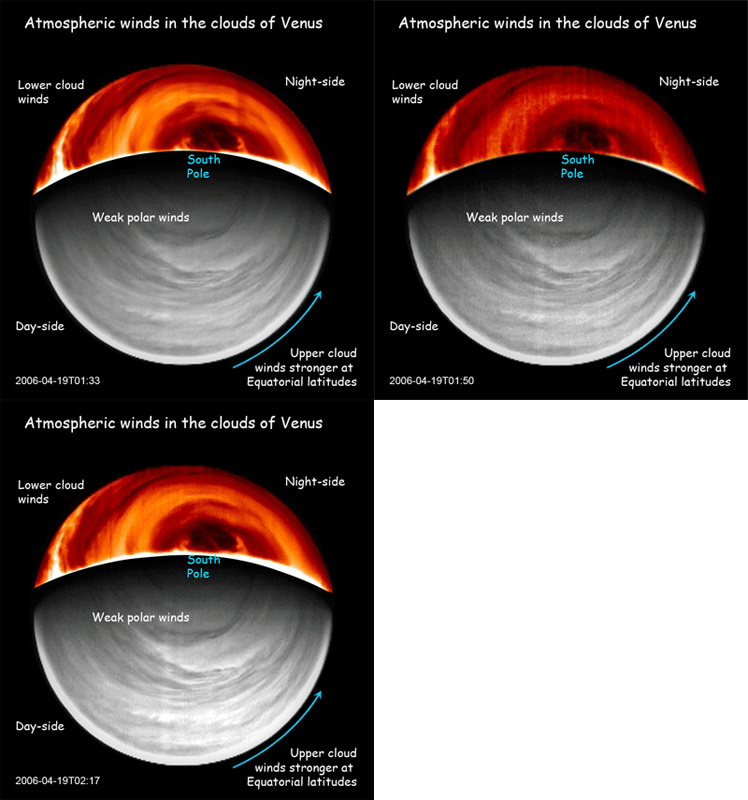
 Credits: ESA/VIRTIS/INAF-IASF/Obs. de Paris-LESIA/ Universidad del País Vasco (R.Hueso) The Venus Express spacecraft has been continuously monitoring the planet in orbit since 2006, and scientists now have enough data to start building a complete picture of the planet's atmospheric phenomena. They have put together a 3-D picture of Venusian winds for the southern hemisphere. It was known that the winds on Venus are extremely fast and powerful, but what was not known was their extreme variability. The winds are highly influenced by the sun, as well as an unusual and unknown mechanism that seems to re-set itself every five days. (...)
Read the rest of Winds on Venus are Variable, Cyclical (448 words)
© Nancy Atkinson for Universe Today, 2008. | Permalink | 4 comments | Add to del.icio.us digg
Who's linking ? Technorati BlogPulse Google
Want more on these topics ? Browse the archive of posts filed under Venus. 

| 































No comments:
Post a Comment
Keep a civil tongue.