From now on, this newsletter will be sent on Tuesdays instead of Fridays. Thanks for reading - LB |
|
|
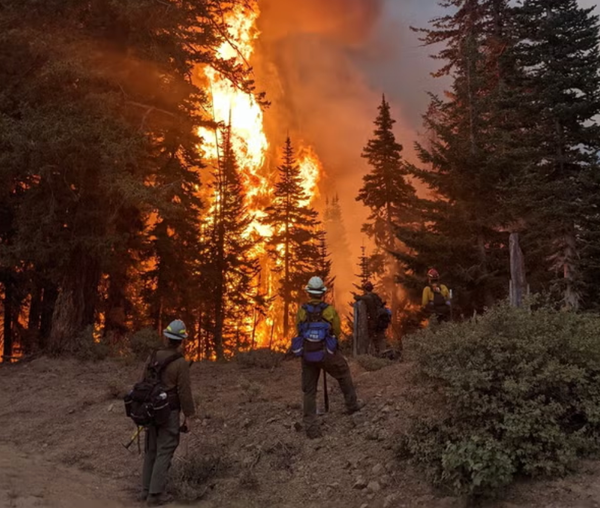
A wildland firefighting crew assess a fire in Washington state in 2021 (Courtesy of Ben McLane) |
|
|
I recently had the chance to speak to current and former federal wildland firefighters about the serious challenges facing the workforce, as larger and more unpredictable fires threaten the US every year.
The interviews are part of The Independent's new series, "Global Warning", telling stories from the frontlines of the climate crisis across America.
Roughly 19,000 firefighters are employed by the US government — many of whom earn far less than a liveable wage, despite working in deadly conditions.
Homelessness has been, at times, just another hazard of the job. Pete Dutchick, a firefighter for two decades, recalled being part of a crew in Colorado back in 2006 when the entire team was without a stable living situation.
"There were eight people in an apartment and a group of folks car-camping at a church, trying to make it work," he told The Independent.
Federal firefighters have the unique mandate of responding to fires anywhere in the country. The workforce has specialized crews, including those who parachute into remote fires (the smokejumpers); tackle the most problematic areas of fires (hotshots), and rappel into blazes from hovering helicopters (helitack).
And for years they have been underpaid, underrecognized and under-resourced compared to municipal and state colleagues, who can be paid up to double for the same work.
The climate crisis is shifting the equation in an already dangerous job. At one time, May would have been the start of a five-month peak season. Now large, unpredictable fires erupt year-round. In February, Texas had its largest wildfire in state history and 10 new large fires were reported last week across the US.
Luke Mayfield, a firefighter with the US forest service for 18 years, first noticed the shift in 2015. "It seemed like every other operational shift, I walked off the line saying, 'Wow, I've never seen that before,'" he told The Independent.
"It was like, well maybe we have no idea what we're looking at anymore."
Many federal firefighters were battling these monster blazes for $13 an hour, less than a fast-food worker's wage. This changed in 2022 when the Biden administration allocated $600m from the Bipartisan Infrastructure Law to increase entry pay to $15 an hour. But the funding was only ever supposed to be a "bridge" while lawmakers came up with long term reforms. Despite a bill that has strong bipartisan support, a bitterly-divided Congress has so far failed to pass it.
Low wages have made recruiting adequate numbers of firefighters more difficult at a time when the country faces an "ongoing wildfire crisis", officials warn. What's more, the sector is losing firefighters with decades of experience from key middle management roles - the "glue" that holds everything together, as Mayfield puts it.
"People who are leaving for financial reasons are doing it under duress… it is a gut-wrenching decision for them," said Riva Duncan, vice president of Grassroots Wildland Firefighters. The current and former firefighters who spoke to The Independent belong to the nonprofit which advocates for better conditions in the profession.
"This is a group of people who truly love what they do. It's not just a job, it becomes so much a part of your life. It is a brotherhood, a sisterhood," Duncan added.
The job isn't for the faint-hearted. A typical assignment is two straight weeks of 16-hour shifts, clocking in at 6am and off at 10pm, with no days off. Crews can be "spiked out" - sleeping under tarp - near the fire. Other times, they are in hastily-erected camps.
"You're sleeping on the ground where a lot of smoke sinks down," said Dutchick, 44. "It's not uncommon for people to get sick with 'camp crud' - coughing, respiratory issues, waking up groggy."
But while the public is likely familiar with the incredible physical demands of the job, the firefighters explained that there is also an immense mental and emotional toll. Constantly, fire crews must keep track of all their team, monitor rapidly evolving threats, and operate millions of dollars of equipment.
"As you move up the leadership chain, you could be responsible for entire portions of the fire, or the whole fire," Dutchick said.
What compounds this stress is uncertainties outside of the job. Wildland firefighters often struggle to afford accommodation where they are based, particularly in western states, and may be away from their families for months at a time.
Dutchick recalled working as a firefighter in the Tahoe area in 2003 when an apartment cost $450 a month.
"Now, you're looking at two grand, easy," he said. "How is a younger person coming into this job able to live and work in an area like that? The answer is, they're not."
It's not unheard of for military veterans who join the profession to end up homeless. "Not only have they served their country in Iraq and Afghanistan but they're continuing to serve their country. And here they are, living out of cars," Dutchick added.
Ben McLane, 29, who leads a federal firefighting crew in the Pacific northwest,
said some colleagues have quipped that the career is only sustainable with independent wealth, aka "trust-fund firefighters".
"Unless you have financial privilege baked into your life, you can't take this job," he explained. "If you're going to advance in life - buy a home, start a family - it's just unrealistic to have a career in this line of work for the federal government."
McLane worries about how long he can remain in the job he loves. "Because of demands on me throughout the fire season, being gone upwards of 100 days a year, we've chosen not to start a family. I can't realistically picture that with me still doing this job," he said.
Dutchick left active operations in 2020 and now does workforce training.
"I truly loved my job, the sense of duty and camaraderie. But in order to appreciate that I had to be away from my wife and daughter," Dutchick said. "Frankly, it came to a point where it was unbearable for me. I knew that I had to move out of operations and be around more for my family. It's hard to find any sense of normalcy when you're gone that much."
Mayfield left firefighting in 2019 after spending increasingly longer periods away from his family as he chased overtime to boost his pay packet.
"You need as much work as possible in order to make life work," he said. "The job and the year-round requirements started to have a detrimental effect on me."
Dutchick has lost three firefighter friends to suicide in five years. "When you are operating in an extremely dangerous environment every day, it's common to be in this hyper-vigilant state. That takes a lot out of you over time," he said.
Wildland firefighters die by suicide at 30 times the rate of the US population, according to a 2017 study. Separate research by Dr Patricia O'Brien, a psychologist and former hotshot, found that they have elevated rates of probable depression, anxiety disorder and PTSD while divorce is also more common. Suicidal ideation, binge drinking, heavy alcohol use, and smokeless tobacco use occurred between two to ten times more than among the general public.
In recent years, work has been done to address the mental health issues plaguing firefighters. The US infrastructure law established a program to address these needs, including PTSD. Peer support networks and "buddy checks" during quiet periods are now more common, the firefighters say.
But there's still a long way to go to improve overall health outcomes. In 2022, the International Agency for Research on Cancer classified firefighting as an occupation with high risk of the disease. While some state and municipal fire agencies have had presumptive cancer and cardiovascular health coverage for years, the Department of Labor only recognized the connection between cancers — including lung, testicular and thyroid — and federal firefighters in 2022. Female-specific cancers were not included on that list — although firefighters believe they should be.
"I certainly have known female firefighters that have died from ovarian or reproductive cancers," Dutchick said. "We want to make sure that everybody is getting equal coverage and being taken care of."
While the spotlight is now on the issues, federal firefighters continue to leave en masse. Up to half of firefighters in the forest service could leave, their union has warned. Last May, 42 firefighters working on the San Bernardino National Forest resigned in 48 hours, NBC reported.
"You cannot fault anybody for taking a job that compensates them adequately for the sacrifices that they and their family are making," McLane said. "No one is asking to get rich as a federal firefighter, we're just asking for enough to stay in this job."
Dutchick said failing to address these issues eats away at how effective federal firefighting crews can be, leaving communities more at risk.
"We simply do not have the staffing to effectively combat these very intense wildfires," he said. "So it's really more about the duty to protect civilians, communities, and natural resources.
"Until we attach a reasonable value to the skill set that our workforce has, I think as a country, we're just missing the mark."
Read the full article here.
If you are experiencing feelings of distress, or are struggling to cope, call the National Suicide Prevention Helpline on 1-800-273-TALK (8255). This is a free, confidential crisis hotline that is available to everyone 24 hours a day, seven days a week.If you are based in the UK, and you or someone you know needs mental health assistance right now, you can speak to the Samaritans, in confidence, on 116 123 (UK and ROI), email jo@samaritans.org, or visit the Samaritans website to find details of your nearest branch.If you are in another country, you can go to www.befrienders.org to find a helpline near you
Climate news this week:
With this year's harvest a write-off, millions in Zimbabwe, southern Malawi, Mozambique and Madagascar won't be able to feed themselves well into 2025. Aid experts have estimated that 20 million people require food relief in southern Africa in the first few months of 2024.
More than 30 counties in the state of Georgia have been designated as "primary natural disaster areas" by the US Department of Agriculture, in the wake of severe droughts. The state is the highest producer of peanuts, pecans, blueberries and more.
Oxford rower Leonard Jenkins has bemoaned "too much poo in the water" of the Boat Race after members of his team fell ill before a crushing defeat to rivals Cambridge on the River Thames.
Poorly insulated homes will increase UK residents' energy bills by about 50 per cent compared to properties that have met government targets, according to new research. Analysis from the Energy and Climate Change Intelligence Unit (ECIU) found the average annual gas bill will be around £340 higher per year for homes with an energy performance certificate (EPC) score of F.
Global Citizen NOW, the summit tackling extreme poverty and climate financing to phase out fossil fuels, is returning to New York on May 1 and 2. Paul Kagame, President of Rwanda; Philip Davis, Prime Minister of the Bahamas; Erna Solberg, Former Prime Minister of Norway, are among the world leaders attending the summit along with celebrities Hugh Jackman, Michelle Yeoh, Anitta, and Dakota Johnson.
|
|
|
We have all accepted it without any complaint since the rain is more than welcome. |
|
|
Life in the climate crisis |
|
|
Enjoy 6 months of Independent Premium for just £66 £6 |
Get unlimited Premium news analysis, advert-free reading, a digital newspaper every morning, and more |
|
|
|
|
|
|
Join the conversation or follow us |
|
|
Download the free Independent app |
|
|
Please do not reply directly to this email You are currently registered to receive The Independent's climate newsletter. To unsubscribe from The Independent's climate newsletter, or to manage your email preferences please click here. This e-mail was sent by Independent Digital News and Media Ltd, 14-18 Finsbury Square, London EC2A 1AH. Registered in England and Wales with company number 07320345
Read our privacy notice and cookie policy
|
|
| |






No comments:
Post a Comment
Keep a civil tongue.