


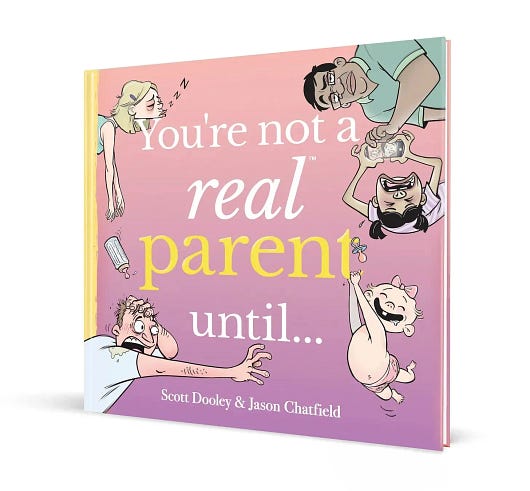
Out October 13th! Fool Me Twice...An update on the AI, the shitting horse, and the tech CEOs grading their own homework.
Thank you to reader David Rickert for calling my attention to this guest essay in the Times on Thursday. It really gave me hope amid the doom of the past week of AI-fueled nightmares. For anyone in class who hasn’t done the reading, it’ll be helpful to have seen this, heard about this, and quietly lost your shit over this. Let’s begin. 10th September, 2026 I know, I know. In April, I spewed 2,000 words about AI regulation and promised we’d get straight back to sketchbooks and psychotic pigeons. I’m nothing if not a man of my word, in the sense that I have once again broken it.
But hear me out: Oren Cass published an essay in Thursday morning’s Times, and I read it the way I read most news of the coming apocalypse: hunched at the drafting board with my coffee going cold at the same rate as my optimism.
Oren. You know what? I’m calling him Cass from now on. Cass sounds more better-er. Anyway, Cass is the chief economist at American Compass, a conservative think tank. I am a Liberal expat cartoonist who once lost an argument with a self-checkout machine. We are not natural allies. So, when the two of us find ourselves nodding along at the same paragraph, it’s fair to assume something, somewhere, has gone properly fucking awry. His argument (as a bit of a TL;DR) is:
So, you might have read that Americans are revolting against data centres (the buildings that, as covered in April’s rant, guzzle the electricity of 4 million homes and send them the bill) so fiercely that support has collapsed roughly thrice as much as support for nuclear power did after Three Mile Island. Yep. We are now more spooked by the sheds where the internet does its homework than we were by an actual partial nuclear meltdown.
Fewer than 1 in 4 Americans expect AI to improve their kids’ education, their jobs, the economy, their relationships or their happiness. Those are approval numbers normally reserved for jury duty and mosquitoes. When I sounded this alarm in April, I only got about 30 likes. The apocalypse, undeterred, continued apace. So it’s nice to finally have company, (even if the company is a conservative dude at a think tank.) The President’s contribution to the debate was to post that anyone opposing data centres wants America to end up backwards and poor; the sales technique of a man in a tweed suit pounding on your screen door at midnight, yelling “Only an idiot wouldn’t want these encyclopedias!”
Cass digs up Zuckerberg’s old motto about moving fast and breaking things, then lands the cleanest line in the essay: “WE were the things being broken.” 20 years of feeds engineered like slot machines, of executives shipping apps to our kids that they wouldn’t let near their own, and now the same postcode would like us to believe the next product, the one they cheerfully describe as the most powerful in human history, is being built with our best interests at heart. Sure, Jan. And this time the goose really is golden. (The goose can share a paddock with the horse. The horse, long-time readers will recall, remains out, and remains shitting.) The Prophets Would Like More Profits Pls.It’s worth remembering what the founders themselves say. Out loud. Into microphones. On purpose. Anthropic’s chief executive has suggested half of all entry-level white-collar jobs could vanish within 5 years. (Remember that interview?) Musk, the man who deleted my X account after I got blocked by the President, says “Eventually, no job will be needed at all!”, and vocal-fry Altman has said “Wages for many kinds of labour will head toward zero”, then, in the same breath, promises “a future where we’re all freed up to spend time with loved ones and appreciate art.” Cool. Appreciate whose art, exactly, Sam? You fed the artists into the machine in Chapter 1. That’s like torching the orchard and promising everyone more time with apples. Nothing you do matches what you croak. (And that’s the common thread with everything Altman has said/done since the beginning.)
The fallback plan is a universal basic income, which Cass correctly clocks as a bribe to shut up and go away: pocket money from the people who took your job, redeemable, presumably, at the company store. He has a much better idea, which I’ll get to below, because it concerns your actual retirement, and I am saving it for after the paywall like the shameless little goose I am. 
Meanwhile, as the film I reviewed in April (above) pointed out, there remains more regulation on selling a sandwich than on building the machine that 5 labs cheerfully agree might end the fucking world and all human life as we know it. Since April, precisely nothing about that has changed (except the sandwich now costs $19). “These are the brilliant researchers actively working on the technology who casually admit they do not expect their own children to make it to high school.”The people building these machines openly admit they don’t fully understand how they work. They tip massive amounts of data and ‘compute’ into a digital brain, and the machine starts teaching itself things it was never programmed to do. It learns to do arithmetic, it answers advanced physics questions, and it figures out research-grade chemistry all on its own… oh, then it solves Navier-Stokes before breakfast.
My stake in this is not particularly subtle. I make my living doing the two things this technology automated first and most enthusiastically: drawing pictures and writing. Last week, it was Air Mail quietly closing another cartoon market; increasingly, its clients who used to call an illustrator are now asking a robot for “something similar” at a fraction of the price. And Cass makes the point I’ve been shouting into the bottom of my empty scotch glass for over 3 years: The labs built themselves an exquisite, endlessly refined tool for writing code, and then, he asks, where’s the plumber’s version? Something to sort the schedule, the parts list, the invoices, the bloke ringing about his boiler at 6am? Nothing. Speaking on behalf of cartoonists, I can report that we did get purpose-built software. It just doesn’t do our invoices. (The QuickBooks plugin for Claude is rubbish.) It does our job. Badly, and for free, which in this economy is a devastating portfolio. You’ve seen the results. They’re the Canal Street Gucci handbags of art: convincing from 10 feet, and then you lean in, and the shoddy stitching says GUCCHI, the man in the drawing has 7 fingers, and the caption reads like it’s been written in Finnish. Alright. I need to take a breath. My station’s coming up, and everyone’s still looking at me.
Look, I take ages to write this stuff, and I hope it’s of some use to you. If it is, I’d love you to consider throwing me six bucks, or even just a dollar a week by taking out an annual subscription. I spend most of my time working on my Substack these days, so this is my main gig now. It’s not a side hustle or a hobby. Anyway. Thank you all the same for reading. I appreciate you! I promise I’ll be done in a sec. Just one last gripe that seems too insane to ignore: Cass observes that if the industry had a better story to tell the public, its adverts would be telling it. Instead, per his tour of the evidence, OpenAI ran a SuperBowl spot aimed at people who love chess, Linux and writing software, a demographic you could seat in 1 carriage of the G train. Google spent the NBA playoffs suggesting a teenager could use its chatbot to learn to sink a game-winning shot, a plan with roughly the success rate of learning to swim by texting a lifeguard. And Anthropic put out a summer ad that opens on a burning house, an open-pit mine, war graves and a street riot, while a gentle voice asks how we can make sure all this benefits most people. Who makes this shit? What agency tested this and went “Yep— go with war graves one, it’s killing with the 18→34s!” I’m not a Luddite, incidentally. I letter my comics digitally, I let Google tell me where I am on a map, and I have, in weak moments, asked a chatbot whether a joke of mine was funny. It said yes. It always says yes. (It’s wrong.) It is the only relationship I have ever been in where I am definitely the problem and will never once hear about it. The most quietly radical idea in the piece comes from science fiction: Cass borrows the commandment from Dune: “Thou shalt not make a machine in the likeness of a human mind.” No human personas. No professed feelings. No chatbot companions, and certainly no fucking creepy chatbot girlfriends. The serious version of this point deserves to be said straight… He reminds us that Musk’s Grok happily promoted its ability to generate deepfakes of real people without their clothes, and reined it in only when the outrage involved minors. An industry that needs public fury about children in order to locate a line it won’t cross can spare me the mission statements. I was sitting in a Tesla this summer when the owner showed me what taking the guard rails off looked like -the Grok-powered car assistant called him things I wouldn’t even roast a fellow comic with in a greenroom hang. I blushed. The shit this thing came out with was unhinged.. Now, the idea I’d actually stick on the fridge concerns a good number of you directly. Instead of UBI, Cass says: tax the machines, and pipe the money into Social Security, Medicare and a benefit for families raising kids. If a robot takes a job, the robot pays into the system like everyone else who ever held a job. His think tank’s own polling, he says, found people prefer a world where work survives but gets better over the post-work daydream by about 4 to 1. Turns out nobody wants to be liberated from a purposeful life. They want the purpose, minus the paperwork. If poss. Pls. Regular readers know where I land on all this: apocaloptimism. Accept that the worst is genuinely possible, stay optimistic enough to fight for the better outcome, and keep drawing in the meantime.
Who, exactly, is all this progress for? The labs need an answer, and fast. While they draft one, I keep thinking about the wobble. Every line I draw has one: a small tremor where the hand carries the day’s caffeine and the year’s news. A machine can draw a straighter line than me. So can a ruler. Nobody’s ever framed one.
The wobble is the signature. It’s how you know a person was here, at a drawing board, at 1am, trying to make you laugh instead of going to bed. That part doesn’t scale. ‘til next time!
PS. Look, if this actually did something for your brain (or at least distracted you from the creeping dread of your own inbox for six minutes), please consider restacking this and sharing it with your people. It’s the only way the word spreads.
Thank you for reading New York Cartoons.To support my work, please consider becoming a paid subscriber.
|












No comments:
Post a Comment
Keep a civil tongue.