The reason we grow old, and how to counter it
|
|
|
Hello,
I don’t have the coordinates to the Fountain of Youth. Nor do I have a portrait of Dorian Gray, or an equivalent, for you to stash in your attic. But I do have age-defying information that trumps both of these things.
Why? Because it is real, free and accessible to anyone. And you can find it below.
The body works on a rough use it or lose it basis. If you perform an action often, your nervous system will view it as valuable and maintain it. If you don’t do it for a prolonged period, your nervous system might view it as surplus to requirements, losing access to it over time by allowing related tissues to tighten up.
Take touching your toes as an example, or standing up from a chair without using your hands. Most children can do these things easily, while far fewer adults have this ability. If you ask those who can’t about the last time they tried, it was likely a very long time ago. This is no coincidence.
There is a similar story with conditions such as sarcopenia and dynapenia – the age-related loss of muscle and strength/power, respectively. What was once seen as an inevitable byproduct of growing older is now widely viewed as a consequence of declining activity levels as we age.
As Gavin and Stacey’s Uncle Bryn once said: “It’s not how old you are, it’s how you are old.”
The cause of these things is increasing levels of stillness in our lives. The remedy is its antithesis: movement – regular, varied and challenging.
|
I should caveat that growing older is a good thing, and a privilege. It is the loss of physical capacity and function that so often comes with it that we are looking to counter.
I had the idea for this newsletter while coaching gymnastics to a group of 11- to 16-year-olds. Rather than the rigid structure of sets and reps, or work and rest, seen in most adult exercise classes, each week we play games that involve running, lifting, jumping, throwing, twisting, bending and more. And each week they tend to arrive more physically capable and mobile than the last.
There’s a well-worn saying on this topic: “We don’t stop playing because we grow old; we grow old because we stop playing.”
And there’s a kernel of truth to it. As adults, I’ve found most people exercise for one of two reasons; to change the way they look, or because they feel they should for better health. Most children move because it’s fun. And while most children can’t wait to run free during playtime at school, many adults dread their weekly workouts.
One of these groups is likely to build an enjoyable and sustainable exercise habit, maintaining strength, mobility and independence for decades to come. The other is likely to seek the solace of their sofa.
“People often chase the ‘best’ exercise programme, wearable metric or training hack, when consistency would often give them a greater return,” movement expert and Health or Hype podcast guest Darryl Edwards tells me.
“I would rather help someone build a movement habit they enjoy and can repeat than give them a theoretically perfect programme they abandon after a few weeks. Movement should also extend beyond formal exercise. Walking, taking the stairs, carrying, playing, gardening and brief bouts of activity throughout the day all contribute.
“My prescription would be simple: find moments in your existing routine where movement can naturally fit, then repeat them consistently.”
Lifting weights and aerobic exercise still hold plenty of value, but the accessible acts listed above are brilliant for getting the ball rolling, while also delivering better flexibility, improved heart health and a reduced risk of diabetes in the long run.
“Their real strength is behavioural: they make starting easier,” says Edwards. “And when it comes to health, any movement you repeatedly do has far greater value than the perfect programme you rarely follow. Sit less. Move more often. Play even more.”
And if you don’t fancy a traditional gym session or 5K run for your formal exercise, informalise your next exercise session: play instead.
Hope this helps!
Harry
|
|
|
Want to move more but not sure how to start? Or looking for ways to progress your existing exercise plans? Drop me an email at wellenough@independent.co.uk and I’ll do my best to help.
|
|
|
Do these five things daily to improve how you look, feel and move within weeks
|
|
|
New research suggests changing one thing about your walk to improve your heart health
|
People spend a disturbing amount of time criticising others’ exercise efforts nowadays.
“You’re doing too much/too little.” “You’re taking it too hard/too easy.” “You should run rather than cycle.” “You should cycle rather than run.” “You should do Pilates instead of yoga.” “You should lift weights instead of Pilates.”
Quite frankly, it’s exhausting. And in my opinion, it’s a bit silly too. In human history, we have only fairly recently started whacking labels on different types of exercise such as Pilates, Hyrox, Bodypump and more. Previously, we just moved – and it worked pretty well.
Linked to this, I heard a phrase I liked this week: “If you’re moving, you’re improving.”
Walking is, for most, the type of movement that has the lowest barrier to entry for most people, offering impressive health benefits from something that is, to my mind, rather enjoyable.
This piece looks at recent research which suggests that upping your walking pace every now and then might deliver even greater perks for your heart, general wellbeing and longevity
|
|
|
The flip-flop game that gets me funny looks in the park – but it works wonders for your fitness
|
|
|
|
|
Earlier this year, I suffered an injury. The way I did this was rather silly.
Shortly after running an ultramarathon up a series of mountains in New Zealand, someone invited me to a cowboy-themed pub in the traveller hotspot that is Queenstown. I don’t drink, but I still love pubs and dancing, and I was on the holiday of a lifetime, so I was never going to say no.
In the early hours, I hopped on the pub’s built-in bucking bronco, squeezed my thighs tight around the saddle, and then felt something unpleasant in my inner thigh.
In the coming weeks, I gently reintroduced movement and load to the muscle, rebuilding its capacity until it was ready to go again.
One of the things I found helped most was varied movement. And after a few weeks of controlled, progressive rehab exercises, I invented something I like to call the “flip-flop game”.
I would wear flip-flops to the park, take them off, leave one where I stood and lob the other one as far as I could. Then I challenged myself to travel between them 10 times, using 10 different methods.
For the first length, I might walk. Then jog. Then crawl, lizard walk, do forward rolls, hop, skip, triple jump, handstand walk, frog jump.
(There are a couple of great videos here and here, which I often use with my under-16 gymnastics classes, if you’re short on ideas.)
Several fellow dog walkers I'm friendly with stopped to watch and ask what was going on. Some even gave it a go and, dare I say it, rather enjoyed themselves.
When exercise becomes play, the benefits of movement don’t go away. But it removes all pressure, often becomes more fun, and the added movement variety on offer delivers some unexpected bonus perks too.
|
|
|
|
|
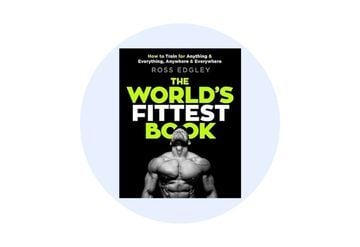
The World’s Fittest Book by Ross Edgley
|
By my definition, exercise is the act of moving ourselves and other things. The scope of this is enormous, with acres of space for experimentation. This is why it amazes me that most people wind up doing the same few exercises.
One man who breaks this mould is athlete-adventurer Ross Edgley. After graduating from Loughborough University, he travelled the world with “a pen and a protein shake”, learning everything he could about sport science.
Sometimes this meant wrestling with Russian juggernauts; other times he was wrangling bulls in Ecuador while nursing a nasty hangover from a traditional tipple, or swimming around the entire UK coastline without touching land.
The World's Fittest Book is the result of these endeavours. It teaches foundational sports science lessons with a sense of fun and awe often missing from textbooks on the topic.
|
|
|
Join the conversation and follow me
|
|
|
Please do not reply directly to this email
You are currently registered to receive the Well Enough newsletter from The Independent.
To unsubscribe from the Well Enough newsletter from The Independent, or to manage your email preferences please click here.
This e-mail was sent by Independent Digital News and Media Ltd, 14-18 Finsbury Square, London EC2A 1AH. Registered in England and Wales with company number 07320345
Read our privacy policy and cookie policy
|
|
|
|




No comments:
Post a Comment
Keep a civil tongue.