


This is the short history of a vision’s decay. We are now living in the rotting corpse of a vision.
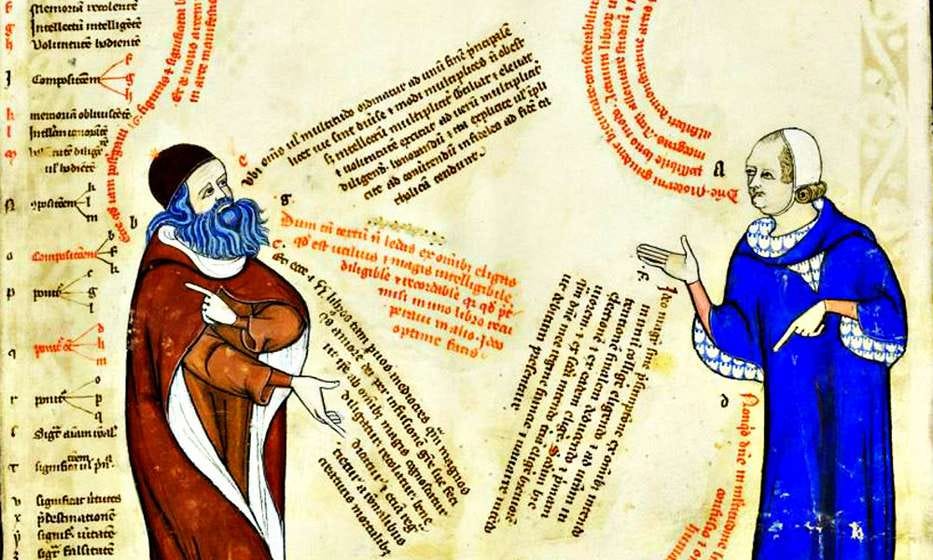
The history of artificial intelligence begins with a mystical vision on Mount Randa on the island of Mallorca in 1274 A.D. Dreams and visions stand at the origin point of most rational developments; only later do they decay into concepts. Even the most rigidly and severely quantitative disciplines—like computer science—flow into the mind through unknown currents, no less than sonnets and limericks. Logic itself began in a vision of Parmenides (the first syllogism was revealed by a goddess), just as artificial intelligence began in a vision of Ramon Llull. Llull, a Franciscan friar, had retreated to Mount Randa for a period of prayer and contemplation. His prior life had not been entirely pious. It is said that he wooed a woman, seeking to make her his mistress. When he finally attained access to her boudoir, she exposed her breast to him. It had been eaten away by cancer. She urged him to seek God instead. Hence, Mount Randa and the visionary retreat. At some point during this spiritual idyll, Llull had his vision. He perceived God’s divine qualities as present in the created world and intuited that the world itself was but a series of combinations of these divine qualities. From his mountaintop perch, he saw them spread below him in a glittering mosaic of meanings. It occurred to Llull that he could create a combinatorial system, a set of wheels within wheels, representing the way in which God’s qualities interacted in the world. Each wheel would contain a code, algebraically representing each of the divine qualities; by moving the wheels, and creating novel combinations, you could arrive at an answer to any human problem. The questions you asked of the wheels could be answered on different levels. For instance, you could consider the wheels as representing the set of divine qualities as manifested in the world of plants or the world of minerals and use the wheels to solve medical and scientific problems. But they would also point towards the deepest truths of spirituality. By fully memorizing and embodying the process represented by the wheels, you accessed a path to God, moving from the qualities as they were manifested at the lowest levels of reality to the qualities as they were manifested at the highest. So, it would be a mistake to think that Llull was engaged in merely engineering a system and not in cultivating the soul. If William Blake was right that we “become what we behold,” the Llullian system, when internalized and impressed on the mind, refashioned that mind. This is the essence of the medieval art of memory: it is a tool for self-transformation, adapting the soul to higher realms of knowledge, proceeding up the great chain of being toward God. Thus, Llull’s Art marked a crucial moment in the history of consciousness, one that has not yet been appropriately appreciated. For Llull and his followers, the Art pointed the way to God through his attributes reflected in creation. But the underlying structure and method of the Art had a different implication (perhaps even the opposite implication), and later thinkers adapted that structure and method to far different purposes than those intended by Llull. The world of the Middle Ages was less alienated from physical reality, from the qualities of being. Hence, the abundant sense of the mystical—a sense not only of the otherworldly and transcendent, but of the deep meaning of the earth itself, “charged with the grandeur of God.” One can see this as typifying an earlier form of consciousness, in which the human relationship to nature and labor was less alienated than under contemporary conditions. The reduction of everything to exchange value, to total quantification, had not yet taken place. A reign of quality proceeded the reign of quantity, and this is reflected in the medieval art of memory, which involved images made memorable through their sensuality. (Compare this to computer memory, which is completely quantitative—ones and zeroes. It is not memory held within the mind, transforming it, but localized outside.) Yet, despite the fact that Llull’s mystical philosophy is of a piece with the medieval world’s greater mystical preoccupations, there were features of Lull’s system that would lend themselves to this project of total quantification, of total reduction to exchange value, when the appointed hour arrived. To some extent, Llull’s methods were indeed grounded in the classic medieval art of memory. Typically, this involved the creation of elaborate memory palaces, spaces visualized in the mind and containing all the objects of memory. The use of sensational imagery attached to each memory further helped engrain it in the mind. However, unlike the other medieval masters of memory, Lull did not use sensual imagery. Rather, as mentioned, he notated the qualities algebraically, through letters. (This seems related to the Kabbalistic art of “gematria,” which involves discovering meanings in the Torah through the recombination of Hebrew letters and numbers assigned to them. The link between Llull and Kabbalism isn’t fully proven, but scholars seem to think it’s likely enough). The combinatorial nature of Lull’s wheels, paired with their use of non-representational content, provided the germinal seed from which new machines would later sprout. The origin of modern computing stands here, with the development of Llull’s art. Nonetheless, it took another four hundred years for the import of Lull’s mechanism to be fully exploited. In the year 1666 (memorable for its last three digits), the German philosopher and co-discoverer of calculus, Gottfried Wilhelm Leibniz, realized that Llull’s basic concept of a combinatorial machine designed to solve all human problems could be adapted into a purely mathematical machine. It wasn’t what Llull was representing (the divine qualities) that attracted Leibniz; it was his mode of representation. Instead of using qualities found in nature, Leibniz postulated the existence of a combinatorial machine that could operate purely on the basis of number. It would use Llull’s combinatorial concept, his wheels, but the notation on the wheels would now represent quantities rather than qualities. This was when modern computing, with its binary code, really took form. In fact, Leibniz was the first thinker to recognize that any number and any logical statement could be expressed in terms of 0s and 1s. Appropriating the idea behind Llull’s wheels, Leibniz invented his own wheel-based calculator, the “Stepped Reckoner” (also known as the “Leibniz Wheel”). It was the first calculator that could perform the four functions of addition, subtraction, multiplication, and division. But what I am interested in here isn’t the fact that Leibniz imagined a machine that would come to have real world implications far beyond Llull’s wheels. I am interested in how Leibniz’s machine reshaped how we see ourselves. Leibniz was an intellectual hero, and one of the great thinkers, so I’m not suggesting that there is anything wrong with the fact that he laid the groundwork for modern computing. I don’t regret its existence. I regret how it has ultimately been received by us. In the same way that Llull’s art was meant to reshape the inner self of the person practicing it, those who practiced Leibniz’s science came to refashion their own selves in its image, to see themselves as machines rather than as a beings capable of manifesting divine qualities and holy names. This isn’t something Leibniz intended, but Leibniz’s combinatorial science, like Llull’s before him, implicitly functioned as a model of the self and of the universe. If all problems could be solved through the combination of quantities, that would imply that the universe was, at root, quantity. And if combinatorial science could solve all human problems, that would imply that human intelligence was, perhaps, fundamentally quantitative. Just as the students of Llull’s Art were led to embody the divine qualities within themselves, it is not too crazy to assume that students of Leibniz’s science would start to embody the quantities within themselves—they would see themselves as mechanistic and mechanical beings. This is how the votaries of artificial intelligence, their ultimate descendants, see themselves. Over time, following this mechanistic logic, the concept of the self became purely associative: the self was no longer a conscious soul but just the combination of its contents. In other words, the self became software (sensory data, words, ideas, etc.) downloaded into the physical body. But there was a counter-movement in the works. Artists and poets have always rightly thought that the self was more than a machine, probably because the experience of inspiration and intuition is so central to art and poetry. Hence, it was up to Samuel Taylor Coleridge to articulate in the early 19th Century why this combinatorial model of mind didn’t really encompass the actual experience of being a self. In his 1817 work Biographia Literaria, Coleridge argued that the combinatorial conception of the mind is really the same as “fancy”—the purely associative mind, yoking things together to form novel combinations. (“Fancy,” in Coleridge’s terms, is basically AI slop.) But Coleridge insists there’s something else, the imagination, which forges new wholes in a way that is top-down rather than bottom-up: “It dissolves, diffuses, dissipates, in order to recreate.” He contrasts this with fancy: “Fany, on the contrary, has no other counters to play with, but fixities and definites. The fancy is indeed no other than a mode of memory…” This is essentially how any system of computation operates. It plays with the “fixities and definites” in its memory and recombines them mechanically. For fancy, the whole only emerges from the parts, but for the imagination, the whole comes before the parts, and the parts are fit to shape the whole. The way computation necessarily functions—and can only function—is in terms of “fancy,” which is why AI slop can be momentarily diverting but can only offer shallow pastiches of great art and literature. Imagination is different, and it’s what makes a great artist unique and not purely derivative. Coleridge goes so far as to exalt it as “the living power and prime agent of all human perception, and as a repetition in the finite mind of the eternal act of creation in the infinite I AM.” Coleridge’s high view of the imagination resonates with many artists. However, it would be hard to argue that it has carried the day in the worlds of technology and business. In these worlds, the imagination is no longer permitted to unlatch its casements to the infinite. There is no Open, no Unbound, whether as metaphysical reality or as human possibility. The world is seen entirely as a finite whole, a reservoir of known quantities, all of them readied for mechanistic recombination and commoditization. What was originally a moral technology and a mode of spiritual self-transformation—Llull’s art—has, in a much different form, been reappropriated as a commercial technology. Rather than offering a means to lift the self to higher realities, it has become a way of disintegrating the self and selling off its parts through data collection by advertisers. At the same time, our memory is stolen (via “cognitive offloading” to AI) rather than augmented and cultivated. It’s the exact opposite of what Lull and Leibniz intended. I think our finest writers have been ringing the alarm on this development for hundreds of years at this point. From Borges to Beckett to Kazuo Ishiguro, we see literature demonstrating the perils of treating the self just as a mechanical combination of parts. In Ishiguro’s Never Let Me Go, for example, Tommy (a male clone who’s being raised to have his organs harvested) draws pictures of imaginary animals at school. The narrator describes the drawings: “The first impression was like one you’d get if you took the back off a radio set: tiny canals, weaving tendons, miniature screws and wheels were all drawn with obsessive precision.” The drawings are a haunting indication that the clone has learned to see himself and all organic lifeforms simply as spare parts. That’s how we’ve relentlessly been convincing ourselves to see ourselves for about four hundred years now. This moment in the book is disturbing precisely because we do not want to see ourselves this way. We rebel at the thought. And yet, some people seem to revel in it. Not surprisingly, these are people who are making money off the idea and its consequences. We need to remember that other modes of seeing are possible and try to recapture those modes. Perhaps we need to recapture the world Ramon Llull saw from his mountaintop retreat—a world alive with divinity.
You're currently a free subscriber to default.blog. For the full experience, upgrade your subscription.
|






No comments:
Post a Comment
Keep a civil tongue.